### Description
This is a temp fix for the failing "Zip-Nuget-Java-Nodejs Packaging
Pipeline". The pipeline is failing because I removed NodeJS from the
build machine pool's image, to reduce the number of dependencies we need
to maintain in VMs.
So this PR will temporarily move the test to a different machine pool to
get the test passed. Then I will move the test to docker. Docker images
are relatively easier to update and maintain. Now we almost run all
Linux test in docker, except for this one. Moving it to docker is needed
for enabling GPU support in nodejs, because all our Linux VMs do not
have CUDA.


### Motivation and Context
### Description
This PR:

(1) Fixes AMD builds after #17200 broke them (Need to remember to run
AMD builds while trying to merge external CUDA PRs next time)

(2) Turn on the NHWC CUDA feature in the Linux GPU CI. The extra time
spent in building a few more files and running a few more tests will not
be much.

Test Linux GPU CI run :
https://dev.azure.com/onnxruntime/onnxruntime/_build/results?buildId=1170770

### Motivation and Context
Keep the NHWC CUDA ops tested
(https://github.com/microsoft/onnxruntime/pull/17200) and guard against
regressions
### Description
**Fixes NPM Packaging pipeline.**

Training was enabled for linux-wasm-ci.yml but not enabled for
win-wasm-ci.yml.

the web CI uses linux-wasm-ci.yml
NPM packaging pipeline uses win-wasm-ci.yml
### Description
<!-- Describe your changes. -->
Android emulator usage updates:
- Change approach to detecting boot has completed
- use `-delay-adb` and a simple command (`ls`) with `wait-for-device` as
the first step
    - this ensures enough startup has occurred for adb to be responsive
- use secondary loop on the python side to check for sys.boot_completed
to be set
- doing the check on the python side provides more feedback and seems to
work well
- make the 'stop' logic more precise by using psutil
- add internal timeout of 20 mins for emulator startup
  - waiting for the CI jobs overall timeout is way too long
- value is hardcoded for now (most CIs startup in under 10 mins) but
could be made configurable if needed

CI updates:
- add template for using the Android emulator
  - update CIs to use template
- reorder React Native CI
- minimize the time the Android emulator or iOS simulator is running by
moving some build steps around
  - don't run both at the same time
- unnecessary and potentially adds significant memory pressure to the
machine
- fix QNN Android emulator CI as much as possible
- now everything works apart from running onnx_test_runner with the QNN
EP

### Motivation and Context
<!-- - Why is this change required? What problem does it solve?
- If it fixes an open issue, please link to the issue here. -->
Fix inconsistent detection of the emulator boot completing.

---------

Co-authored-by: Edward Chen <18449977+edgchen1@users.noreply.github.com>
### Description
Update NDK to 26.0.10792818 which is included in every macOS build
machine so that we do not need to download a different version every
time in every build.

### Motivation and Context
Downloading NDK on-the-fly is a main contributor of Android related
build failures.
### Description
<!-- Describe your changes. -->


### Motivation and Context
Compliance check would fail randomly but the stage couldn't be rerun if
the pipeline artifacts are already published.
There's the error like `Artifact xxxx already exists`.
We had to restart the whole pipeline if there's a random error in
compliance check.
### Description
allow gpu IO binding tests to fail temporarily.

when the root cause is still in investigation, use `continueOnError:
true` to allow the test to fail without blocking PRs.
### Description
"NPM packaging pipeline" needs to download an artifact from
"Zip-Nuget-Java-Nodejs Packaging Pipeline".
It has been a long-time issue that they two pipelines often use
different commit ids.
This change declares 'Zip-Nuget-Java-Nodejs Packaging Pipeline' as a
resource, so that "NPM packaging pipeline" will always fetch from the
pipeline run that triggers this NPM pipeline.
Their official document says:
"When you define a resource trigger, if its pipeline resource is from
the same repo as the current pipeline, triggering follows the same
branch and commit on which the event is raised."
### Description
<!-- Describe your changes. -->
Include CoreML EP in python package.

I've added to the base package as CoreML comes from the OS so there are
no additional libraries to distribute.

Updated the CPU-based provider list to add the AzureEP, which is also
included in the base package, to fix some test failures. Without this
the infrastructure thinks a device copy implementation is required
between AzureEP and CoreML nodes, which is not the case as the AzureEP
is CPU based.

### Motivation and Context
<!-- - Why is this change required? What problem does it solve?
- If it fixes an open issue, please link to the issue here. -->
#16989
- Update ROCm and MIGraphX CI to ROCm5.7
- Simplify test exculde file. Some tests will output `registered
execution providers ROCMExecutionProvider were unable to run the model.`
if they cannot run.
- Add `enable_training` build argument for MIGraphX pipeline.
Python package pipeline fails due to "tokenizers" compilation. Since
"tokenizers" is a dep of "transformers", we update its version and hope
a new solution had been there.

```
error: casting `&T` to `&mut T` is undefined behavior, even if the reference is unused, consider instead using an `UnsafeCell`
--> tokenizers-lib/src/models/bpe/trainer.rs:517:47
```
- we will publish the onnxruntime-training-rocm package on ADO feeds.
The onnxruntime-training package will solely be for cuda.

- Add new pipeline for onnxruntime-training-rocm ADO feeds
https://aiinfra.visualstudio.com/Lotus/_build?definitionId=1278. Only
package with latest rocm version is publish to ADO.
### Description
Improve the QNN context binary cache feature to reduce the memory
overhead and initialization time overhead.
Instead of dumping a Qnn context binary file with metadata as header, we
dump a Onnx format file with metadata inside Onnx node.

### Motivation and Context
 reduce the memory overhead and initialization time overhead
Two major modifications of this PR:

1. Refactor OrtTensorRTProviderOptions initialization and make it easy
to add new field.
2. Make Python API capable of using TensorRT plugins by adding new
Python binding api `register_tensorrt_plugins_as_custom_ops`. (It needs
to register ep's custom op domain before model load. For C++ API, it's
slightly different, when calling
SessionOptionsAppendExecutionProvider_TensorRT_XX, it appends cutom op
domain to session option. Later ORT can register custom op domain from
session option before model loading)
Bump ruff version and remove pylint from the linter list. Fix any new
error detected by ruff.

### Motivation and Context

Ruff covers many of the pylint rules. Since pylint is not enabled in
this repo and runs slow, we remove it from the linters
### Description
<!-- Describe your changes. -->

Move the swift files to ORT SPM repo now:
https://github.com/microsoft/onnxruntime-swift-package-manager


### Motivation and Context
<!-- - Why is this change required? What problem does it solve?
- If it fixes an open issue, please link to the issue here. -->

---------

Co-authored-by: rachguo <rachguo@rachguos-Mac-mini.local>
This PR introduces
- New data structure to represent kernel-level (aka node-level or
op-level) tensor sharding informaiton. I consider it as the
fundamentaion of ONNX distribtued inference.
- Building blocks for distribtued kernels implementation especially
stateless implementation for communication ops.
- Implementation of DistributedMatMul and its tests.

Code structure:
- sharding.h/.cc: Function to shard and reshard tensors (calling into
NCCL).
- sharding_spec.h/.cc: Representation of how a tensor is sharded.
- distributed_matmul.h/.cc: Implementation of tensor parallel MatMul.
Inputs and outputs are sharded across devices.
- onnxruntime_test_distributed.py: distributed operator tests.

Example of specifying sharding information
```python
        @onnxscript.script()
        def matmul_rs_sr_rr(tensor_x: FLOAT, tensor_w: FLOAT) -> FLOAT:
            # Run MatMul by sharding x along column axis and w along row axis on
            # 2 GPUs.
            return MICROSOFT_OPSET.DistributedMatMul(
                tensor_x,
                tensor_w,
                device_mesh_shape=[2],
                device_mesh_elements=[0, 1],
                input_shard_specs=["RS[0]", "S[0]R"],
                output_shard_specs=["RR"],
            )
        onnx_model = matmul_rs_sr_rr.to_model_proto(
            input_types=[FLOAT[2, "s"], FLOAT["s", 2]],
            output_types=[FLOAT[2, 2]],
        )
```

In this example, the device mesh can be visualized as 1-D tensor, `[0,
1]`. The 2nd axis of `tensor_x` is sharded across `[0, 1]` (i.e., the
0-axis of the device mesh). Similarly, the 1st axis of `tensor_w` is
sharded across `[0, 1]` as well.

C++ classes to represent tensor sharding (copied from sharding_spec.h):
```cpp
class DeviceMesh {
 public:
  // [Device Mesh and Tensor Sharding for Tensor Parallel]
  // Device mesh is a tensor of device indices.
  // A tensor can then be partitioned along specific mesh axes.
  //
  // Assume we have 4 GPUs indexed by 0, 1, 2, and 3.
  // Let's consider some examples.
  //  1. 1D device mesh [0, 1, 2, 3]. In this case,
  //     device_mesh_shape is [4] and device_mesh_elements
  //     is [0, 1, 2, 3].
  //     If we want to shard a 2-D tensor along its axis 1, the
  //     corresponding sharding spec is a string "RS[0]".
  //  2. 2D device mesh [[0, 1], [2, 3]]. In this case,
  //     device_mesh_shape is [2, 2] and device_mesh_elements
  //     is [0, 1, 2, 3].
  //     If we want to shard a 2-D tensor's
  //     rows along mesh axis 1 and
  //     columns along mesh axis 0, the
  //     corresponding sharding spec is a string "S[1]S[0]".
  //     If that 2-D tensor's value is np.array([[5, 6], [7, 8]]),
  //     GPU 0/1/2/3 owns 5/7/6/8.  Below is a visualization the sharding
  //     proccess.
  //     - Start with a 2-D device mesh [[0, 1], [2, 3]] and
  //       a 2-D tensor [[5, 6], [7, 8]]
  //       - GPU: [[0, 1], [2, 3]], Tensor: [[5, 6], [7, 8]]
  //     - Split GPU mesh along axis 1 and tensor along
  //       axis 0 for "S[1]" in "S[1]S[0]"
  //       - GPU: [[0], [2]], Tensor: [[5, 6]]
  //         GPU: [[1], [3]], Tensor: [[7, 8]]
  //     - Split GPU mesh along axis 0 and tensor along
  //       axis 1 for "S[0]" in "S[1]S[0]"
  //       - GPU: [[0]], Tensor: [[5]]
  //       - GPU: [[2]], Tensor: [[6]]
  //       - GPU: [[1]], Tensor: [[7]]
  //       - GPU: [[3]], Tensor: [[8]]

  // Actual shape of device mesh represented by `device_mesh_elements`.
  std::vector<int64_t> device_mesh_shape;

  // Flattened device mesh.
  std::vector<int64_t> device_mesh_elements;
};

class AxisPartitionSpec {
  // [Device Mesh and Tensor Sharding for Tensor Parallel]
  // This class is the in-memory representation of
  //  1. if a tensor is sharded or not (aka replica), and
  //  2. which tensor axis is shard by which device mesh axis.
  // Let's consider sharding 2-D tensor along column axis on
  // device mesh [0, 1] as an example.
  // The required sharding spec RS[0] can be represented by
  // - AxisPartitionSpec(Condition::Replica, -1)
  // - AxisPartitionSpec(Condition::Shard, 0)
 public:
  // Status of a tensor axis.
  // A tensor axis can be either sharded or replicated
  // along a device mesh axis.
  enum class Condition { Replica,
                         Shard };

  // This field tells if a tensor axis is sharded or not.
  Condition cond;

  // If a tensor axis is sharded, this field tells which device
  // mesh axis to distribute the shards along.
  // If a tensor axis is not sharded, this field is ignored.
  int device_mesh_axis;

  // A helper to construct a replica spec for a tensor axis.
  static AxisPartitionSpec CreateReplica() {
    return AxisPartitionSpec(Condition::Replica, -1);
  }

  // A helper to construct a sharding spec for a tensor axis.
  // This tensor axis is sharded along `device_mesh_axis` in device mesh.
  static AxisPartitionSpec CreateShard(int device_mesh_axis) {
    return AxisPartitionSpec(Condition::Shard, device_mesh_axis);
  }
};

class TensorPartitionSpec {
  // [Device Mesh and Tensor Sharding for Tensor Parallel]
  // TensorPartitionSpec holds a collection of AxisPartitionSpec and an
  // associated DeviceMesh. It is responsible for determining how a tensor
  // should be partitioned across a device mesh.
  //
  // Example 1: RS[0]
  // In this scenario, `axis_specs` would contain two `AxisPartitionSpec` objects.
  // - The first object is a Replica, denoting that the first axis of the tensor is
  //   not sharded but is instead replicated.
  // - The second object is a Shard along the 0-th axis of the device mesh. It denotes
  //   that the second axis of the tensor is sharded along the first axis of the
  //   device mesh.
  //
  // Example 2: S[0]RR
  // In this scenario, `axis_specs` would contain three `AxisPartitionSpec` objects.
  // - The first object is a Shard along the 0-th axis of the device mesh, indicating
  //   that the first axis of the tensor is sharded along the first axis of the
  //   device mesh.
  // - The second and third objects are Replicas, indicating that the second and third
  //   axes of the tensor are not sharded but are instead replicated.
 public:
  // axis_specs[i]: AxisPartitionSpec for tensor axis i. For a 2-D tensor,
  //                axis_specs[0] is for row axis and axis_specs[1] is for
  //                column axis. axis_specs[i].device_mesh_axis = j means that
  //                tensor axis i is sharded along device mesh axis j.
  std::vector<AxisPartitionSpec> axis_specs;

  // device_mesh: DeviceMesh for sharding the associated tensor.
  // Read [Device Mesh and Tensor Sharding for Tensor Parallel] in DeviceMesh's comment.
  DeviceMesh device_mesh;
};
```
<del>
**This PR is based on a few prerequisites PRs. They are listed as
below:**
- #17465
- #17469
- #17470
- #17472
- #17473
- #17484

Please review the current change by only looking at commit
e2e6623e673ec6de55a5c1f8edcbd3a46b535a89 and later.


</del>

### Description

This PR introduces WebGPU IO binding. This new feature allows
onnxruntime-web users to use tensors created from GPU as model
input/output so that a model inferencing can be done without unnecessary
data copy between CPU and GPU for model input/output.

### Examples

An E2E demo/example is being worked on.

Following is some simple demo with code snippet.

Let's first check today how we do:
```js
// STEP.1 - create an inference session:
const mySession = await ort.InferenceSession.create('./my_model.onnx', { executionProviders: ['webgpu'] });

// STEP.2 - create model input: (supposing myImageCpuData is a Float32Array)
const feeds = {
  'input_image:0': new ort.Tensor('float32', myImageCpuData, [1, 224, 224, 3])
};

// STEP.3 - run model
const myResults = await mySession.run(feeds);

// STEP.4 - get output data
const myData = myResults['output_image:0'].data; // Float32Array

```

#### for inputs (GPU tensor):

Now, with IO binding, you can create a tensor from a GPU buffer, and
feed it to the model:
```js
// new STEP.2.A - create model input from a GPU buffer: (supposing myInputGpuBuffer is a `GPUBuffer` object with input data)
const feeds = {
  'input_image:0': ort.Tensor.fromGpuBuffer(myInputGpuBuffer, { dataType: 'float32', dims: [1, 224, 224, 3] })
};
```

### for outputs (pre-allocated GPU tensor)

you can also do that for output, **if you know the output shape**:
```js
// new STEP.2.B - create model output from a GPU buffer: (supposing myOutputGpuBuffer is a pre-allocated `GPUBuffer` object)
const fetches = {
  'output_image:0': ort.Tensor.fromGpuBuffer(myOutputGpuBuffer, { dataType: 'float32', dims: [1, 512, 512, 3] })
};

// new STEP.3 - run model with pre-allocated output (fetches)
const myResults = await mySession.run(feeds, fetches);
```

### for outputs (specify location)

if you do not know the output shape, you can specify the output location
when creating the session:

```js
// new STEP.1 - create an inference session with an option "preferredOutputLocation":
const mySession = await ort.InferenceSession.create('./my_model.onnx', {
    executionProviders: ['webgpu'],
    preferredOutputLocation: "gpu-buffer"
});
```

if the model has multiple outputs, you can specify them seperately:
```js
// new STEP.1 - create an inference session with an option "preferredOutputLocation":
const mySession = await ort.InferenceSession.create('./my_model.onnx', {
    executionProviders: ['webgpu'],
    preferredOutputLocation: {
         "output_image:0": "gpu-buffer"
    }
});
```

now you don't need to prepare the `fetches` object and onnxruntime-web
will prepare output data on the location that specified.

#### read data

when you get the output tensor, you can:
```js
// get the gpu buffer object:
const gpuBuffer = myOutputTensor.gpuBuffer; // GPUBuffer

// get the CPU data asynchronizely
const cpuData = await myOutputTensor.getData();

// get the CPU data asynchronizely and release the underlying GPU resources
const cpuData = await myOutputTensor.getData(true);

// dispose the tensor (release the underlying GPU resources). This tensor object will be invalid after dispose() is called.
myOutputTensor.dispose();
```

#### resource management

JavaScript has GC so you don't need to worry about managing JavaScript
objects. But there are 2 types of resources that are not managed by GC:
- GPU buffer that used in tensors
- Underlying ORT native resources

To simplify, most of the unmanaged resources and handled inside ORT web.
But there are a few resources that need users to manage:
- All external GPU resources, including GPU buffers inside all tensors
created by `Tensor.fromGpuBuffer()`, will not be managed by ORT. User
should manage those GPU buffers themselves.
- When a session is created with `preferredOutputLocation` ==
"gpu-buffer" specified in session options, and the corresponding output
is not pre-allocated, user need to call the output tensor's `dispose()`
or `getData(true)` to manually release the underlying GPU buffers.
- ORT internal errors (including providing a pre-allocated output tensor
with wrong type/dims) will invalidate the whole wasm memory and is not
recoverable. An exception is thrown in this situation.
### Description
this is for ORT 1.17.0 - make ORT to use ONNX release 1.15.0 branch. Eventually will update to the release tag once ONNX 1.15.0 is released


### Motivation and Context
Prepare for ORT 1.17.0 release. People can start work on new and updated ONNX ops in ORT.
---------

Signed-off-by: Liqun Fu <liqfu@microsoft.com>
1. Upgrade nodejs from 16.x to 18.x for Windows pipelines
2. Avoid using Azure DevOps "NodeTool" on Linux. The tool installs
nodejs from internet or local disk cache. But we already moved all Linux
tests to docker. So we do not need the installer anymore.
3. Remove some other unused code.
### Description
1. Remove 'dnf update' from docker build scripts, because it upgrades TRT
packages from CUDA 11.x to CUDA 12.x.
To reproduce it, you can run the following commands in a CentOS CUDA
11.x docker image such as nvidia/cuda:11.8.0-cudnn8-devel-ubi8.
```
export v=8.6.1.6-1.cuda11.8
dnf  install -y libnvinfer8-${v} libnvparsers8-${v} libnvonnxparsers8-${v} libnvinfer-plugin8-${v} libnvinfer-vc-plugin8-${v}        libnvinfer-devel-${v} libnvparsers-devel-${v} libnvonnxparsers-devel-${v} libnvinfer-plugin-devel-${v} libnvinfer-vc-plugin-devel-${v} libnvinfer-headers-devel-${v}  libnvinfer-headers-plugin-devel-${v}
dnf update -y
```
The last command will generate the following outputs:
```
========================================================================================================================
 Package                                     Architecture       Version                          Repository        Size
========================================================================================================================
Upgrading:
 libnvinfer-devel                            x86_64             8.6.1.6-1.cuda12.0               cuda             542 M
 libnvinfer-headers-devel                    x86_64             8.6.1.6-1.cuda12.0               cuda             118 k
 libnvinfer-headers-plugin-devel             x86_64             8.6.1.6-1.cuda12.0               cuda              14 k
 libnvinfer-plugin-devel                     x86_64             8.6.1.6-1.cuda12.0               cuda              13 M
 libnvinfer-plugin8                          x86_64             8.6.1.6-1.cuda12.0               cuda              13 M
 libnvinfer-vc-plugin-devel                  x86_64             8.6.1.6-1.cuda12.0               cuda             107 k
 libnvinfer-vc-plugin8                       x86_64             8.6.1.6-1.cuda12.0               cuda             251 k
 libnvinfer8                                 x86_64             8.6.1.6-1.cuda12.0               cuda             543 M
 libnvonnxparsers-devel                      x86_64             8.6.1.6-1.cuda12.0               cuda             467 k
 libnvonnxparsers8                           x86_64             8.6.1.6-1.cuda12.0               cuda             757 k
 libnvparsers-devel                          x86_64             8.6.1.6-1.cuda12.0               cuda             2.0 M
 libnvparsers8                               x86_64             8.6.1.6-1.cuda12.0               cuda             854 k
Installing dependencies:
 cuda-toolkit-12-0-config-common             noarch             12.0.146-1                       cuda             7.7 k
 cuda-toolkit-12-config-common               noarch             12.2.140-1                       cuda             7.9 k
 libcublas-12-0                              x86_64             12.0.2.224-1                     cuda             361 M
 libcublas-devel-12-0                        x86_64             12.0.2.224-1                     cuda             397 M

Transaction Summary
========================================================================================================================

```
As you can see from the output,  they are CUDA 12 packages.

The problem can also be solved by lock the packages' versions by using
"dnf versionlock" command right after installing the CUDA/TRT packages.
However, going forward, to get the better reproducibility, I suggest
manually fix dnf package versions in the installation scripts like we do
for TRT now.

```bash
v="8.6.1.6-1.cuda11.8" &&\
    yum-config-manager --add-repo https://developer.download.nvidia.com/compute/cuda/repos/rhel8/x86_64/cuda-rhel8.repo &&\
    yum -y install libnvinfer8-${v} libnvparsers8-${v} libnvonnxparsers8-${v} libnvinfer-plugin8-${v} libnvinfer-vc-plugin8-${v}\
        libnvinfer-devel-${v} libnvparsers-devel-${v} libnvonnxparsers-devel-${v} libnvinfer-plugin-devel-${v} libnvinfer-vc-plugin-devel-${v} libnvinfer-headers-devel-${v}  libnvinfer-headers-plugin-devel-${v}
```
When we have a need to upgrade a package due to security alert or some
other reasons, we manually change the version string instead of relying
on "dnf update". Though this approach increases efforts, it can make our
pipeines more stable.

2. Move python test to docker
### Motivation and Context
Right now the nightly gpu package mixes using CUDA 11.x and CUDA 12.x
and the result package is totally not usable(crashes every time)
### Description
Include onnxruntime_float16.h in the package.

### Motivation and Context
This was missed in the recently released 1.16 pkgs (except Nuget).
manylinux build is used for nightly packaging generation and it's hard
to capture issue in time when related files change. This PR add
manylinux build in CI.
### Description
1. use standard win build template
2. enable compiler cache

### Motivation and Context
Make win build task easy to maintain and accelerate the pipeline.
### Description
PR 15470 updated some C/C++ dependencies. The change caused ROCM EP's
nightly build to fail. see issue
https://github.com/ROCm-Developer-Tools/HIP/issues/2082 for a
background. So, the root cause is HIP compiler has a special requirement
that HIP's include dirs must be used before the operating system's
include folder: /usr/include. HIP adds "-isystem" in front of
"/usr/include". gcc or clang will search the folders added with "-I"
first, then the "-isystem" folder. It works fine as long as we do not
add "-I/usr/include" to the compile commands for *.cu files. It would be wrong if
we already have installed an open source library to /usr and want to use the
prebuilt library from there instead of the current build dir.


### Motivation and Context
### Description
supplement of #17417


### Motivation and Context
<!-- - Why is this change required? What problem does it solve?
- If it fixes an open issue, please link to the issue here. -->
### Description
<!-- Describe your changes. -->

The name of nightly ACPT image has been updated to
`ptebic.azurecr.io/internal/aifx/acpt/nightly-ubuntu-cuda-torch-dev`

As the previous image alias had `cu118`, `torch210dev` or `py38`, any
version update will break the training nightly pipeline


### Motivation and Context
<!-- - Why is this change required? What problem does it solve?
- If it fixes an open issue, please link to the issue here. -->

Using constant image alias to avoid pipeline failure.
### Description
Delete all Prefast tasks because the new VS 17.7 version crashes every
time when we run the task on our CI build servers. However, we cannot
reproduce it locally. And this problem blocks us installing security
patches to our CI build machines.

Will use [CodeQL](https://codeql.github.com/) instead.

### Motivation and Context
Address some security alerts.
The old provisioning profile no longer works. Switched to a temporary one that we can use before a new one is available. The temporary one has a different name.
### Description
Updates the version of QNN SDK used by CI Pipelines. Enables some tests
fixed by 2.14.1, but still need to look into Resize in a separate PR.

### Motivation and Context
Test latest version of QNN SDK.
### Description

Update the Web CI pipelines:

- remove parameter 'WebTemplate': Since we start to support webgpu, the
linux-web-ci.yml is no longer working and it is already out-of-date.
remove this file and parameter so that we always use win-web-ci.yml

- change flag `RunWebGpuTests` into 2 flags, for release and debug.
Currently for CI we only run webgpu tests on release build. But we want
to have the capability to run webgpu tests on debug build as well.


After this PR is merged, next step is to enable both Debug and Release
webgpu tests in PostMerge pipeline.
### Description
[Successful pipeline
run](https://dev.azure.com/onnxruntime/onnxruntime/_build/results?buildId=1123141&view=results)

Added flag to build the training artifacts & updated the
pull-wasm-artifacts script to pull the training artifacts as well.

Bundled into this PR are minor formatting fixes + naming fixes.

### Motivation and Context
[This PR](https://github.com/microsoft/onnxruntime/pull/16521) extended
the WASM API wrapper to build training WASM artifacts as well.
The ORT training WASM artifacts are required to support ORT training web
bindings.
### Description
The yaml file changes made in #16050 do not really work. Currently the
pipeline is failing with error:
```
Error: Not found SourceFolder: C:\a\_work\5\b\RelWithDebInfo\RelWithDebInfo\nuget-artifacts\onnxruntime-win-x64\lib
```

So, I will revert the yaml changes first to bring the pipeline back.
Some people are waiting for our nightly packages.

Test run:
https://aiinfra.visualstudio.com/Lotus/_build/results?buildId=351104&view=results

### Motivation and Context
### Description
install dotnet 6.0 in the docker image.
move C# build and test into docker.

### Motivation and Context

### Note
The Unit tests and Symbolic shape infer's migration will be in another
PR.
### Description
1. Update docker files and their build instructions.
ARM64 and x86_64 can use the same docker file.

2. Upgrade Linux CUDA pipeline's base docker image from CentOS7 to UBI8
AB#18990
### Description
<!-- Describe your changes. -->

As title.

### Motivation and Context
<!-- - Why is this change required? What problem does it solve?
- If it fixes an open issue, please link to the issue here. -->

Now we have multiple data types that we want to disable for minimal
build and to reduce binary size. may be worth adding an argument in the
build script for specifying that.

Also for fp16 type stuff, it may be too restrict to disable that for all
minimal build.

---------

Co-authored-by: rachguo <rachguo@rachguos-Mac-mini.local>
### Description
Add the compiler cache in linux GPU tensorRT CI.
Save about 30 minutes in the GPU machine. (52 minutes -> 24 minutes)

PS.
There're only white-space differences in the dockerfile.

### Motivation and Context
<!-- - Why is this change required? What problem does it solve?
- If it fixes an open issue, please link to the issue here. -->
### Description
<!-- Describe your changes. -->


### Motivation and Context
<!-- - Why is this change required? What problem does it solve?
- If it fixes an open issue, please link to the issue here. -->
Get the latest gcc 12 by default

---------

Co-authored-by: Changming Sun <chasun@microsoft.com>
### Description
<!-- Describe your changes. -->


### Motivation and Context
<!-- - Why is this change required? What problem does it solve?
- If it fixes an open issue, please link to the issue here. -->
### Description
* Integrate `trt_multi_gpu` test stage in ORT post merge CI (Win-2xA10
vm)
* Deprecate Linux MultiGPU TRT CI (This vm will be deprecated soon)
* Add multi gpu support to existing C# test cases
* Deprecate unfunctional flag `--enable_multi_device_tests`

### Motivation and Context
* Two contexts of replacing Linux MultiGPU TRT CI:
* Flag `--enable_multi_device_tests` is not functional, which cannot
detect issues like #17036
* The Linux-2xM60 VM of this CI pool is about to be deprecated 9/6/23.
Need to enable this test in other dualGPU vm pool.
### Description
Add single test step in Window GPU Reduced Ops workflow


### Motivation and Context
The old workflow's building and testing were running in one command.
In PR #17263, the test step was removed by mistake.
So, readd it.
How to consolidate the test step is in consideration.
### Description
<!-- Describe your changes. -->


### Motivation and Context
<!-- - Why is this change required? What problem does it solve?
- If it fixes an open issue, please link to the issue here. -->
### Description
Unify some pre-build common steps.

### Motivation and Context
In the long run, other devs should only focus on build option and test
commands.
It would reduce mistakes and maintenance cost to use common template
steps.
There will be more PRs to achieve the goal.
### Description
1. Add a CUDA 12.x pipeline
2. Improve install_third_party_deps.ps1: avoid using Start-process.
Directly call the command instead.

### Motivation and Context
Since our official packages and all CI pipelines still use CUDA 11.x, we need extra pipelines to validate our source code level compatibility with CUDA 12.x. BTW for sure the prebuilt binaries in our release page are not compatible with CUDA 12.x. Do not report bugs for that.

AB#15152
### Description
1. Fix python packaging test pipeline. There was an error in
tools/ci_build/github/linux/run_python_tests.sh that it installed a
released version of onnxruntime python package from pypi.org to run the
test. Supposedly it should pick one from the current build.
2. Refactor the pipeline to allow choosing cmake build type from the web
UI when manually trigger a build. Now this feature is for Linux only.
Because I don't want to change too much when we are about to cut a
release branch. After that I will expand it to all platforms. This
feature is useful for debugging pipeline issues, also, we may consider
having a nightly pipeline to run all tests in Debug mode which may catch
extra bugs because in debug mode we can enforce range check.

Test run:
https://aiinfra.visualstudio.com/Lotus/_build/results?buildId=342674&view=results

### Motivation and Context
Currently the pipeline has a crash error.

AB#18580
### Description
Updates NuGet packaging pipelines to use the correct license name.

### Motivation and Context
The license name changed. See https://github.com/microsoft/onnxruntime/pull/17170
The QNN_Windows_Nuget and Zip-Nuget-* pipelines will not run without this update.
### Description
Move DML build job's Prefast task to a CPU machine pool which has larger
memory. The current one runs out of memory in every run.

### Motivation and Context
To fix the broken python packaging pipeline.
- 'js/web'
    - 'js/node'
    - 'onnxruntime/core/providers/js'
    is updated

### Description
<!-- Describe your changes. -->


### Motivation and Context
<!-- - Why is this change required? What problem does it solve?
- If it fixes an open issue, please link to the issue here. -->
### Description
Adds continuous integration and pull-requestion validation triggers
directly to the yaml file for the Windows x64 QNN CI Pipeline.


### Motivation and Context
There have been various unit tests failures that break the
QNN_Windows_Nuget pipeline, which builds QNN EP for Windows x64. This PR
ensures that QNN EP is built and tested on a Windows x64 image for every
pull request.
### Description
<!-- Describe your changes. -->


### Motivation and Context
<!-- - Why is this change required? What problem does it solve?
- If it fixes an open issue, please link to the issue here. -->
### Description

The onnxruntime-CI-nightly-ort-pipeline encounters occasional failures
due to synchronization discrepancies between the ACPT nightly image and
the repository. We are addressing this by executing tests using the
commit ID associated with the ort build within the ACPT image.

---------

Co-authored-by: Adam Louly <adamlouly@microsoft.com@orttrainingdev9.d32nl1ml4oruzj4qz3bqlggovf.px.internal.cloudapp.net>
### Description
1. Clean up cmake files. Remove some unused code
2. Remove the "Semmle" task from
tools/ci_build/github/azure-pipelines/templates/win-ci.yml. Semmle is
deprecated and replaced by CodeQL.
### Description
- Disables Resize tests that use nearest mode on QNN CPU.
- Fixes indentation problems on yaml for win x64 qnn pipeline.


### Motivation and Context
The QNN windows Nuget pipeline does not run due to failing unit tests on
Windows x64. These tests should not be enabled until we determine the
rounding behavior of QNN's ResizeNearestNeighbor operator.
ROCm python package pipeline failed because this
PR(https://github.com/microsoft/onnxruntime/pull/16325) changed onnx
version to a commit and we need to build onnx from source. Low protobuf
version will cause build errors.
This PR remove `cmake ` and `protobuf ` from Dockerfile, these two will
install by `install_os_deps.sh`.
### Description
<!-- Describe your changes. -->


### Motivation and Context
<!-- - Why is this change required? What problem does it solve?
- If it fixes an open issue, please link to the issue here. -->
### Description
The correct name should be  onnxruntimecpubuildpython


### Motivation and Context
<!-- - Why is this change required? What problem does it solve?
- If it fixes an open issue, please link to the issue here. -->

Co-authored-by: Yulong Wang <7679871+fs-eire@users.noreply.github.com>
### Description
Some pipelines are failing. It is because PR #16325 set ONNX version to
`rel-1.14.1` . It is a branch name, not a commit or tag name. It means
whenever the branch got a new commit, we will auto pick it and use it.
### Description
This change upgrade emsdk to 3.1.44.

Because backend is upgraded to LLVM 16, so need to fix a lot of build
failures caused by "-Wshorten-64-to-32".

most of the build failures comes from generated `onnx.pb.h`, and this
can be fixed by including "core/graph/onnx_protobuf.h", which detects
and ignore shorten-64-to-32 warnings.
### Description
enable webgpu in browser unit test.

The CI pipeline uses Edge v113+ which enables WebGPU.

===

**UPDATE on 08/07/2023:**
- add flags to Edge browser launch commandline so that Edge on CI agents
can initialize WebGPU correctly.
- ONLY enable webgpu on web release build. Other pipelines are using
flag `-b=wasm,webgl,xnnpack` to specify the other 3 backends explicitly.
- disable "Resize" related test failures. Once they are fixed the tests
can be re-enabled.

---------

Co-authored-by: Satya Jandhyala <satya.k.jandhyala@gmail.com>
Add script to get iOS simulator device info so we don't need to use hardcoded specifiers which may or may not refer to a valid simulator device.

Add use-xcode-version step to a packaging pipeline so it uses a consistent version of Xcode.
### Description
1. Add valgrind to existing ep_perf CI MemTest and parse ORT-TRT memLeak
details
1. General Valgrind logs and logs related to ORT-TRT will be parsed in
[CI
artifacts](https://aiinfra.visualstudio.com/Lotus/_build/results?buildId=334122&view=artifacts&pathAsName=false&type=publishedArtifacts)
      1. Logic:
1. Run valgrind with `onnxruntime-perf-test -e tensorrt` and export log
to `valgrind.log`
         2. Identify if any `definitely lost` memleak happened
1. For log paragraphs which show `definitely lost`, parse if they have
keyword `TensorrtExecutionProvider`.
2. If so, extract these details to `ort_trt_memleak_detail.log`, and
return `build failure` to EP Perf CI
3. Fix existing addressSanitizer and sync the squeezenet testcase with
latest update from
[ort-inference-example](https://github.com/microsoft/onnxruntime-inference-examples/blob/main/c_cxx/squeezenet/main.cpp)
1. Updates in short: Upgrade main.cpp to be using
OrtTensorRTProviderOptionsV2
4. Reorder the 7-min-MemTest to be ahead of 9-hr-model-tests, and enable
MemTest by default
### Description
This change allows Web CI to do some check as the first step, so that if
there are errors it won't launch the task to build web assembly, which
is heavy.

Checks includes:
- "npm ci" in /js, /js/common and /js/web. this implicitly include:
    - typescript compiler in /js
    - typescript compiler in /js/common
    - webpack build in /js/common
    - typescript compiler in /js/web
- ESLint on typescripts
- clang-format formatter (.js, .ts, .cc, .h, .mm)
- Prettier formatter (.json, .jsonc, .md)

---------

Co-authored-by: Caroline Zhu <carolinezhu@microsoft.com@orttrainingdev7.d32nl1ml4oruzj4qz3bqlggovf.px.internal.cloudapp.net>
### Description
1. rename OrtValue.FillStringTensorElement to StringTensorSetElementAt .
To the API user I think we're conceptually setting the string at an
offset in the tensor with is roughly equivalent to `List<string> list
... list[index] = "value"`.
2. While working on new inference examples, I noticed that I am still
inclined to use `DenseTensor` for N-D indexing. Added `GetStrides()` and
`GetIndex()` from strides for long dims, so the user can obtain strides
and translate N-D indices into a flat index to operate directly on the
native `OrtValue` buffers. Expose these functions to the user.
3. Make sure we generate docs for C# public static  functions.
### Description
There are currently multiple failures that blocking the CI pipelines so
this PR has all of the fixes in order to make sure it passes the CI.
Otherwise a single fix will still fail the CI.
includes:
#16960#16958
Please help to make sure this PR get merged once CI passed.
@snnn @carzh @guschmue
Fixed:
[AB#18118](https://aiinfra.visualstudio.com/6a833879-cd9b-44a4-a9de-adc2d818f13c/_workitems/edit/18118)
---------
Co-authored-by: Caroline Zhu <carolinezhu@microsoft.com@orttrainingdev7.d32nl1ml4oruzj4qz3bqlggovf.px.internal.cloudapp.net>
### Description
- enable unit test for js/common in CI
- add debug config in js/.vscode/launch.json
- enable source map for js/common/test for debugging purposes; add
source map files to ignore list
- ignore js/common/test folder for npm packaging
### Description
1. As a follow-up of #16761, this PR allows build ORT on iOS/Android
without the need to explicitly specify a protoc path. #16761 is for
WASM. This one is for iOS/Android
2. Update the MacOS/Linux build scripts that build/install protobuf from
source. Make them be more flexible. Add the support for
RedHatEnterprise(ubi), which will needed for upgrading the base image
from centos:7 to ubi:8.
3. Update tools/ci_build/github/pai/rocm-ci-pipeline-env.Dockerfile :
the docker file's base image has preinstalled protobuf in /usr/local, we
should uninstall them to avoid conflicts.
### Description
The `%AGENT_TEMPDIRECTORY%\v11.8` is created in azcopy step.
So, the set env step should be after the azcopy step.

### Motivation and Context
Correct the previous logic
Unify the step since multiple jobs are using it.
### Description
<!-- Describe your changes. -->
Split stages for CPU and CPU+NNAPI builds as CodeQL is enabled at the
stage level.
We run it for CPU+NNAPI as that covers all the Android code.
We don't want to run it for both as duplicate issues would be created
for a problem in code included in both builds.

### Motivation and Context
<!-- - Why is this change required? What problem does it solve?
- If it fixes an open issue, please link to the issue here. -->
### Description
Remove VS 2019 code.

### Motivation and Context
<!-- - Why is this change required? What problem does it solve?
- If it fixes an open issue, please link to the issue here. -->
### Description
These yaml files and docker files are not used by any pipeline. If I
were wrong, feel free to submit a PR to get the wrongly deleted file
back from git history (git keeps everything forever).
### Description


### Motivation and Context
It's also used to upgrade visual studio to VS2022.
onnxruntime-gpu-winbuild-T4 and onnxruntime-gpu-tensorrt8-winbuild-t4
are using the image based on one dev branch and VS2019

To avoid breaking the current CIs, we move jobs running on
onnxruntime-gpu-winbuild-T4/onnxruntime-gpu-tensorrt8-winbuild-t4 to
onnxruntime-Win2022-GPU-T4.
### Description

Support SmoothQuant for ORT static quantization via intel neural
compressor

> Note:
Please use neural-compressor==2.2 to try SmoothQuant function.

### Motivation and Context
For large language models (LLMs) with gigantic parameters, the
systematic outliers make quantification of activations difficult. As a
training free post-training quantization (PTQ) solution, SmoothQuant
offline migrates this difficulty from activations to weights with a
mathematically equivalent transformation. Integrating SmoothQuant into
ORT quantization can benefit the accuracy of INT8 LLMs.

---------

Signed-off-by: Mengni Wang <mengni.wang@intel.com>
### Description

Disable two PERF* rules in ruff to allow better readability. Rational
commented inline. This change also removes the unused noqa directives
because of the rule change.

### Motivation and Context

Readability
Update upload_pod_archive_and_update_podspec.sh to take a pod archive path glob pattern. The actual pod archive path has a version suffix which changes.
### Description
1. use the pool with VS2022
2. upgrade System.Memory to 4.5.5


### Motivation and Context
Solve the build error while using VS2022:
`[Failure] Msbuild failed when processing the file
'D:\a\_work\1\s\csharp\src\Microsoft.ML.OnnxRuntime\Microsoft.ML.OnnxRuntime.csproj'
with message: Method not found: 'System.ReadOnlySpan`1<Char>
Microsoft.IO.Path.GetFileName(System.ReadOnlySpan`1<Char>)'`

Ref:
https://stackoverflow.com/questions/73399777/azure-build-failing-due-to-method-not-found-system-readonlyspan1char-micros
Stack from [ghstack](https://github.com/ezyang/ghstack) (oldest at
bottom):
* __->__ #16789

Bump ruff to 0.0.278 and fix new lint errors. I added noqa to all
existing RUF012 errors which requires mutable class variables to be
annotated with `ClassVar`, as well as all PERF issues.

Signed-off-by: Justin Chu <justinchu@microsoft.com>
This pull request contains a few changes:

1. Adds support for string ort values.
2. Fixes the training minimal build (that was broken with #16601) by
putting custom op registration behind #ifdefs
3. Fixes the iOS pod package generation (that was again broken with
#16601) by explicitly providing paths to be copied during pod creation.
### Description
- Updates the default QNN SDK to 2.12 for CI pipelines
- Adds a disabled InstanceNormalization test for regression on QNN SDK
2.12
- Cleans up logs for unsupported ops.

### Motivation and Context
Test with the latest QNN SDK.
### Description
This PR is includes changes in the documentation of _readmeOV.rst_ file
and also the changes in the dockerfile which enables to build ORT with
latest OpenVINO 2023.0.0


### Motivation and Context
Modified the dockerfile to incorporate the latest version of OpenVINO
(2023.0.0) for building Onnxruntime.
The changes in the PR aim to improve the overall user experience by
providing accurate and up-to-date documentation while leveraging latest
OpenVINO 2023.0.0
### Description
<!-- Describe your changes. -->
Delete second reference to onnxruntime_api_tests_without_env in the code
coverage commands. One was removed in #16373 and the duplicate wasn't
noticed.


### Motivation and Context
<!-- - Why is this change required? What problem does it solve?
- If it fixes an open issue, please link to the issue here. -->
Fix pipeline.
This PR mainly optimize ROCm CI test to reduce time and CPU utilization.

- use smaller batch size on strided_batched_gemm/batched_gemm test
- disable cpu training test
- fix test_e2e_padding_elimination Occasional failures on ROCm.
### Description
Use pipeline cache instead of reading data from the image.


### Motivation and Context
1. To reduce the browser dependency of custom image.
2. The onnx node test data is less than 30M and the cache download time
is very short.
### Description
<!-- Describe your changes. -->
Add ort_value.h to session_options.h so OrtValue is defined.

Update a unit test binary to add required include paths. Adding
ort_value.h pulls in more data type headers.

### Motivation and Context
<!-- - Why is this change required? What problem does it solve?
- If it fixes an open issue, please link to the issue here. -->
#16193
- Move ROCm build step on CPU only machine
- Add the performance data of the huggingface bert-large model on the
MI200
- At the beginning of the test step, check the agent's GPU usage and
kill the threads occupying the GPU, which may be left over from previous
tasks that exited abnormally.
- Use different docker images during the build and test steps. The
difference is the `uid` and `user` when build docker image and create
docker container.
- Update some documentation comments.
- Use onnxruntime_training.h as the umbrella header so training API docs are included in generated docs.
- Fix static analysis build.
### Description
Enable support for building iOS packages/CocoaPods with training API

- Add `Training` Package variant and config files in current iOS
packaging utilities to enable creation of training packages

### Motivation and Context
This PR introduces new `Training` variant in
`build_and_assemble_ios_pods.py` script which allows creating pods for
iOS with training API enabled.

The sample script to build training pods:

```
python3 tools/ci_build/github/apple/build_and_assemble_ios_pods.py --variant Training \
--build-settings-file  tools/ci_build/github/apple/default_full_ios_training_framework_build_settings.json \
-b=-- path_to_protoc_exe=<path/to/protoc>
```

Note: build settings file should have `--enable_training` as a build
parameter.


Simply adding training packaging increases the duration of the Azure
pipeline for packaging by 70 minutes. To address this issue, we need to
parallelize pod creation. In order not to further strain the pipeline,
the changes for training packaging will be added in another PR, which
optimizes the packaging pipeline.

---------

Co-authored-by: Edward Chen <18449977+edgchen1@users.noreply.github.com>
The ONNX exporter in DORT have been moved to PyTorch as a formal
feature. We therefore switch to consume the exporter from PyTorch
instead of maintaining two duplicates.
### Description
<!-- Describe your changes. -->
Set emulator logging to verbose to see if it helps with intermittent
React Native CI failures when emulator crashes at startup


### Motivation and Context
<!-- - Why is this change required? What problem does it solve?
- If it fixes an open issue, please link to the issue here. -->
### Description
<!-- Describe your changes. -->

As title.


### Motivation and Context
<!-- - Why is this change required? What problem does it solve?
- If it fixes an open issue, please link to the issue here. -->

Works with local onnxruntime-c pod in js/rn/e2e test.
The image for the onnxruntime-CI-nightly-ort-pipeline is too old.
The ort package in the image is older than latest test code in nightly
ci. This causes the nightly ci failed.
Some CI jobs may interrupted unexpectedly and didn't execute umount data
step. The data left in host device will cause `device or resource busy`
and make subsequent CI jobs fail.

Move the mount data step into docker container, the host machine will
not be occupied when CI jobs exit incorrectly.
### Description
Revert docker base image to
nvidia/cuda:11.8.0-cudnn8-devel-ubuntu20.04@sha256:b754c43fe9d62e88862d168c4ab9282618a376dbc54871467870366cacfa456e


### Motivation and Context
The default img env of nvidia/cuda:11.8.0-cudnn8-devel-ubuntu20.04 has
minor upgrade, which make Linux MultiGPU TensorRT CI (NV12 instance with
Maxwell GPU) fail on three CApiTestGlobalThreadPoolsWithProvider
tests (these three tests have higher error which are above the tolerance)

That minor upgrade includes cudnn 8.7.0->8.9.0, which might be a factor
that make maxwell GPU generator higher error. CIs with T4 GPU are not
affected.
### Description
<!-- Describe your changes. -->

As title.

### Motivation and Context
<!-- - Why is this change required? What problem does it solve?
- If it fixes an open issue, please link to the issue here. -->
### Description
<!-- Describe your changes. -->
Set onnxruntime-c local pod path environment variable for react native
e2e tests on react-native-ci.yml


### Motivation and Context
<!-- - Why is this change required? What problem does it solve?
- If it fixes an open issue, please link to the issue here. -->

Previously the E2E test project is not properly consuming a local built
onnxruntime-c version pod.


https://github.com/microsoft/onnxruntime/pull/16411#issuecomment-1598512816
### Description
1. Keep symlink in the package.
2. keep the artifact package format

### Motivation and Context
<!-- - Why is this change required? What problem does it solve?
- If it fixes an open issue, please link to the issue here. -->
### Description
The build pipeline runs on Azure NV12 machines that will be deprecated
soon because the SKU is too old. So this PR will move the pipeline to a
Windows machine with two A10 GPUs.
1. Enable xnnpack test
2. Change TSA database name from onnxruntime_master to onnxruntime_main.
This is a leftover of renaming the "master" branch to "main"
3. Add two static analysis jobs for WinML and DML
4. Rename the machine pool "aiinfra-dml-winbuild" to
"onnxruntime-Win2019-GPU-dml-A10", so that the internal and public ADO
instances use the same machine pool name.
5. Move Windows GPU CI build pipeline from "onnxruntime-Win2022-GPU-T4"
to "onnxruntime-Win2022-GPU-A10" machine pool, because we do not have
enough T4 GPUs.
### Description
<!-- Describe your changes. -->

Publish E2E test logs on build failure too.

### Motivation and Context
<!-- - Why is this change required? What problem does it solve?
- If it fixes an open issue, please link to the issue here. -->

Get more information about intermittent test failures.
### Description
A few QDQ tests failed on XNNPACK EP.

The reason should be the range of input_data doesn't fit for scale and
zero_point.


### Motivation and Context
<!-- - Why is this change required? What problem does it solve?
- If it fixes an open issue, please link to the issue here. -->
### Description

Add an API for users to get version of current package. example usage:

```js
import { env } from 'onnxruntime-node';

console.log(env.versions.node);  // output "1.16.0"
```

```js
import { env } from 'onnxruntime-web';

console.log(env.versions.web);  // output "1.16.0"
console.log(env.versions.common);  // output "1.16.0"
console.log(env.versions.node);  // output "undefined"
```

#16156
### Description
1. Updated Mac package workflow for easily debugging.
2. Changed Archive type from tgz to zip since zip is supported by ESRP.
3. .../dylib.dSYM/Contents/Resources/DWARF/libonnxruntime.1.16.0.dylib
is a debug symbol file, so it couldn't be signed.

### Motivation and Context
It‘s required from VS code.
Mac binaries in nuget should be signed
### Description
Implement Objective-C binding for `ORTCheckPoint`. Additionally,
- Modify `onnxruntime_objectivec.cmake` to only include training header
and sources when training flag is enabled
- Enable objective-c binding for `orttraining-mac-ci-pipeline`

### Motivation and Context
This PR is part of implementing Objective-C bindings for training API.
It implements objective-c binding for ORTCheckPoint class. The
objective-C API closely resembles the C++ API.

**Note**: The test for saving checkpoint is skipped as it requires use
of training session. It will be added when the objective-c binding for
`ORTTrainingSession` is added.
- Fix flatbuffers flatc warning, unused-but-set-variable.
- Address `-Wshorten-64-to-32` warnings (fix in our code, allow in dependencies' code).
- Update CI builds to use Xcode 14.3.
- Update minimum iOS version to 12.0.
- Update Mac hosted agents to MacOS 13 where possible.
MIGraphX CI

- Change docker container user name to `onnxruntimedev`

ROCm CI

- Build docker image every job instead of using prebuild image.
- Every job create a container with only one GPU with command `docker
run -it --device=/dev/kfd --device=/dev/dri/renderDxxx`
- Remove tests that are unstable or use outdated interfaces.
- Enable training ortmodule test.
### Description
1. Avoid taking dependency on dl.fedoraproject.org
The website is not very stable. Our build pipelines often fail to fetch
packages from there.

2. Update manylinux to the latest version
### Description
1. Add a Memory Profiling build job
2. Remove no absl build job since the feature will be removed
3. Simplify post-merge-jobs.yml by unifying the pool names

### Motivation and Context
To catch build errors in #16124
### Description
The PR implements FloatE4M3FN, FloatE5M2, FloatE4MEFNUZ, FloatE5M2FNUZ
as described in PR https://github.com/onnx/onnx/pull/4805. It uses CUDA
API to cast float/half to float8 if CUDA>=11.8, a custom implementation
if CUDA<11.8.

* It implements, Cast, QuantizeLinear, DequantizeLinear for all types on
CPU, only for types FloatE4M3FN, FloatE5M2 on CUDA.
* It extends the supported types for control flow operator, Shape,
Reshape, Identity, If, Loop, Scan, Reshape
* It implements Equal(19).
* Cast, QuantizeLinear, DequantizeLinear operators now support a
parameter `saturate` only valid for float 8 types. It is true by
default. In that case, any value out of range is converted into the
maximum float 8 value. If false, it is infinite.
* QuantizeLinear, DequantizeLinear now supports multiple scales on CUDA
(and ROCm by extension), scale = 1D tensor with one scale per channel

### Motivation and Context
Supports latest onnx version.

Fixes
[AB#15395](https://aiinfra.visualstudio.com/6a833879-cd9b-44a4-a9de-adc2d818f13c/_workitems/edit/15395)

---------

Co-authored-by: Xavier Dupre <xadupre@microsoft.com@orttrainingdev8.d32nl1ml4oruzj4qz3bqlggovf.px.internal.cloudapp.net>
Co-authored-by: Randy Shuai <rashuai@microsoft.com>
Co-authored-by: Edward Chen <18449977+edgchen1@users.noreply.github.com>
Co-authored-by: Scott McKay <Scott.McKay@microsoft.com>
1. Cherry-pick #16054 back to the main branch
2. Replace onnxruntime-gpu-winbuild-t4 with onnxruntime-Win2022-GPU-T4.
The later one has VS2022.

---------

Co-authored-by: Patrice Vignola <vignola.patrice@gmail.com>
### Description

This change is a follow-up to #15327. It adds Unary operators (Sqrt,
Reciprocal) and Reduce operators (ReduceSum, ReduceMean). I've tried to
follow existing patterns in the code :-)


### Motivation and Context

This reduces fragmentation across EPs when using CoreML on macOS,
thereby speeding up execution.

---------

Co-authored-by: Edward Chen <18449977+edgchen1@users.noreply.github.com>
### Description
Enable Qnn Context cache feature to save model initialization time
Provider options:
qnn_context_cache_enable|1 to enable the cache feature
qnn_context_cache_path to set the cache path. It is set to model_file.onnx.bin by default.

### Motivation and Context
Model initialization time takes long because the cost of conversion from Onnx model to Qnn model. Qnn have feature to serialize the Qnn context to file, then next time user can load it from the cache context and execute the graph to save the cost.

---------

Co-authored-by: Adrian Lizarraga <adlizarraga@microsoft.com>
Here's the motivating issue:
https://github.com/microsoft/azure-pipelines-tasks/issues/10331

Noticed some problems in other repos so also updating usages in ORT.

We may be fine now without it, but this change adds some safeguard against future additions of 'set -x' for debugging.
### Description
Change CUDA pipelines to download CUDA SDK in every build job


### Motivation and Context
<!-- - Why is this change required? What problem does it solve?
- If it fixes an open issue, please link to the issue here. -->
### Description
1. Set gtest output while ctest is set to empty.
2. onnx_src in _deps shouldn't be removed because
onnx_test_pytorch_converted and onnx_test_pytorch_converted need to read
data from onnx/backend/test/data/..

### Motivation and Context
Test result report is important to find the flaky tests.

### To do
Tests are not inconsistent.
If ctest_path is empty, onnx_test_pytorch_converted and
onnx_test_pytorch_converted will not be executed, if it's not,
onnxruntime_mlas_test will not be executed.


270c09a37f/tools/ci_build/build.py (L1743-L1753)
### Description
After this PR there are following pool need to be updated.

old|new|note
---|---|---
onnxruntime-Win2019-GPU-dml-A10|tbd|
onnxruntime-Win2019-GPU-T4|onnxruntime-Win2022-GPU-T4|
onnxruntime-Win2019-GPU-training-T4|onnxruntime-Win2022-GPU-T4|ame as
the above because we do not have many T4 GPUs
onnxruntime-tensorrt8-winbuild-T4|tbd|
aiinfra-dml-winbuild|tbd|
### Motivation and Context
<!-- - Why is this change required? What problem does it solve?
- If it fixes an open issue, please link to the issue here. -->
### Description
<!-- Describe your changes. -->


Old pool | New pool | Notes
-- | -- | --
onnxruntime-Win-CPU-2019 | onnxruntime-Win-CPU-2022 |
onnxruntime-Win2019-CPU-training | onnxruntime-Win2022-CPU-training-AMD
|
onnxruntime-Win2019-CPU-training-AMD |
onnxruntime-Win2022-CPU-training-AMD | Same as the above
onnxruntime-Win2019-GPU-dml-A10 | Need be created | You need to create a
new image for it first
onnxruntime-Win2019-GPU-T4 | onnxruntime-Win2022-GPU-T4 |
onnxruntime-Win2019-GPU-training-T4 | onnxruntime-Win2022-GPU-T4 | Same
as the above because we do not have many T4 GPUs
onnxruntime-tensorrt8-winbuild-T4| TBD|TBD
Win-CPU-2021|onnxruntime-Win-CPU-2022| will do it in next PR
Win-CPU-2019|onnxruntime-Win2022-Intel-CPU'| Intel CPU needed for
win-ci-pipeline.yml -> `stage: x64_release_dnnl`

<br class="Apple-interchange-newline">

### Motivation and Context
With vs2022 we can take the advantage of 64bit compiler. It also with
better c++20 support
Set default value for parameters in nuget-zip pipeline, and only apply
the configurations when they are not "NONE".

---------

Co-authored-by: Randy Shuai <rashuai@microsoft.com>
### Description
<!-- Describe your changes. -->


### Motivation and Context
<!-- - Why is this change required? What problem does it solve?
- If it fixes an open issue, please link to the issue here. -->
### Description
Updates the default QNN SDK version to 2.10 for the QNN NuGet pipeline.

### Motivation and Context
Ensures that the daily QNN NuGet pipeline builds ORT using the latest
QNN SDK by default.
update ROCm/MIGraphX CI to ROC5.5.

TODO:
two PR to fix failure on
orttraining/orttraining/test/python/orttraining_test_ortmodule_api.py
-
test_gradient_correctness_minmax/test_gradient_correctness_argmax_unfold/test_gradient_correctness_argmax_diagonal
(https://github.com/microsoft/onnxruntime/pull/15903)
- test_ortmodule_attribute_name_collision_warning
(https://github.com/microsoft/onnxruntime/pull/15884)
### Description
The CI is extremely slow on downloading source code (~1MB/sec) so the
web CI went timeout. This is blocking the PR/checks.

Increase the timeout temporarily.
### Description
this is for ort 1.15 release to work with onnx 1.14
It shall be merged after onnx 1.14 release and before ort 1.15 release.


### Motivation and Context

---------

Signed-off-by: Liqun Fu <liqfu@microsoft.com>
### Description
Fix the bug in #15693


### Motivation and Context
<!-- - Why is this change required? What problem does it solve?
- If it fixes an open issue, please link to the issue here. -->
### Description
- Updates the default QNN SDK for CI pipelines to version 2.10.0.
- Disables convolution op tests that run on the QNN CPU backend due to a
potential bug with QNN SDK 2.10.0.

### Motivation and Context
Allows us to test the latest QNN SDK in default CI pipeline runs.
### Description
<!-- Describe your changes. -->
Various fixes to the CSharp setup
- fix warnings
- fix invalid tests
- update test sdk nuget package
  - enables testing on linux
  - fixes issue with some unit tests not running in CI
- run unit tests in linux pipeline using dotnet

### Motivation and Context
<!-- - Why is this change required? What problem does it solve?
- If it fixes an open issue, please link to the issue here. -->
Unit tests weren't breaking in CIs for both Windows and Linux builds and
should have been.
### Description
add target ort.webgpu.min.js

WebGPU is experimental feature, so I don't want to put webgpu into the
ort.min.js file. This change adds 2 ways for users to access ort-web
with webgpu:
- using script tag: by URL
`https://cdn.jsdelivr.net/npm/onnxruntime-web@1.15.0/dist/ort.webgpu.min.js`
( this URL is not ready yet )
- using `import()`: use `import { Tensor, InferenceSession } from
'onnxruntime-web/webgpu';` - 'onnxruntime-web/webgpu' instead of
'onnxruntime-web'
### Description
latest emsdk generated multi-thread version sometimes crash with unknown
reason ( error: memory access out of bounds ).

we don't want to break existing ort-web users, so revert emsdk back to
3.1.19 (same to what ort v1.14.0 uses)
### Description
They were missed in #15707 , because they are not in common places for Dockerfiles.

Though this commit updated tools/ci_build/github/pai/rocm-ci-pipeline-env.Dockerfile, it won't automatically take effect. The image needs to be manually generated and pushed to a place, and before doing that our CMakeLists.txt also needs to be tweaked a little bit.
### Description
This is the first part to create a webassembly artifacts for ort-web
webgpu EP (wasm build).

there will be following steps to consume the artifacts in web build
### Description
Download protoc from Github Release instead of Nuget to avoid having
dependency on nuget.exe on Linux

### Motivation and Context
To avoid having dependency on nuget.exe on Linux. Many users' build
environment do not have nuget or dotnet.
### Description
This PR creates Nuget and Android for Training.


### Motivation and Context
These packages are intended to be released in ORT 1.15 to enable
On-Device Training Scenarios.

## Packaging Story for Learning On The Edge Release
### Nuget Packages:
1. New Native package -> **Microsoft.ML.OnnxRuntime.Training** (Native
package will contain binaries for: win-x86, win-x64, win-arm, win-arm64,
linux-x64, linux-arm64, android)
2. C# bindings will be added to existing package ->
**Microsoft.ML.OnnxRuntime.Managed**

### Android Package published to Maven:
1. New package for training (full build) ->
**onnxruntime-training-android-full-aar**

### Python Package published to PyPi:
1. Python bindings and offline tooling will be added to the existing ort
training package -> **onnxruntime-training**
### Description
All our Windows build pipelines already uses cmake 3.26 except one
pipeline: QNN ARM64.
This PR does the same for Linux build pipelines.

### Motivation and Context
This change is related to #15704 .
### Description
- Update to QNN SDK 2.9.0 for QNN pipelines
- Temporarily disable warnings as errors for QNN Windows x64 pipeline
- Note that this pipeline did not previously run to completion. It also
currently does not run for pull requests.
### Motivation and Context
Need to update and test the latest available version of the QNN SDK.
Rename onnxruntime-Linux-CPU-2019 machine pool to
"onnxruntime-Ubuntu2004-AMD-CPU". The old one has an internal error and
stuck there. I cannot make any change to it. It has been like this for
more than 1 week. So I created a new pool with the same setting except
the name is different.
Also, move some android pipelines to
"onnxruntime-Linux-CPU-For-Android-CI" which uses a standard image from
https://github.com/actions/runner-images
### Description
* Update TensorRT 8.6 lib dependencies in dockerfile of TRT EP Perf
pipeline
* Avoid using `--allow_running_as_root` and build ORT with non-root user
### Motivation and Context
To fix the build issue on EP perf pipeline
Fixed
[AB#14615]
### Description
Add parameters to make some stages could use other run's intermediate
output.
### Motivation and Context
nuget workflow has 38 stages of 4 layers.
We had to run the whole workflow from begining to test one stage.
It could make life easier to run only one stage for testing.
like
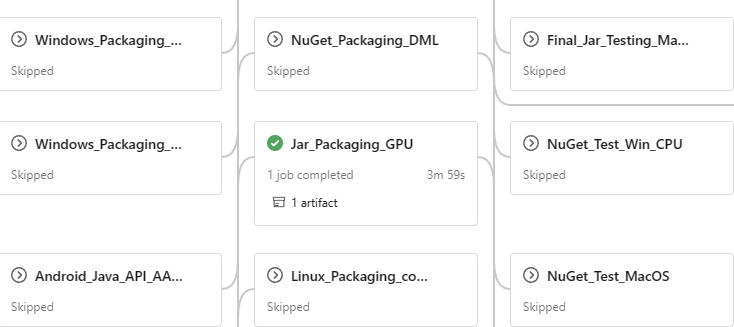
### N.B.
In this PR, Nuget_Test_Linux_CPU, Nuget_Test_LinuxGPU and
Jar_Packaging_GPU are enabled as the first step.
So I can start to move tests from Linux host to container
### Description
In 2021 we restricted onnx node test CI execution in range of opset
14-15 for ORT-TRT, which was the latest opset that TRT EP could support
Update this range to opset 14-17 to improve the ORT-TRT unit test
coverage, as [Nvidia announced that TRT 8.6 supported
opset17](https://github.com/onnx/onnx-tensorrt/blob/main/docs/operators.md)
### Description
* Reverting default TensorRT version to 8.5 as temporary fix
* Apart from that, this PR temporarily leaves this CI as a place to
validate user behavior that uses TRT 8.5 with latest ORT
### Context
* This CI pool equips 2xTesla M60 GPUs, which are no longer supported by
TensorRT 8.6.
* Currently, other CIs are using single-T4 VM but there's no VM with
2xT4 or other suitable dualGPU in the range.
* Once we decide which VM instance for this CI to migrate to, TRT8.6 can
be enabled on this CI
* According to
[Nvidia](https://docs.nvidia.com/deeplearning/tensorrt/release-notes/index.html):
* TensorRT 8.5.3 was the last release supporting NVIDIA Kepler (SM 3.x)
and NVIDIA Maxwell (SM 5.x) devices. *These devices are no longer
supported in TensorRT 8.6*. NVIDIA Pascal (SM 6.x) devices are
deprecated in TensorRT 8.6.
### Description
This PR resolves a part of non-critical comments from code review
comments in #14579.
- use `USE_JSEP` instead of `USE_JS` in build definition to make it less
ambiguous
- remove unused util functions from util.ts
- fix transpose.h
- other misc fixes
### Description
Update cuda 11.6 to 11.8 for Windows pipelines
This PR is just for Windows CUDA pipelines. It does include any change
for Linux pipelines or TensorRT pipelines
### Motivation and Context
It is a planned feature for the upcoming ONNX Runtime release.
### Description
This change introduced the following new components into ONNX Runtime
Web:
- JavaScript Execution Provider (JSEP)
- Asynchronized inferencing execution powered by Emscripten's Asyncify
- WebGPU backend implemented in TypeScript
- initial implementation of kernels:
- elementwise operators (22)
- binary operators (5)
- tensor: Shape, Reshape, Transpose, Gemm
- nn: Conv, {Global}Maxpool, {Global}AveragePool
Code need to be polished. still working on it.
## Q&A
What is JSEP?
> JSEP, aka JavaScript Execution Provider, is a new ONNXRuntime
execution provider that specifically works on Web environment
(browsers). JSEP allows JavaScript code to kick in from various places
when ONNX Runtime inferences a model.
Why JSEP?
> JSEP is a hybrid mode EP that contains both C/C++ and
TypeScript/JavaScript implementation. There are 2 strong reasons why we
introduces JSEP:
> 1. the C/C++ part helps JSEP to leverage ONNX Runtime's capabilities
as much as possible including graph transformer, optimizers and also the
capabilities to fallback to CPU EP. TypeScript/JavaScript helps JSEP to
develop and debug much easier in the browser for the kernel
implementation.
> 2. the requirement of asynchronized execution from JavaScript API (eg.
`buffer.mapAsync()`) makes it impossible to run `OrtRun()` in a
synchronized context (see "async problem" section below). This is done
by using Emscripten's Asyncify.
What is WebGPU?
> WebGPU is the new GPU API that available in browser. It's one of the
only 2 APIs that currently available to access the GPU from browser (the
other is WebGL).
> WebGPU is designed with more advanced and stronger features comparing
to WebGL and is potentially solution that offer the best GPU performance
for model inferencing that currently available.
What is the async problem and why we have the problem?
> The "async problem" is a problem that you cannot call an async
function in a synchronous context. Think about the following C++ code:
> ```c
> // C-style declarations (API)
> typedef void (*ON_COMPLETE)(PVOID state, DATA *data);
> void read_data_from_file(FILEHANDLE file, ON_COMPLETE on_complete);
>
> // implementation
> DATA * my_impl_read_data_from_file_sync(FILEHANDLE file) {
> // how to implement?
> }
> ```
> The answer is, it's impossible to implement this function. Usually we
try to find a sync version API, or launch a thread to call the async
function and sync-wait on the main thread. Unfortunately, in browser
environment, neither is possible.
>
> WebGPU does not offer any synchronized API for data downloading (GPU
to CPU). This is the only operation that MUST be async. As `OrtRun()`
will eventually call into DataTransfer for copy data from GPU to CPU,
and `OrtRun()` is a synchronized function, this cannot be done in normal
way.
What is Emscripten? How is the Asyncify feature resolved the problem?
> Emscripten is the C/C++ compiler for WebAssembly. It's what we use to
compile ORT and generates the WebAssembly artifacts which runs on
browsers.
>
> Asyncify is a [compiler
feature](https://emscripten.org/docs/porting/asyncify.html) that allows
calling async functions from a synchronized context. In short, it
generates code to unwind and rewind call stack to emulate async
execution. With this feature, we are able to call the async function
inside `OrtRun()` call.
## Design Overview
**Inter-op**
JSEP is doing pretty much same thing to just another EP. It exposes an
interface for inter-op with JavaScript, which is defined in
onnxruntime/wasm/js_internal_api.js:
```js
// init JSEP
Module["jsepInit"] = function (backend, alloc, free, copy, copyAsync, createKernel, releaseKernel, run) {
Module.jsepBackend = backend;
Module.jsepAlloc = alloc;
Module.jsepFree = free;
Module.jsepCopy = copy;
Module.jsepCopyAsync = copyAsync;
Module.jsepCreateKernel = createKernel;
Module.jsepReleaseKernel = releaseKernel;
Module.jsepRun = run;
};
```
This simple JavaScript snippet defines all language barrier level
functions that requires by JSEP to achieve implementing kernels and data
transfers using JavaScript inside ONNX Runtime:
- `jsepBackend`: assign the singleton object to webassembly module
- `jsepAlloc` and `jsepFree`: implementation of data transfer's Alloc()
and Free()
- `jsepCopy`: synchronized copy ( GPU to GPU, CPU to GPU)
- `jsepCopyAsync`: asynchronized copy ( GPU to CPU)
- `jsepCreateKernel` and `jsepReleaseKernel`: a corresponding object
that maintained in JS to match lifecycle of Kernel in ORT
- `jsepRun`: OpKernel::Compute() should call into this
The abstraction above allows to tie as little as possible connections
and dependencies between C/C++ and TypeScript/JavaScript.
**Resource Management**
Lifecycle of tensor data and kernels are managed by ORT(C/C++) but the
implementation are left to JavaScript. JavaScript code are responsible
to implement the callbacks correctly.
For WebGPU, the GPU data is managed by JavaScript using a singleton map
(tensot_data_id => GPUBuffer). GPU pipeline is managed as singleton.
Shaders are managed using a singletonmap (shader_key => gpu_program),
while shader_key is generated by cache_key (OP specific, including
attributes) and input shapes.
**about data transfer**
`js::DataTransfer::CopyTensor` implemented to call either synchronized
or asynchronized copy callback, depending on the destination is GPU or
not. Emscripten's macro `EM_ASYNC_JS` is used to wrap the async function
to be called in the synchronized context.
**run kernel in JS**
Kernel class constructor calls once `jsepCreateKernel()` with an
optional per-kernel specific serialization to pass attributes into
JavaScript.
`Compute()` are implemented in a way that a metadata serialization is
performed in a base class and JavaScript code can access the data using
the Emscripten specific builtin macro `EM_ASM_*`.
**disabled features**
memory pattern is force disabled, because the WebGPU data is not
presented by a general memory model (a buffer can be represented by
offset + size).
concurrent run support is disabled. WebGPU is stateful and it also has
async function call. To support concurrent run will significantly
increase the complexity and we don't get any real benefit from it.
**prefer channels last**
JSEP prefers channels last and returns `DataLayout::NHWC` in method
`GetPreferredLayout()`. This will let the graph transformers to
preprocess the graph into a channels last form so that a more optimized
WebGPU shader can be used.
**Testing code**
It's impossible to test JSEP directly because JSEP itself does not
contain any kernel implementation. However, it has the kernel
registration which need to work together with the corresponding
JavaScript code. There are unit tests that run onnx models from
JavaScript API.
---------
Co-authored-by: Scott McKay <skottmckay@gmail.com>
TensorRT will load/unload libraries as builder objects are created and
torn down. This will happen for
every single unit test, which leads to excessive test execution time due
to that overhead.
This overhead has steadily increased over the past few TensorRT versions
as the library objects get bigger leading to
8 hours to run all the unit tests. Nvidia suggests to keep a placeholder
builder object around to avoid this.
### Description
<!-- Describe your changes. -->
Integrate react native e2e test framework with detox.
https://wix.github.io/Detox/
Good build in CI:
https://dev.azure.com/onnxruntime/onnxruntime/_build/results?buildId=946695&view=results
### Motivation and Context
<!-- - Why is this change required? What problem does it solve?
- If it fixes an open issue, please link to the issue here. -->
Write cross-platform end-to-end tests in JavaScript.
Resolve flaky e2e tests in react native ci pipelines.
---------
Co-authored-by: rachguo <rachguo@rachguos-Mini.attlocal.net>
Co-authored-by: rachguo <rachguo@rachguos-Mac-mini.local>
### Description
- Updates the QNN Windows ARM64 pipeline to use a new image with Visual
Studio 2022 (updated from VS 2019)
- Creates a new gtest fixture class that skips tests for the QNN CPU
backend if we detect that the QNN CPU backend is not
available/functional. The current windows arm64 vm does not support any
QNN backend.
### Motivation and Context
Visual Studio 2022 adds support for native arm64 compilation. This
pipeline will help catch any build regressions on Windows ARM64 w/ VS
2022.
### Description
<!-- Describe your changes. -->
Add Swift Package Manager (SPM) support for ORT based on #14621
- uses the existing objective-c bindings
- some re-organization of the directory structure was required but the
contents of the files are unchanged, apart from adjustments due to file
movements
Add tool for updating ORT native pod used in the SPM package
Update CIs to use ORT native pod from build, and build/test using SPM
### Motivation and Context
<!-- - Why is this change required? What problem does it solve?
- If it fixes an open issue, please link to the issue here. -->
iOS developers are using SPM as much as cocoapods, so adding SPM means
both are catered for.
### Description
Bump ruff version in CI and fixed new lint errors.
- This change enables the flake8-implicit-str-concat rules which helps
detect unintended string concatenations:
https://beta.ruff.rs/docs/rules/#flake8-implicit-str-concat-isc
- Update gitignore to include common python files that we want to
exclude.
### Motivation and Context
Code quality
### Description
1. Disable XNNPack EP's tests in Windows CI pipeline
The EP code has a known problem(memory alignment), but the problem does
not impact the usages that we ship the code to. Now we only use XNNPack
EP in mobile apps and web usages. We have already pipelines to cover
these usages. We need to prioritize fixing the bugs found in these
pipelines, and there no resource to put on this Windows one. We can
re-enable the tests once we reached an agreement on how to fix the
memory alignment bug.
2. Delete anybuild.yml which was for an already deleted pipeline.
3. Move Windows CPU pipelines to AMD CPU machine pools which are
cheaper.
4. Disable some qdq/int8 model tests that will fail if the CPU doesn't
have Intel AVX512 8-bit instructions.
### Description
<!-- Describe your changes. -->
* Integrate TRT 8.6EA on relevant Linux/Windows/pkg pipelines
* Update onnx-tensorrt to 8.6
* Add new dockerfiles for TRT 8.6 and clean old ones
* Update
[CGManifest](https://github.com/microsoft/onnxruntime/tree/main/cgmanifests)
files and ort build deps version
* yml/script update
* Enable built-in TRT parser option on TRT related pipelines by default
* Exclude test TopKOperator.Top3ExplicitAxisInfinity out of TRT EP tests
(8.6-EA has issue with topk operator)
This change moves the DML CI pipeline to the A10 machines and fixes or
disables tests that were failing from this change.
- Max error rate threshold was increased for Image Tests
- Some failing batch tests were disabled
---------
Co-authored-by: Changming Sun <chasun@microsoft.com>
### Description
<!-- Describe your changes. -->
As title
### Motivation and Context
<!-- - Why is this change required? What problem does it solve?
- If it fixes an open issue, please link to the issue here. -->
https://github.com/microsoft/onnxruntime/issues/15110
---------
Co-authored-by: rachguo <rachguo@rachguos-Mac-mini.local>
Co-authored-by: rachguo <rachguo@rachguos-Mini.attlocal.net>
Co-authored-by: Scott McKay <skottmckay@gmail.com>
### Description
add script to validate generated NPM packages and publish it to
artifacts, so that release pipeline can use it.
once this PR is merged, I will update the NPM package release pipeline.
### Description
Implement Optional Type metadata support in the library.
Implement optional support in C# API along with metadata.
Implement Sequence, Map, Optional test data support
and test execution.
Prune tests and provide more details for failing tests in C# code.
Note, this PR does not enable running onnx test models in C++.
### Motivation and Context
Opset18 optional type support.
### Description
1. Move it to a separated pool that use the same image as [the public
hosted
pool](https://learn.microsoft.com/en-us/azure/devops/pipelines/agents/hosted?view=azure-devops&tabs=yaml).
Also, create a beta pool which contains the next version image of the
hosted pool, and add jobs in our post merge pipeline to test if the next
version image will break our CI. So, usually we will have at least one
week to prepare.
2. Change the cmake generator in use in our pipelines from "Ninja" to
"MingW Makefile", because the latest version of cmake doesn't work with
the latest version of Ninja. People who prefer Ninja could still use
ninja in their local build by passing "--cmake_generator ninja" to
[build.py](https://github.com/microsoft/onnxruntime/blob/main/tools/ci_build/build.py).
3. Delete eager mode CI pipeline.
### Motivation and Context
I need to update the software we have in our CI build machines, and I
need to resolve this incompatibility issue. In more detail, the build
error I hit was:
em++: error:
CMakeFilesonnxruntime_mlas_test.dirC_a_work1sonnxruntimetestmlasunittesttest_activation.cpp.o:
No such file or directory
("CMakeFilesonnxruntime_mlas_test.dirC_a_work1sonnxruntimetestmlasunittesttest_activation.cpp.o"
was expected to be an input file, based on the commandline arguments
provided)
After this PR we will deprecate python 3.7 support. The eager mode CI
pipeline is the last one that still use python 3.7. Then we can rework
the PR #10953 made by [fs-eire](https://github.com/fs-eire) last year.
Fixed
[AB#14435](https://aiinfra.visualstudio.com/6a833879-cd9b-44a4-a9de-adc2d818f13c/_workitems/edit/14435)
Add workflow to update Objective-C API docs. Remove the Objective-C API doc generation step from the packaging pipeline.
There are similar workflows for automatically updating other language API docs. This change enables this for Objective-C too.
Ensure that we build with a known version of NDK and are not surprised when the default version on the build machine changes.
A similar change was made for other Android build pipelines previously, but this one was missed.
### Description
1. The protoc package on nuget.org contains binaries for
Windows_x86/Windows_x64/Linux_x86/Linux_x64/MacOS_x64, which can cover
most use cases. Though it doesn't have binaries for AMR64, they are only
needed when we cross-compile for Intel CPUs on ARM CPUs. It is rare.
When you have such a need, you always can build protoc from source by
yourself and pass it to build.py as "--path_to_protoc_exe". Or if you
have security concerns that you don't want to use prebuilt binaries from
outside, you can do the same thing.
2. Remove GoogleTestAdapter related thing. That part of code is out of
maintain.
### Motivation and Context
As a follow-up of PR #15190.
### Description
Update mimalloc dependency.
### Motivation and Context
The latest release contains important fixes including memory leaks and
used by customers.
WindowsAI build failing due to deprecated .NET5 SDK missing in build
image
.NET5 was deprecated last year, and recently the build machine images
have been updated to not include this SDK.
Unblock failing builds by force insalling .NET5 SDK as part of the build
pipeline.
### Description
Upgrade remainding python to 3.11 removing 3.7
### Motivation and Context
<!-- - Why is this change required? What problem does it solve?
- If it fixes an open issue, please link to the issue here. -->
### Description
Update python package pipeline to support 3.11
### Motivation and Context
<!-- - Why is this change required? What problem does it solve?
- If it fixes an open issue, please link to the issue here. -->
### Description
In merge branch, the run only reads the cache generated in main build.
As a result, each run in merge branch will not upload new cache except
at the first time.
### Motivation and Context
1.Reduce the cache storage.
If there's some big changes, devs should trigger the specific builds
manually in https://dev.azure.com/onnxruntime/onnxruntime/_build. It
still reads own branch cache.
Temporarily remove Azure build check to unblock PR(s).
We need to investigate the sudden build failure and reenable.
Co-authored-by: Randy Shuai <rashuai@microsoft.com>
rocm python packaging pipeline failed because manylinux version and
manylinux.patch update.
1. fix duplicate `epel-release` installation issue, ROCm pipeline
install it at the begin of the dockerfile to install rocm libs. remove
duplicate installation on install-runtime-packages.sh.
```
/var/tmp/yum-root-sMRl36/epel-release-latest-7.noarch.rpm: does not update installed package.
Error: Nothing to do
```
2. add python10 to fix error below.
```
+ /opt/python/cp310-cp310/bin/python -m venv /opt/_internal/tools
build_scripts/finalize.sh: line 40: /opt/python/cp310-cp310/bin/python: No such file or directory
```
3. add python10 to rocm pipeline.
pipeline link:
https://aiinfra.visualstudio.com/Lotus/_build/results?buildId=294776&view=results
### Description
1. Make 2 cache tasks in one pipeline really works
2. Each building step has its own environment variable CCACHE_DIR
instead of job variables.
3. Extenal Protobuf compilation cache only updates with deps.txt. It
doesn't generate new cache in every commit.
### Motivation and Context
The simple workflow is as below
```
--------build with ccache-------
|
cache
|
{CCACHE_DIR}-----cache stat.
```
```
-------Cache@2------
|
download cache
|
{path}--------upload cache
```
1. {XXX} means environment variable or task input.
2. {CCACHE_DIR} must be consistent with {path}. Ccache produces caches
in {CCACHE_DIR} and Cache@2 download cache into {path} and tar {path}
and upload it.
3. Protobuf changes with deps.txt so that it would reduce the storage
size.
4. Next step, we may split the compilation into 2 steps, one for
external dependencies and another for ORT.
### Description
1. move the cache task definition into template
2. In debug mode, the compiler mtime is different in different machine.
So, change the CCACHE_COMPILERCHECK to content.
### Motivation and Context
1. Accelerate the CoreML pipeline.
Test run:
https://dev.azure.com/onnxruntime/onnxruntime/_build/results?buildId=938040&view=logs&j=1ac7588f-a5bd-5ff7-4a8a-a34869d50220
With Cache, the run can be finished in 12 minutes. Without cache, it
takes about 1 hour.
3. Make the cache function easy to use and maintain.
---------
Co-authored-by: Edward Chen <18449977+edgchen1@users.noreply.github.com>
### Description
This PR disables browser test temporarily. The test randomly fails and
we are investigating the issue. Disable the test to unblock others.
### Description
1. Remove Linux jobs for ORT-Extension combined build
2. Add a macOS build job for ORT-Extension combined build
3. Adjust the yaml file so that it can support two different ADO
instances.
### Motivation and Context
To test our code better. And it will enable us to run such tests for
every commit in the main branch. It would be easier for us to figure out
which change caused a build break.
See
[AB#13435](https://aiinfra.visualstudio.com/6a833879-cd9b-44a4-a9de-adc2d818f13c/_workitems/edit/13435)
### Description
windows update python3.11
### Motivation and Context
<!-- - Why is this change required? What problem does it solve?
- If it fixes an open issue, please link to the issue here. -->
---------
Co-authored-by: Ubuntu <chasun@chasunlinux.lw3b1xzoyrkuzm34swpscft0ff.dx.internal.cloudapp.net>
### Description
1. Move Linux CPU pipelines to an AMD CPU pool which is cheaper
2. Enable CCache for orttraining pipeline
### Motivation and Context
Azure AMD CPU machines are generally much cheaper than Intel CPU
machines. However, they don't have local disks.
### Description
Pause caching the docker images in pipeline cache in Linux Aten
Pipeline.
### Motivation and Context
We need to work out a better way to reduce the storage.
### Description
`lintrunner` is a linter runner successfully used by pytorch, onnx and
onnx-script. It provides a uniform experience running linters locally
and in CI. It supports all major dev systems: Windows, Linux and MacOs.
The checks are enforced by the `Python format` workflow.
This PR adopts `lintrunner` to onnxruntime and fixed ~2000 flake8 errors
in Python code. `lintrunner` now runs all required python lints
including `ruff`(replacing `flake8`), `black` and `isort`. Future lints
like `clang-format` can be added.
Most errors are auto-fixed by `ruff` and the fixes should be considered
robust.
Lints that are more complicated to fix are applied `# noqa` for now and
should be fixed in follow up PRs.
### Notable changes
1. This PR **removed some suboptimal patterns**:
- `not xxx in` -> `xxx not in` membership checks
- bare excepts (`except:` -> `except Exception`)
- unused imports
The follow up PR will remove:
- `import *`
- mutable values as default in function definitions (`def func(a=[])`)
- more unused imports
- unused local variables
2. Use `ruff` to replace `flake8`. `ruff` is much (40x) faster than
flake8 and is more robust. We are using it successfully in onnx and
onnx-script. It also supports auto-fixing many flake8 errors.
3. Removed the legacy flake8 ci flow and updated docs.
4. The added workflow supports SARIF code scanning reports on github,
example snapshot:

5. Removed `onnxruntime-python-checks-ci-pipeline` as redundant
### Motivation and Context
<!-- - Why is this change required? What problem does it solve?
- If it fixes an open issue, please link to the issue here. -->
Unified linting experience in CI and local.
Replacing https://github.com/microsoft/onnxruntime/pull/14306
---------
Signed-off-by: Justin Chu <justinchu@microsoft.com>
### Description
Use build.sourceversion in docker image cache key.
### Motivation and Context
We used filpath as the cache key in #14496.
In most cases, the docker base image tag is latest.
So, the hash of the files couldn't be aware of the change of base image.
As the result, the docker image restored, but the image will still be
rebuilt .
The maintenance cost would be huge if we pin image hash in docker file.
For example,
https://quay.io/repository/pypa/manylinux2014_x86_64?tab=tags&tag=latest,
it's updated almost every week.
So far, the build.sourceversion is the right way to keep cache is
updated and valid.
### Description
<!-- Describe your changes. -->
1. upgrade cutlass to 3.0 that containing attn_bias support.
2. extend Attention/MHA to use memory efficient attention when
rel_pos_bias with [1, num_head, s, s*] and 1d mask with [2 * batch_size
+ 1] are present.
new mask format introduction:
MASK_1D_KEY_SEQ_LEN_START,
[3 * batch_size + 2] with [key_len[0], ..., key_len[batch_size - 1],
query_start[0], ..., query_start[batch_size - 1], query_end[batch_size -
1], key_start[0], ..., key_start[batch_size - 1], key_end[batch_size -
1]]
e.g
2D mask with [[1, 1, 1, 0, 0, 0], [1, 1, 1, 1, 1, 0]] converts to this
1D mask is [3, 5, 0, 6, 12, 0, 6, 12]
### Motivation and Context
<!-- - Why is this change required? What problem does it solve?
- If it fixes an open issue, please link to the issue here. -->
It potentially benefits tnlrv6 and t5(encoder)
---------
Co-authored-by: Ubuntu <wy@v100-2.0cdb2e52twzevn1i4fi45bylyg.jx.internal.cloudapp.net>
Co-authored-by: Kunal Vaishnavi <kvaishnavi@microsoft.com>
Co-authored-by: Kunal Vaishnavi <kvaishnavi@microsoft.com@orttrainingdev7.d32nl1ml4oruzj4qz3bqlggovf.px.internal.cloudapp.net>
### Description
Check the Mac x86_64 packages installation.
### Motivation and Context
To avoid installation error, add packages smoking test before release.


