Here's the motivating issue:
https://github.com/microsoft/azure-pipelines-tasks/issues/10331

Noticed some problems in other repos so also updating usages in ORT.

We may be fine now without it, but this change adds some safeguard against future additions of 'set -x' for debugging.
### Description
Change CUDA pipelines to download CUDA SDK in every build job


### Motivation and Context
<!-- - Why is this change required? What problem does it solve?
- If it fixes an open issue, please link to the issue here. -->
### Description
After this PR there are following pool need to be updated.

old|new|note
---|---|---
onnxruntime-Win2019-GPU-dml-A10|tbd|
onnxruntime-Win2019-GPU-T4|onnxruntime-Win2022-GPU-T4|
onnxruntime-Win2019-GPU-training-T4|onnxruntime-Win2022-GPU-T4|ame as
the above because we do not have many T4 GPUs
onnxruntime-tensorrt8-winbuild-T4|tbd|
aiinfra-dml-winbuild|tbd|
### Motivation and Context
<!-- - Why is this change required? What problem does it solve?
- If it fixes an open issue, please link to the issue here. -->
### Description
<!-- Describe your changes. -->


Old pool | New pool | Notes
-- | -- | --
onnxruntime-Win-CPU-2019 | onnxruntime-Win-CPU-2022 |
onnxruntime-Win2019-CPU-training | onnxruntime-Win2022-CPU-training-AMD
|
onnxruntime-Win2019-CPU-training-AMD |
onnxruntime-Win2022-CPU-training-AMD | Same as the above
onnxruntime-Win2019-GPU-dml-A10 | Need be created | You need to create a
new image for it first
onnxruntime-Win2019-GPU-T4 | onnxruntime-Win2022-GPU-T4 |
onnxruntime-Win2019-GPU-training-T4 | onnxruntime-Win2022-GPU-T4 | Same
as the above because we do not have many T4 GPUs
onnxruntime-tensorrt8-winbuild-T4| TBD|TBD
Win-CPU-2021|onnxruntime-Win-CPU-2022| will do it in next PR
Win-CPU-2019|onnxruntime-Win2022-Intel-CPU'| Intel CPU needed for
win-ci-pipeline.yml -> `stage: x64_release_dnnl`

<br class="Apple-interchange-newline">

### Motivation and Context
With vs2022 we can take the advantage of 64bit compiler. It also with
better c++20 support
### Description
The CI is extremely slow on downloading source code (~1MB/sec) so the
web CI went timeout. This is blocking the PR/checks.

Increase the timeout temporarily.
### Description
this is for ort 1.15 release to work with onnx 1.14
It shall be merged after onnx 1.14 release and before ort 1.15 release.


### Motivation and Context

---------

Signed-off-by: Liqun Fu <liqfu@microsoft.com>
### Description
Fix the bug in #15693


### Motivation and Context
<!-- - Why is this change required? What problem does it solve?
- If it fixes an open issue, please link to the issue here. -->
### Description
add target ort.webgpu.min.js

WebGPU is experimental feature, so I don't want to put webgpu into the
ort.min.js file. This change adds 2 ways for users to access ort-web
with webgpu:
- using script tag: by URL
`https://cdn.jsdelivr.net/npm/onnxruntime-web@1.15.0/dist/ort.webgpu.min.js`
( this URL is not ready yet )
- using `import()`: use `import { Tensor, InferenceSession } from
'onnxruntime-web/webgpu';` - 'onnxruntime-web/webgpu' instead of
'onnxruntime-web'
### Description
latest emsdk generated multi-thread version sometimes crash with unknown
reason ( error: memory access out of bounds ).

we don't want to break existing ort-web users, so revert emsdk back to
3.1.19 (same to what ort v1.14.0 uses)
### Description
This is the first part to create a webassembly artifacts for ort-web
webgpu EP (wasm build).

there will be following steps to consume the artifacts in web build
### Description
Download protoc from Github Release instead of Nuget to avoid having
dependency on nuget.exe on Linux

### Motivation and Context
To avoid having dependency on nuget.exe on Linux. Many users' build
environment do not have nuget or dotnet.
### Description
This PR creates Nuget and Android for Training.


### Motivation and Context
These packages are intended to be released in ORT 1.15 to enable
On-Device Training Scenarios.

## Packaging Story for Learning On The Edge Release
### Nuget Packages:
1. New Native package -> **Microsoft.ML.OnnxRuntime.Training** (Native
package will contain binaries for: win-x86, win-x64, win-arm, win-arm64,
linux-x64, linux-arm64, android)
2. C# bindings will be added to existing package ->
**Microsoft.ML.OnnxRuntime.Managed**

### Android Package published to Maven:
1. New package for training (full build) ->
**onnxruntime-training-android-full-aar**

### Python Package published to PyPi:
1. Python bindings and offline tooling will be added to the existing ort
training package -> **onnxruntime-training**
Rename onnxruntime-Linux-CPU-2019 machine pool to
"onnxruntime-Ubuntu2004-AMD-CPU". The old one has an internal error and
stuck there. I cannot make any change to it. It has been like this for
more than 1 week. So I created a new pool with the same setting except
the name is different.
Also, move some android pipelines to
"onnxruntime-Linux-CPU-For-Android-CI" which uses a standard image from
https://github.com/actions/runner-images
### Description
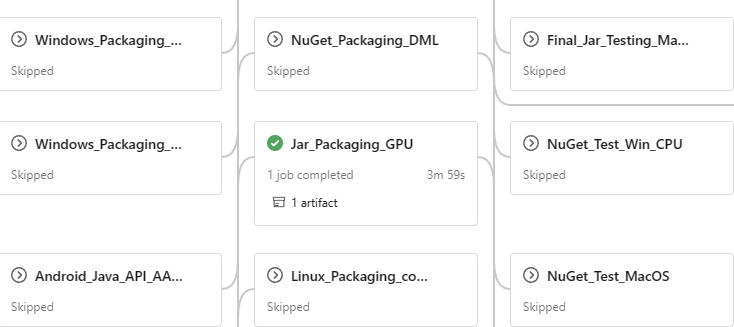
Add parameters to make some stages could use other run's intermediate
output.
### Motivation and Context
nuget workflow has 38 stages of 4 layers.
We had to run the whole workflow from begining to test one stage.
It could make life easier to run only one stage for testing.
like
### N.B.
In this PR, Nuget_Test_Linux_CPU, Nuget_Test_LinuxGPU and
Jar_Packaging_GPU are enabled as the first step.
So I can start to move tests from Linux host to container
### Description
This PR resolves a part of non-critical comments from code review
comments in #14579.

- use `USE_JSEP` instead of `USE_JS` in build definition to make it less
ambiguous
- remove unused util functions from util.ts
- fix transpose.h
- other misc fixes
### Description
This change introduced the following new components into ONNX Runtime
Web:
- JavaScript Execution Provider (JSEP)
  - Asynchronized inferencing execution powered by Emscripten's Asyncify
- WebGPU backend implemented in TypeScript
  - initial implementation of kernels:
    - elementwise operators (22)
    - binary operators (5)
    - tensor: Shape, Reshape, Transpose, Gemm
    - nn: Conv, {Global}Maxpool, {Global}AveragePool


Code need to be polished. still working on it.

## Q&A
What is JSEP?
> JSEP, aka JavaScript Execution Provider, is a new ONNXRuntime
execution provider that specifically works on Web environment
(browsers). JSEP allows JavaScript code to kick in from various places
when ONNX Runtime inferences a model.

Why JSEP?
> JSEP is a hybrid mode EP that contains both C/C++ and
TypeScript/JavaScript implementation. There are 2 strong reasons why we
introduces JSEP:
> 1. the C/C++ part helps JSEP to leverage ONNX Runtime's capabilities
as much as possible including graph transformer, optimizers and also the
capabilities to fallback to CPU EP. TypeScript/JavaScript helps JSEP to
develop and debug much easier in the browser for the kernel
implementation.
> 2. the requirement of asynchronized execution from JavaScript API (eg.
`buffer.mapAsync()`) makes it impossible to run `OrtRun()` in a
synchronized context (see "async problem" section below). This is done
by using Emscripten's Asyncify.

What is WebGPU?
> WebGPU is the new GPU API that available in browser. It's one of the
only 2 APIs that currently available to access the GPU from browser (the
other is WebGL).
> WebGPU is designed with more advanced and stronger features comparing
to WebGL and is potentially solution that offer the best GPU performance
for model inferencing that currently available.

What is the async problem and why we have the problem?
> The "async problem" is a problem that you cannot call an async
function in a synchronous context. Think about the following C++ code:
> ```c
> // C-style declarations (API)
> typedef void (*ON_COMPLETE)(PVOID state, DATA *data);
> void read_data_from_file(FILEHANDLE file, ON_COMPLETE on_complete);
>
> // implementation
> DATA * my_impl_read_data_from_file_sync(FILEHANDLE file) {
>   // how to implement?
> }
> ```
> The answer is, it's impossible to implement this function. Usually we
try to find a sync version API, or launch a thread to call the async
function and sync-wait on the main thread. Unfortunately, in browser
environment, neither is possible.
>
> WebGPU does not offer any synchronized API for data downloading (GPU
to CPU). This is the only operation that MUST be async. As `OrtRun()`
will eventually call into DataTransfer for copy data from GPU to CPU,
and `OrtRun()` is a synchronized function, this cannot be done in normal
way.

What is Emscripten? How is the Asyncify feature resolved the problem?
> Emscripten is the C/C++ compiler for WebAssembly. It's what we use to
compile ORT and generates the WebAssembly artifacts which runs on
browsers.
>
> Asyncify is a [compiler
feature](https://emscripten.org/docs/porting/asyncify.html) that allows
calling async functions from a synchronized context. In short, it
generates code to unwind and rewind call stack to emulate async
execution. With this feature, we are able to call the async function
inside `OrtRun()` call.

## Design Overview

**Inter-op**

JSEP is doing pretty much same thing to just another EP. It exposes an
interface for inter-op with JavaScript, which is defined in
onnxruntime/wasm/js_internal_api.js:
```js
// init JSEP
Module["jsepInit"] = function (backend, alloc, free, copy, copyAsync, createKernel, releaseKernel, run) {
    Module.jsepBackend = backend;
    Module.jsepAlloc = alloc;
    Module.jsepFree = free;
    Module.jsepCopy = copy;
    Module.jsepCopyAsync = copyAsync;
    Module.jsepCreateKernel = createKernel;
    Module.jsepReleaseKernel = releaseKernel;
    Module.jsepRun = run;
};
```
This simple JavaScript snippet defines all language barrier level
functions that requires by JSEP to achieve implementing kernels and data
transfers using JavaScript inside ONNX Runtime:
- `jsepBackend`: assign the singleton object to webassembly module
- `jsepAlloc` and `jsepFree`: implementation of data transfer's Alloc()
and Free()
- `jsepCopy`: synchronized copy ( GPU to GPU, CPU to GPU)
- `jsepCopyAsync`: asynchronized copy ( GPU to CPU)
- `jsepCreateKernel` and `jsepReleaseKernel`: a corresponding object
that maintained in JS to match lifecycle of Kernel in ORT
- `jsepRun`: OpKernel::Compute() should call into this

The abstraction above allows to tie as little as possible connections
and dependencies between C/C++ and TypeScript/JavaScript.

**Resource Management**

Lifecycle of tensor data and kernels are managed by ORT(C/C++) but the
implementation are left to JavaScript. JavaScript code are responsible
to implement the callbacks correctly.

For WebGPU, the GPU data is managed by JavaScript using a singleton map
(tensot_data_id => GPUBuffer). GPU pipeline is managed as singleton.
Shaders are managed using a singletonmap (shader_key => gpu_program),
while shader_key is generated by cache_key (OP specific, including
attributes) and input shapes.

**about data transfer**
`js::DataTransfer::CopyTensor` implemented to call either synchronized
or asynchronized copy callback, depending on the destination is GPU or
not. Emscripten's macro `EM_ASYNC_JS` is used to wrap the async function
to be called in the synchronized context.

**run kernel in JS**

Kernel class constructor calls once `jsepCreateKernel()` with an
optional per-kernel specific serialization to pass attributes into
JavaScript.

`Compute()` are implemented in a way that a metadata serialization is
performed in a base class and JavaScript code can access the data using
the Emscripten specific builtin macro `EM_ASM_*`.

**disabled features**
memory pattern is force disabled, because the WebGPU data is not
presented by a general memory model (a buffer can be represented by
offset + size).
concurrent run support is disabled. WebGPU is stateful and it also has
async function call. To support concurrent run will significantly
increase the complexity and we don't get any real benefit from it.

**prefer channels last**
JSEP prefers channels last and returns `DataLayout::NHWC` in method
`GetPreferredLayout()`. This will let the graph transformers to
preprocess the graph into a channels last form so that a more optimized
WebGPU shader can be used.

**Testing code**
It's impossible to test JSEP directly because JSEP itself does not
contain any kernel implementation. However, it has the kernel
registration which need to work together with the corresponding
JavaScript code. There are unit tests that run onnx models from
JavaScript API.

---------

Co-authored-by: Scott McKay <skottmckay@gmail.com>
TensorRT will load/unload libraries as builder objects are created and
torn down. This will happen for
every single unit test, which leads to excessive test execution time due
to that overhead.
This overhead has steadily increased over the past few TensorRT versions
as the library objects get bigger leading to
8 hours to run all the unit tests. Nvidia suggests to keep a placeholder
builder object around to avoid this.
### Description
<!-- Describe your changes. -->

Integrate react native e2e test framework with detox.
https://wix.github.io/Detox/

Good build in CI:

https://dev.azure.com/onnxruntime/onnxruntime/_build/results?buildId=946695&view=results

### Motivation and Context
<!-- - Why is this change required? What problem does it solve?
- If it fixes an open issue, please link to the issue here. -->

Write cross-platform end-to-end tests in JavaScript.
Resolve flaky e2e tests in react native ci pipelines.

---------

Co-authored-by: rachguo <rachguo@rachguos-Mini.attlocal.net>
Co-authored-by: rachguo <rachguo@rachguos-Mac-mini.local>
### Description

1. Disable XNNPack EP's tests in Windows CI pipeline
The EP code has a known problem(memory alignment), but the problem does
not impact the usages that we ship the code to. Now we only use XNNPack
EP in mobile apps and web usages. We have already pipelines to cover
these usages. We need to prioritize fixing the bugs found in these
pipelines, and there no resource to put on this Windows one. We can
re-enable the tests once we reached an agreement on how to fix the
memory alignment bug.

2.  Delete anybuild.yml which was for an already deleted pipeline.
3. Move Windows CPU pipelines to AMD CPU machine pools which are
cheaper.
4. Disable some qdq/int8 model tests that will fail if the CPU doesn't
have Intel AVX512 8-bit instructions.
### Description

<!-- Describe your changes. -->

* Integrate TRT 8.6EA on relevant Linux/Windows/pkg pipelines
  * Update onnx-tensorrt to 8.6
  * Add new dockerfiles for TRT 8.6 and clean old ones
* Update
[CGManifest](https://github.com/microsoft/onnxruntime/tree/main/cgmanifests)
files and ort build deps version
  * yml/script update
* Enable built-in TRT parser option on TRT related pipelines by default
* Exclude test TopKOperator.Top3ExplicitAxisInfinity out of TRT EP tests
(8.6-EA has issue with topk operator)
### Description
1. Move it to a separated pool that use the same image as [the public
hosted
pool](https://learn.microsoft.com/en-us/azure/devops/pipelines/agents/hosted?view=azure-devops&tabs=yaml).
Also, create a beta pool which contains the next version image of the
hosted pool, and add jobs in our post merge pipeline to test if the next
version image will break our CI. So, usually we will have at least one
week to prepare.

2. Change the cmake generator in use in our pipelines from "Ninja" to
"MingW Makefile", because the latest version of cmake doesn't work with
the latest version of Ninja. People who prefer Ninja could still use
ninja in their local build by passing "--cmake_generator ninja" to
[build.py](https://github.com/microsoft/onnxruntime/blob/main/tools/ci_build/build.py).

3. Delete eager mode CI pipeline.


### Motivation and Context
I need to update the software we have in our CI build machines, and I
need to resolve this incompatibility issue. In more detail, the build
error I hit was:

em++: error:
CMakeFilesonnxruntime_mlas_test.dirC_a_work1sonnxruntimetestmlasunittesttest_activation.cpp.o:
No such file or directory
("CMakeFilesonnxruntime_mlas_test.dirC_a_work1sonnxruntimetestmlasunittesttest_activation.cpp.o"
was expected to be an input file, based on the commandline arguments
provided)

After this PR we will deprecate python 3.7 support. The eager mode CI
pipeline is the last one that still use python 3.7. Then we can rework
the PR #10953 made by [fs-eire](https://github.com/fs-eire) last year.

Fixed
[AB#14435](https://aiinfra.visualstudio.com/6a833879-cd9b-44a4-a9de-adc2d818f13c/_workitems/edit/14435)
Ensure that we build with a known version of NDK and are not surprised when the default version on the build machine changes.

A similar change was made for other Android build pipelines previously, but this one was missed.
### Description
1. The protoc package on nuget.org contains binaries for
Windows_x86/Windows_x64/Linux_x86/Linux_x64/MacOS_x64, which can cover
most use cases. Though it doesn't have binaries for AMR64, they are only
needed when we cross-compile for Intel CPUs on ARM CPUs. It is rare.
When you have such a need, you always can build protoc from source by
yourself and pass it to build.py as "--path_to_protoc_exe". Or if you
have security concerns that you don't want to use prebuilt binaries from
outside, you can do the same thing.

2. Remove GoogleTestAdapter related thing. That part of code is out of
maintain.

### Motivation and Context
As a follow-up of PR #15190.
### Description
Update mimalloc dependency.

### Motivation and Context
The latest release contains important fixes including memory leaks and
used by customers.
### Description
Upgrade remainding python to 3.11 removing 3.7


### Motivation and Context
<!-- - Why is this change required? What problem does it solve?
- If it fixes an open issue, please link to the issue here. -->
### Description
Update python package pipeline to support 3.11

### Motivation and Context
<!-- - Why is this change required? What problem does it solve?
- If it fixes an open issue, please link to the issue here. -->

