### Manage ORTModule options

Move all env vars that used for feature ON/OFF into runtime options for
consistent managements.


Be noted: the features' switch are assigned in 2 phases: default values,
overwritten by env vars (if specified by users). So env vars take the
highest priority when all 2 phases both given value explicitly for one
feature.


### Motivation and Context
<!-- - Why is this change required? What problem does it solve?
- If it fixes an open issue, please link to the issue here. -->
### Use PadAndUnflatten to replace GatherGrad for restore


### Motivation and Context
<!-- - Why is this change required? What problem does it solve?
- If it fixes an open issue, please link to the issue here. -->
### Description
Eliminate Cast operator if Shape is the next one.

### Motivation and Context
#### Cast
When working with onnx opset 15 and above, the shape operator now
accepts all types of variables.
This change is documented in the [onnx
Changelog](https://github.com/onnx/onnx/blob/main/docs/Changelog.md#Shape-15).

As a result, casting variables right before the shape operation becomes
unnecessary.
Removing these unnecessary casts will improve the graph and potentially
provide better performance gains.


## Results
On :
torchrun examples/onnxruntime/training/language-modeling/run_clm.py
--model_name_or_path gpt2 --do_train --overwrite_output_dir --output_dir
./outputs/ --seed 1337 --fp16 True --per_device_train_batch_size 4
--num_train_epochs 1 --dataset_name wikitext --dataset_config_name
wikitext-2-raw-v1 --learning_rate 2e-5 --report_to none --optim
adamw_ort_fused

without changes:
***** train metrics *****
  epoch                    =        1.0
  train_loss               =     3.2981
  train_runtime            = 0:02:13.29
  train_samples            =       2318
  train_samples_per_second =      17.39
  train_steps_per_second   =      4.351

With my changes:
***** train metrics *****
  epoch                    =        1.0
  train_loss               =     3.2981
  train_runtime            = 0:02:08.98
  train_samples            =       2318
  train_samples_per_second =     17.971
  train_steps_per_second   =      4.497

We see around 3% gain.

---------

Co-authored-by: Adam Louly <adamlouly@microsoft.com@orttrainingdev9.d32nl1ml4oruzj4qz3bqlggovf.px.internal.cloudapp.net>
🛠️ __Changes in this pull request:__

This pull request introduces two significant changes to the project:

- Changing on device training checkpoint format: The current
implementation stores the on device training checkpoint as a sequence of
tensors in multiple files inside a checkpoint folder, which can be
inefficient in terms of storage and performance. In this PR, I have
modified the checkpoint format to utilize the flatbuffer table to save
the checkpoint to a single file, providing a more compact and efficient
representation. The changes around this are twofold:
- Add the checkpoint flatbuffer schema that will generate the necessary
checkpoint source files.
- Update the checkpoint saving and loading functionality to use the new
format.

- Adding support for onnxruntime minimal build: To support scenarios
where binary size is a constraint, I made changes to ensure that the
training build can work well with the minimal build.

🔍 __Open Issues:__
- In order to extract the optimizer type, the existing implementation
re-loaded the onnx optimizer model and parsed it. This is no longer
possible, since the model format can either be onnx or ort. One idea is
to do the same for ort format optimizer model. This needs some
investigation.
- Changes to the offline tooling to generate ort format training
artifacts.
- End-to-end training example showcasing the use of the minimal training
build.
- Add support for export model for inferencing in a minimal build.
### Description
<!-- Describe your changes. -->
protobuf CopyFrom doesn't work for model > 2GB for version 4.23. This PR
removes the copy for Calibrator.

Currently Calibrator copies the ModelProto to avoid changing it. The
reason is that: quantize_static passes a ModelProto to Calibrator to
calibrate quantitation parameters, and then use it for quantization. If
calibrator changes the ModelProto, quantizaiton won't work.

This PR changes quantize_static to pass in a model path to Calibrator
instead of a ModelProto, and make Calibrator only take in model path as
input, which is how it is used in most cases.

This PR also remove the optimization from quantization. User needs to
call pre-process to optimize the model
### Description
DORT support for custom ops


### Motivation and Context
Custom ops registered via custom_ops shared_library cannot be run using
DORT atm. This PR enables it using:
1. registering custom_ops supported in DORT
2. plumbing down session_options from OrtBackend when creating the
InferenceSession, that were used to register the custom_ops shared
library using
`session_options.register_custom_ops_library(shared_library)`
### Description
<!-- Describe your changes. -->
1. Add a new test lib `onnxruntime_providers_cuda_ut` which is similar
to `onnxruntime_providers_cuda` but `onnxruntime_providers_cuda_ut` is
only built if `onnxruntime_BUILD_UNIT_TESTS` is set. We can call all
CUDA UTs through this ut lib without affecting production lib
`onnxruntime_providers_cuda`.
2. Move all test cases from `core/providers/cuda/test/` to
`test/providers/cuda/`. These test cases are built into lib
`onnxruntime_providers_cuda_ut` and run by `./onnxruntime_test_all
--gtest_filter="*CUDA_EP_Unittest*"`. Since the lib is only for test, we
can use gtest macros in the test cases. Previous implementation do not
support using gtest lib in the CUDA UT cases.
3. The cmake code in `cmake/onnxruntime_providers.cmake` is refactored a
bit. A new function `onnxruntime_add_object_library` is to build a
object target. The 2 libs `onnxruntime_providers_cuda_ut` &
`onnxruntime_providers_cuda` share most of the code, so the object files
can be used in both libs, which helps reduce build time. Another
function `config_cuda_provider_shared_module` is used to configure all 3
similar
targets(onnxruntime_providers_cuda_obj/onnxruntime_providers_cuda/onnxruntime_providers_cuda_ut).
4. Refactored the test to call `testing::InitGoogleTest` &
`RUN_ALL_TESTS` in `libonnxruntime_providers_cuda_ut.so`'s `TestAll`.
After this change, we can see all the cases running in
`CUDA_EP_Unittest.All`:

### Motivation and Context
<!-- - Why is this change required? What problem does it solve?
- If it fixes an open issue, please link to the issue here. -->
After https://github.com/microsoft/onnxruntime/pull/13016, there are
still test files in test/providers/cuda/ that are not moved to
core/providers/cuda/test/ and the test cases are disabled. This PR helps
to clean the unfinished TODOs.
Even through onnxruntime_shared_lib_test covers some test for CUDA
provider. onnxruntime_shared_lib_test works like a coarse grain
end-to-end test for CUDA provider. If CUDA unittest can run cases for a
single component, this wound be helpful for CUDA developers.
---------
Co-authored-by: Yuhong Guo <yuhong.gyh@antgroup.com>
Fix#16355. The root cause change in PyTorch is
[#103302](https://github.com/pytorch/pytorch/pull/103302), which seem
blocking calling make_fx inside a dynamo backend.
Changes:
1. Move decomposition to `register_backend.py`, so we don't have to call
`make_fx` inside DORT, which triggers a bunch of new exceptions.
2. Remove shape inference based on FakeTensorProp since the FX graph
received from dynamo contains all shapes now.
3. Fix a macro bug so that DORT can build without CUDA.
Before (3),
```
#if defined(USE_CUDA) || defined(USE_ROCM)
virtual PhiloxGenerator& PhiloxGenerator__Default() = 0;
#ifdef ENABLE_TRAINING_TORCH_INTEROP
...
#endif
#endif
```
After (3),
```
#if defined(USE_CUDA) || defined(USE_ROCM)
virtual PhiloxGenerator& PhiloxGenerator__Default() = 0;
#endif
#ifdef ENABLE_TRAINING_TORCH_INTEROP
...
#endif
```
The later one looks better since the `ENABLE_TRAINING_TORCH_INTEROP` is
for Python bridge code, not for random-number-generating kernels
`PhiloxGenerator`.
### Description
This PR is to refactor ExecutionProvider API for memory management,
which is to move allocators from EP level to SessionState level and
indexed by OrtDevice


### Motivation and Context
<!-- - Why is this change required? What problem does it solve?
- If it fixes an open issue, please link to the issue here. -->
This PR is to refactor ExecutionProvider API for memory management,
which is to move allocators from EP level to SessionState level and
indexed by OrtDevice. By this change, EP level will shift the burden of
maintaining allocators, which will be user friendly for EP developers

---------

Co-authored-by: Lei Cao <leca@microsoft.com@orttrainingdev8.d32nl1ml4oruzj4qz3bqlggovf.px.internal.cloudapp.net>
### Description
Optimize compute graph by eliminating padding in embedding.


### Motivation and Context
The computation for padding in nodes after embedding is unnecessary and
waste computation resources.
This pr just add an Optimizer of PaddingElimination to check and
eliminate the padding after embedding automatically by modifying the
graph.

### Implementation:
1. Find and check embedding node in graph.
2. Iterate the subgraph afterward the embedding node and record all the
input nodes and output nodes to this subgraph.
3. Insert 'Reshape + ShrunkenGather' to flatten each input node shape
from [batch_size, seqlen, ...] to [valid_token_without_padding, ...],
and insert 'GatherGrad + Reshape' to unflatten each output node shape
from [valid_token_without_padding, ...] to [batch_size, seqlen, ...]

---------

Co-authored-by: mindest <linminuser@gmail.com>
### Description
<!-- Describe your changes. -->
Split up OpTester to separate out operator vs model testing. This led to
a lot of other cleanups/refactoring.

- create BaseTester class and derived OpTester/ModelTester classes to
limit APIs to what is applicable for each test type
  - e.g. adding an attribute isn't relevant to a model test
- cleanup structure
- don't expose member variables either directly or via public methods
returning them
  - split out checkers so they can be easily re-used
- refactor so there's one public Check method for comparing two OrtValue
instances containing any data type
  - refactor the GradientOpTester usage
- it required a lot of OpTester internals to be exposed and no other
tests needed this
- it also returned Status through various parts which prevented the
usage of the google test macros which provide better output. change to
return void and use the macros.
- fix some other minor issues
  - update some cmake files so all the source files are included
  - remove some low value helpers (FetchTensor and GetShapeVector)
- remove some outdated code to allow unreleased opset versions from when
onnx opset 15 wasn't released
  - move files from test/util/include/test to test/util/include
- doesn't seem to be any reason for the additional subdirectory given
they're not files use to test the code in test/util
    - files were moved with no changes

### Motivation and Context
<!-- - Why is this change required? What problem does it solve?
- If it fixes an open issue, please link to the issue here. -->
Cleanup test infrastructure.

---------

Co-authored-by: Edward Chen <18449977+edgchen1@users.noreply.github.com>
### Enhance StatisticsSubscriber

There are few improvements for `StatisticsSubscriber`:

- Reduce peak memory impact for tensors (having many many many elements,
consuming too much GPU memory, causing original recipe run failed with
OOM), by split the statistics into two phases (split into buckets, and
merge result across buckets).
- Allow dump intermediate tensors. Originally only nn.Module forward()'s
return value are dumped, there are requirements we want to inspect some
specific intermediate tensor in the forward() function, now we support
it.
- Add documents for collecting dumps on multiple ranks

Docs link on this branch for better view:
https://github.com/microsoft/onnxruntime/blob/pengwa/conv_tool_v2/docs/ORTModule_Convergence_Notes.md

---------

Co-authored-by: mindest <30493312+mindest@users.noreply.github.com>
### Description
We should avoid using the macro since the value of the macro is
inaccurate. For example, our prebuilt packages are built with CUDA 11.8
but people may run the binaries with CUDA 11.4. (The minimal CUDA version we support is CUDA 11.4)
A runtime function should be used to determine CUDA version. Like:
```C++
  int cuda_runtime_version = 0;
  CUDA_CALL_THROW(cudaRuntimeGetVersion(&cuda_runtime_version));
  ORT_ENFORCE(cuda_runtime_version >= 11040, "ONNX Runtime needs cuda runtime higher than 11.4");
```
### Description
<!-- Describe your changes. -->

Detect fake tensor mode if it has already been created. Follows this
example in pytorch:
86c7652503/torch/_inductor/compile_fx.py (L280)


### Motivation and Context
As of torch nightly 6/2/23, when trying to run a torch dynamo graph on
the ORT backend, we observe

```
E           torch._dynamo.exc.BackendCompilerFailed: backend='compiler_fn' raised:
E           AssertionError: Mixing fake modes NYI
E
E
E           You can suppress this exception and fall back to eager by setting:
E               import torch._dynamo
E               torch._dynamo.config.suppress_errors = True
```
The issue is that `ort_backend.py` creates a new fake tensor mode even
though one has already been created by torch.
### Consolidate ORTModule logging
There are few improvements for ORTModule loggings:
- All ORTModule logging are used logger that is initialized in
`ortmodule.py`.
- Manage all export logs same way, e.g. use `
_logger.suppress_os_stream_output(log_level=self._debug_options.logging.log_level)`
to control exporting related logs suppressing or not. If any warning or
errors suppressed, `self._warning_log_detected_during_export` will be
set to True, then when we log ORTModule feature matrix, we will also
told users there are logs suppressed.
- Downgrade some warnings. We had some warnings for years, and looks
many models have them by default, no action we actually can take, so
downgrade them to make user logging cleaner.
- PyTorch export requires update of custom export function signature
changes, otherwise, _symbolic_context_handler complains with warnings,
so update custom export function adaption for version >=1.13 PyTorch.
- Add ORTModule feature matrix summary, **this is supposed to be only
places users see our logs by default** (unless they use INFO or
VERBOSE). Features ON/OFF states are shown clearly to them in case they
want to try some features in OFF states. This logs only shows up in rank
0 (if there are multiple rank), the intention is we want user to see a
useful and clean output from ORTModule by default. The outputs shown as
below:


- `reinitialize_ortmodule` in util.py is only used by ortmodule.py,
moving it into ortmodule.py, then utils takes no dependency on
`orttraining/orttraining/python/training/ortmodule/_custom_op_symbolic_registry.py`,
then `_custom_op_symbolic_registry.py` can call functions defined in
utils.py (without recursively include).
Change ortmodule test because rocm ep behaves differently than cuda.
The warning from torch `The first argument to symbolic functions is
deprecated in 1.13 and will be removed in the future. Please annotate
treat the first argument (g) as GraphContext and use context information
from the object instead.` appears twice on ROCm EP.

On ROCm EP, the log is shown as below:
```
The first argument to symbolic functions is deprecated in 1.13 and will be removed in the future. Please annotate treat the first argument (g) as GraphContext and use context information from the object instead.
The first argument to symbolic functions is deprecated in 1.13 and will be removed in the future. Please annotate treat the first argument (g) as GraphContext and use context information from the object instead.
User Module's attribute name _torch_module collides with ORTModule's attribute name. User Module's attribute may not be returned when trying to retrieve the attribute through ORTModule.
User Module's attribute name load_state_dict collides with ORTModule's attribute name. User Module's method may not be called upon invocation through ORTModule.
```
### Description
The PR implements FloatE4M3FN, FloatE5M2, FloatE4MEFNUZ, FloatE5M2FNUZ
as described in PR https://github.com/onnx/onnx/pull/4805. It uses CUDA
API to cast float/half to float8 if CUDA>=11.8, a custom implementation
if CUDA<11.8.

* It implements, Cast, QuantizeLinear, DequantizeLinear for all types on
CPU, only for types FloatE4M3FN, FloatE5M2 on CUDA.
* It extends the supported types for control flow operator, Shape,
Reshape, Identity, If, Loop, Scan, Reshape
* It implements Equal(19).
* Cast, QuantizeLinear, DequantizeLinear operators now support a
parameter `saturate` only valid for float 8 types. It is true by
default. In that case, any value out of range is converted into the
maximum float 8 value. If false, it is infinite.
* QuantizeLinear, DequantizeLinear now supports multiple scales on CUDA
(and ROCm by extension), scale = 1D tensor with one scale per channel

### Motivation and Context
Supports latest onnx version.

Fixes
[AB#15395](https://aiinfra.visualstudio.com/6a833879-cd9b-44a4-a9de-adc2d818f13c/_workitems/edit/15395)

---------

Co-authored-by: Xavier Dupre <xadupre@microsoft.com@orttrainingdev8.d32nl1ml4oruzj4qz3bqlggovf.px.internal.cloudapp.net>
Co-authored-by: Randy Shuai <rashuai@microsoft.com>
Co-authored-by: Edward Chen <18449977+edgchen1@users.noreply.github.com>
Co-authored-by: Scott McKay <Scott.McKay@microsoft.com>
### Type hint for ORTModule

Add Type hint for ORTModule
Refine comments.

The reason of removing theinterface execution_session_run_forward from
`orttraining/orttraining/python/training/ortmodule/_graph_execution_manager.py`:

PR
cc275e7529 (diff-497e18dc8878818205b81fd80f85942548d8aa15d0f1204ce3e3d9795e3dd195)
and some commit before it breaks the function interface contracts
between parent calss _graph_execution_manager.py and its children
_training_manager.py and _inference_manager.py. So there is no need to
have this interface.


### Other EE work opportunities

1. Use logger correctly.
2. Remove few duplication logic parsing input/output recursively.
3. Clean up environment variable usage.
### Enable conditional optimization on inputs

Label sparsity based optimization can be enabled depending on the input
inspection result.

So this PR introduce a conditional optimization path for ORTModule,
where we automatically detect data sparsity from label or embedding, and
enable the graph optimization accordingly without any user interaction.

This feature had a new requirement of delaying passing pre_grad graph
transformation config to OrtModuleGraphBuilder, from `Initialize` phase
to its `Build` phase. Because once after `_initialize_graph_builder` we
can detect the input sparsity, and make a decision to enable the
label/embed sparisty based graph optimizations.

Add UT cases for label/embed input runtime inspector.
### Description
Add maybe_unused attribute to variables that are only used for logging


### Motivation and Context
Building ORT with training using Xcode 14.3 causes`
-Wunused-but-set-variable` error as some variables are created and
exclusively used for debug logging. Adding maybe_unused suppresses
warnings on unused variables when logging is disabled and fixes the
local build.
ROCm CI batch size test occasionally fail. Try reduce batch size to fix
it.

error log:
Non-zero status code returned while running FusedMatMul node.
Name:'MatMul_2914_Grad/FusedMatMul_0' Status Message: HIP error
hipErrorNotFound:named symbol not found
Non-zero status code returned while running Gemm node.
Name:'MatMul_2891_Grad/Gemm_5' Status Message: HIP error
hipErrorNotFound:named symbol not found
update ROCm/MIGraphX CI to ROC5.5.

TODO:
two PR to fix failure on
orttraining/orttraining/test/python/orttraining_test_ortmodule_api.py
-
test_gradient_correctness_minmax/test_gradient_correctness_argmax_unfold/test_gradient_correctness_argmax_diagonal
(https://github.com/microsoft/onnxruntime/pull/15903)
- test_ortmodule_attribute_name_collision_warning
(https://github.com/microsoft/onnxruntime/pull/15884)
### Few minor refinements:
- Simplify ParameterOptimizerState a bit
- Use inlined containers
- Remove GetStateDict APIs]
- Re-enable cuda test for lr scheduler
### Add CPU allocation test for non-CPU devices distributed run
When CUDA EP is enabled in distributed training, CPU memory is still
used for some node output. Early we have distributed run test coverage,
but don't cover the case when some of the node are using CPU devices for
storing tensor output. As a result, I recalled we hit regression twice
in the passing months:
- https://github.com/microsoft/onnxruntime/pull/14050
- https://github.com/microsoft/onnxruntime/pull/15823
So adding this test to avoid future regressions.
The test graph looks like this:
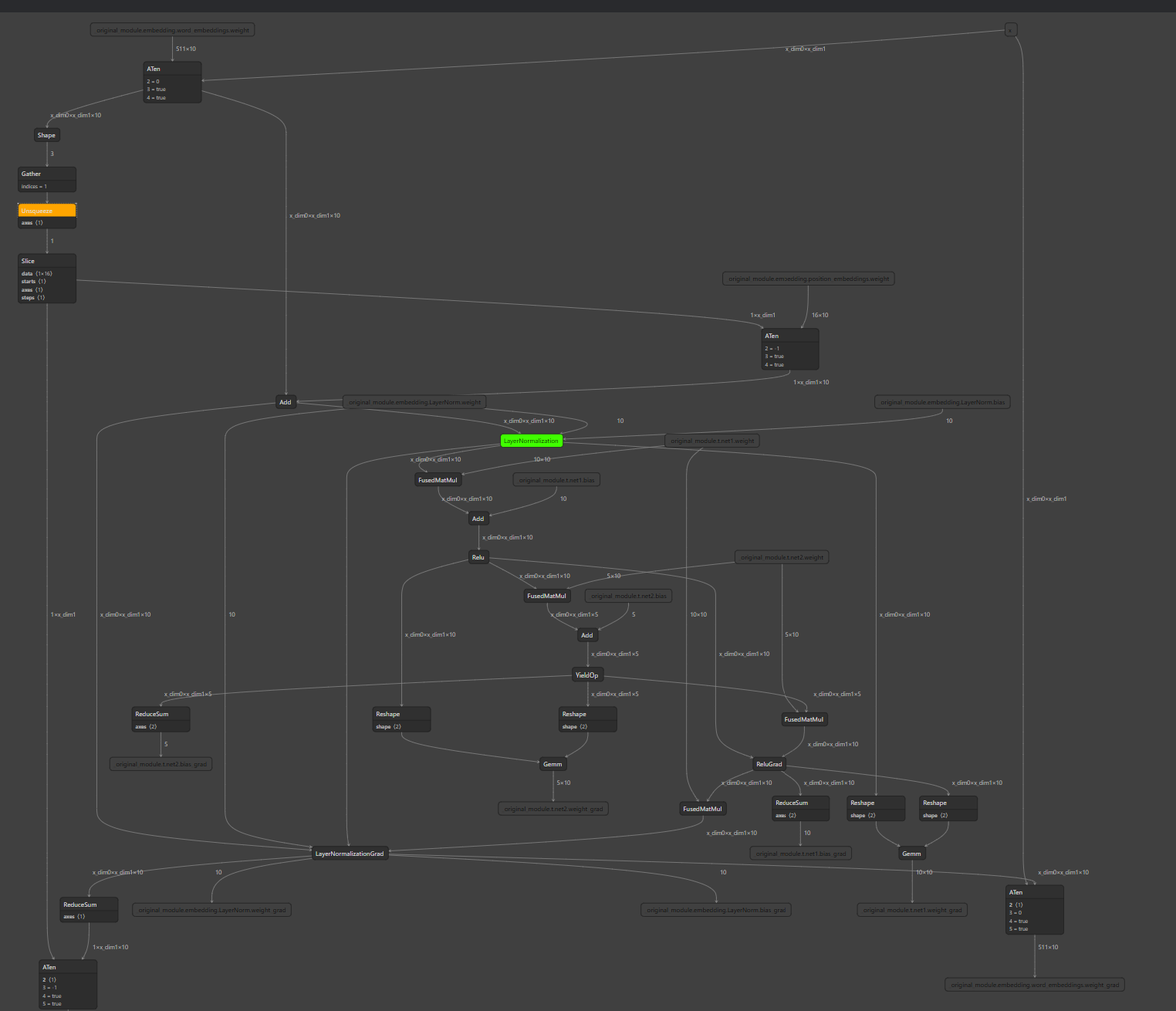
### Motivation and Context
<!-- - Why is this change required? What problem does it solve?
- If it fixes an open issue, please link to the issue here. -->
### Description
This PR creates Nuget and Android for Training.


### Motivation and Context
These packages are intended to be released in ORT 1.15 to enable
On-Device Training Scenarios.

## Packaging Story for Learning On The Edge Release
### Nuget Packages:
1. New Native package -> **Microsoft.ML.OnnxRuntime.Training** (Native
package will contain binaries for: win-x86, win-x64, win-arm, win-arm64,
linux-x64, linux-arm64, android)
2. C# bindings will be added to existing package ->
**Microsoft.ML.OnnxRuntime.Managed**

### Android Package published to Maven:
1. New package for training (full build) ->
**onnxruntime-training-android-full-aar**

### Python Package published to PyPi:
1. Python bindings and offline tooling will be added to the existing ort
training package -> **onnxruntime-training**
### Fold shape related operation at best efforts.
This is a follow up for PR
https://github.com/microsoft/onnxruntime/pull/12561.
Create a specialized shape_optimzer to constant fold shape related
operation.
ShapeOptimizer at the best efforts to constant fold the dim values that
exists from shape inferencing. This is helpful to simplify the graph,
which on the other hand, help other graph transformers to do more.
Transformer that traverses the graph top-down and performs shape
optimizations.
Try the best effort to constant fold the shape related to Shape node
outputs:
1. Shape generates 1D tensor [12, 128, 512] (all dimensions have
concrete dim value), which can be constant folded
to an initializer including 1D tensor values [12, 128, 512]. (Some logic
of ConstantFolding also does the same thing.)
2. Shape generate 1D tensor [batch_size, 128, 512] ->
Slice(start=1,end=3), we can constant fold the Shape->Slice to
an initializer including 1D tensor values [128, 512].
3. Shape generate 1D tensor [batch_size, 128, 512] -> Gather(axes=[0],
index=[2]), we can constant fold the
Shape->Gather to an initializer including 1D tensor values [512].
4. Shape 15 takes input of shape [batch_size, 128, 512], slicing from 1
to 2(exclusive), we can constant fold the
Shape15(start=1,end=2) to an initializer including 1D tensor values
[128].
This would help clean up the graph, combined with ConstantFolding, the
graph would be much more simplified.
### Motivation and Context
One direct motivation to have this is, we have a model subgraph like
this:
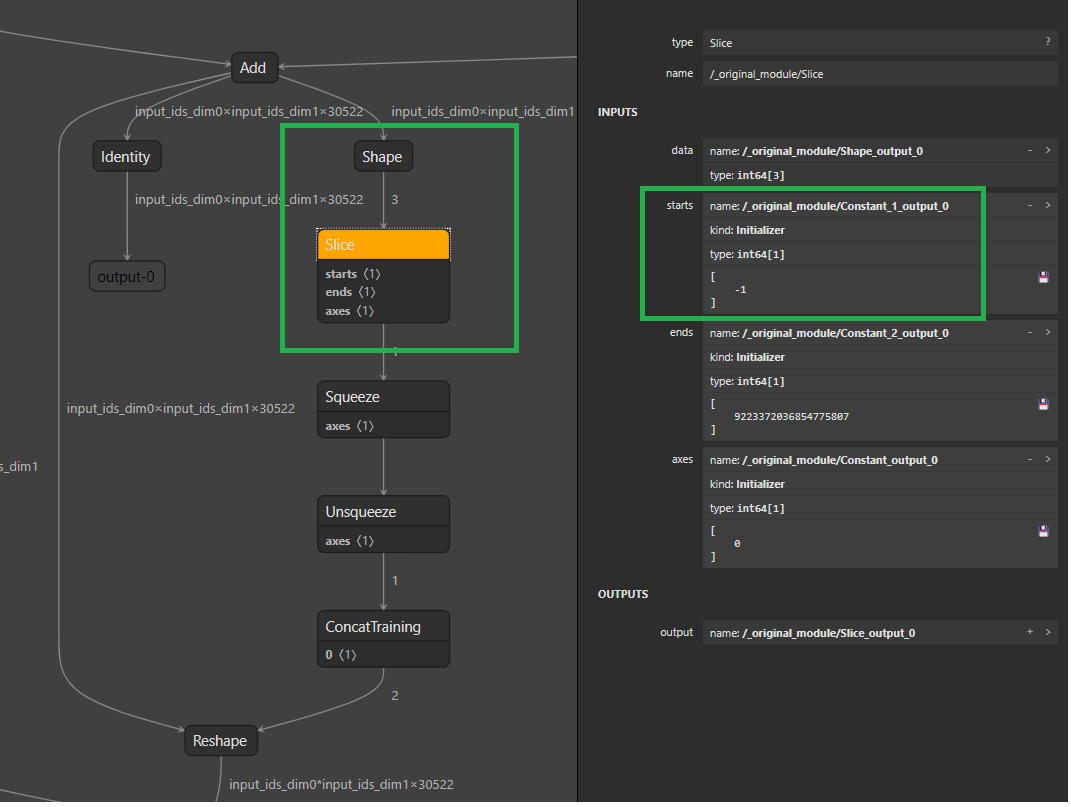
The subgraph in the green rectangle is trying to get the value `30522`,
with the changes in this PR, the subgraph will be constant folded. Plus
ConstantFolding optimizer will further to optimize out the subsquent
`Squeeze`/`Unsqueeze`/`ConcatTraining`, then we will have a clean very
clean Reshape node, with its shape input be an constant `[-1, 20522]`.
Having this simplified graph, our other compute optimizer can help
further optimize the graph by re-ordering gather/reshape nodes.
### Description
<!-- Describe your changes. -->

support the latest deepspeed 0.9.1 for the next release


### Motivation and Context
<!-- - Why is this change required? What problem does it solve?
- If it fixes an open issue, please link to the issue here. -->
This will avoid the warn message `Skip modifying optimizer because of
unsupported DeepSpeed version`

---------

Co-authored-by: ruiren <ruiren@microsoft.com>
### Description
<!-- Describe your changes. -->
### Error
```
RuntimeError: There was an error while exporting the PyTorch model to ONNX:-

Traceback (most recent call last):
  File "/opt/conda/envs/ptca/lib/python3.8/site-packages/onnxruntime/training/ortmodule/_utils.py", line 254, in get_exception_as_string
    raise exception
  File "/opt/conda/envs/ptca/lib/python3.8/site-packages/onnxruntime/training/ortmodule/_graph_execution_manager.py", line 385, in _get_exported_model
    torch.onnx.export(self._flattened_module,
  File "/opt/conda/envs/ptca/lib/python3.8/site-packages/torch/onnx/__init__.py", line 305, in export
    return utils.export(model, args, f, export_params, verbose, training,
  File "/opt/conda/envs/ptca/lib/python3.8/site-packages/torch/onnx/utils.py", line 118, in export
    _export(model, args, f, export_params, verbose, training, input_names, output_names,
  File "/opt/conda/envs/ptca/lib/python3.8/site-packages/torch/onnx/utils.py", line 743, in _export
    proto, export_map, val_use_external_data_format = graph._export_onnx(
RuntimeError: ONNX export failed: Couldn't export Python operator XDropout
```
The error leads to Out of Memory issue, because the log.txt file is **26
GB**.


### Motivation and Context
<!-- - Why is this change required? What problem does it solve?
- If it fixes an open issue, please link to the issue here. -->
The root cause is that in each `_forward`
```
      if log_level <= _logger.LogLevel.WARNING and not self._raised_ORTModuleONNXModelException:
          warnings.warn(
              (
                  f"Fallback to PyTorch due to exception {type(self._exception)} was triggered. "
                  "Report this issue with a minimal repro at https://www.github.com/microsoft/onnxruntime. "
                  f"See details below:\n\n{_utils.get_exception_as_string(self._exception)}"
              ),
              UserWarning,
          )
```


above code will be called and log the `exception` through
`get_exception_as_string`,

In my training case, this will lead to 40 k times of `Traceback` stdout
and 110 millions lines of `onnx graph` output and run into OOM.

### Validation

After above fixes, the log.txt file will only be **2.4 MB**.

---------

Co-authored-by: ruiren <ruiren@microsoft.com>
### Description
Removing compute optimizer from on device training builds.

### Motivation and Context
1. mitigate android build failures
2. reduce binary size

Since only CPU EP is enabled for LTE builds, we can optimize the models
offline.
### Description

Run clang-format in CI. Formatted all c/c++, objective-c/c++ files.

Excluded

```
    'onnxruntime/core/mlas/**',
    'onnxruntime/contrib_ops/cuda/bert/tensorrt_fused_multihead_attention/**',
```

because they contain assembly or is data heavy


### Motivation and Context

Coding style consistency
### Description

Bump ruff version in CI and fixed new lint errors.

- This change enables the flake8-implicit-str-concat rules which helps
detect unintended string concatenations:
https://beta.ruff.rs/docs/rules/#flake8-implicit-str-concat-isc
- Update gitignore to include common python files that we want to
exclude.


### Motivation and Context

Code quality




