Here's the motivating issue:
https://github.com/microsoft/azure-pipelines-tasks/issues/10331

Noticed some problems in other repos so also updating usages in ORT.

We may be fine now without it, but this change adds some safeguard against future additions of 'set -x' for debugging.
### Description
After this PR there are following pool need to be updated.

old|new|note
---|---|---
onnxruntime-Win2019-GPU-dml-A10|tbd|
onnxruntime-Win2019-GPU-T4|onnxruntime-Win2022-GPU-T4|
onnxruntime-Win2019-GPU-training-T4|onnxruntime-Win2022-GPU-T4|ame as
the above because we do not have many T4 GPUs
onnxruntime-tensorrt8-winbuild-T4|tbd|
aiinfra-dml-winbuild|tbd|
### Motivation and Context
<!-- - Why is this change required? What problem does it solve?
- If it fixes an open issue, please link to the issue here. -->
### Description
<!-- Describe your changes. -->


Old pool | New pool | Notes
-- | -- | --
onnxruntime-Win-CPU-2019 | onnxruntime-Win-CPU-2022 |
onnxruntime-Win2019-CPU-training | onnxruntime-Win2022-CPU-training-AMD
|
onnxruntime-Win2019-CPU-training-AMD |
onnxruntime-Win2022-CPU-training-AMD | Same as the above
onnxruntime-Win2019-GPU-dml-A10 | Need be created | You need to create a
new image for it first
onnxruntime-Win2019-GPU-T4 | onnxruntime-Win2022-GPU-T4 |
onnxruntime-Win2019-GPU-training-T4 | onnxruntime-Win2022-GPU-T4 | Same
as the above because we do not have many T4 GPUs
onnxruntime-tensorrt8-winbuild-T4| TBD|TBD
Win-CPU-2021|onnxruntime-Win-CPU-2022| will do it in next PR
Win-CPU-2019|onnxruntime-Win2022-Intel-CPU'| Intel CPU needed for
win-ci-pipeline.yml -> `stage: x64_release_dnnl`

<br class="Apple-interchange-newline">

### Motivation and Context
With vs2022 we can take the advantage of 64bit compiler. It also with
better c++20 support
### Description
Fix the bug in #15693


### Motivation and Context
<!-- - Why is this change required? What problem does it solve?
- If it fixes an open issue, please link to the issue here. -->
### Description
This PR creates Nuget and Android for Training.


### Motivation and Context
These packages are intended to be released in ORT 1.15 to enable
On-Device Training Scenarios.

## Packaging Story for Learning On The Edge Release
### Nuget Packages:
1. New Native package -> **Microsoft.ML.OnnxRuntime.Training** (Native
package will contain binaries for: win-x86, win-x64, win-arm, win-arm64,
linux-x64, linux-arm64, android)
2. C# bindings will be added to existing package ->
**Microsoft.ML.OnnxRuntime.Managed**

### Android Package published to Maven:
1. New package for training (full build) ->
**onnxruntime-training-android-full-aar**

### Python Package published to PyPi:
1. Python bindings and offline tooling will be added to the existing ort
training package -> **onnxruntime-training**
### Description
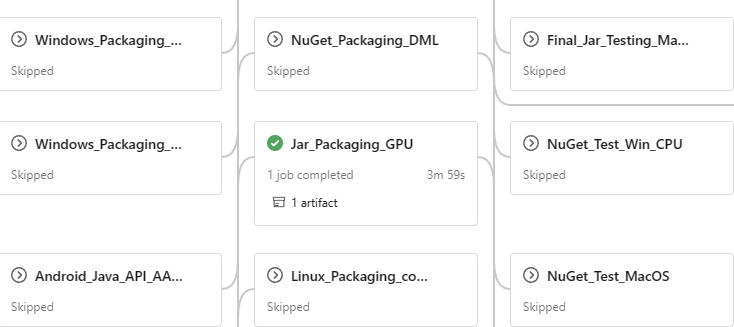
Add parameters to make some stages could use other run's intermediate
output.
### Motivation and Context
nuget workflow has 38 stages of 4 layers.
We had to run the whole workflow from begining to test one stage.
It could make life easier to run only one stage for testing.
like
### N.B.
In this PR, Nuget_Test_Linux_CPU, Nuget_Test_LinuxGPU and
Jar_Packaging_GPU are enabled as the first step.
So I can start to move tests from Linux host to container
### Description
Update cuda 11.6 to 11.8 for Windows pipelines
This PR is just for Windows CUDA pipelines. It does include any change
for Linux pipelines or TensorRT pipelines

### Motivation and Context
It is a planned feature for the upcoming ONNX Runtime release.
### Description

1. Disable XNNPack EP's tests in Windows CI pipeline
The EP code has a known problem(memory alignment), but the problem does
not impact the usages that we ship the code to. Now we only use XNNPack
EP in mobile apps and web usages. We have already pipelines to cover
these usages. We need to prioritize fixing the bugs found in these
pipelines, and there no resource to put on this Windows one. We can
re-enable the tests once we reached an agreement on how to fix the
memory alignment bug.

2.  Delete anybuild.yml which was for an already deleted pipeline.
3. Move Windows CPU pipelines to AMD CPU machine pools which are
cheaper.
4. Disable some qdq/int8 model tests that will fail if the CPU doesn't
have Intel AVX512 8-bit instructions.
WindowsAI build failing due to deprecated .NET5 SDK missing in build
image

.NET5 was deprecated last year, and recently the build machine images
have been updated to not include this SDK.
Unblock failing builds by force insalling .NET5 SDK as part of the build
pipeline.
### Description
windows update python3.11


### Motivation and Context
<!-- - Why is this change required? What problem does it solve?
- If it fixes an open issue, please link to the issue here. -->

---------

Co-authored-by: Ubuntu <chasun@chasunlinux.lw3b1xzoyrkuzm34swpscft0ff.dx.internal.cloudapp.net>
### Description
<!-- Describe your changes. -->
This fix macos packaging build on universal2 arch.


### Motivation and Context
<!-- - Why is this change required? What problem does it solve?
- If it fixes an open issue, please link to the issue here. -->
### Description
Fixes the DML release build for 1.14.1. This was initially fixed by
https://github.com/microsoft/onnxruntime/pull/13417 for 1.13.1, but the
changes didn't make their way back to the main branch.
## Description
1. Convert some git submodules to cmake external projects
2. Update nsync from
[1.23.0](https://github.com/google/nsync/releases/tag/1.23.0) to
[1.25.0](https://github.com/google/nsync/releases/tag/1.25.0)
3. Update re2 from 2021-06-01 to 2022-06-01
4. Update wil from an old commit to 1.0.220914.1 tag
5. Update gtest to a newer commit so that it can optionally leverage
absl/re2 for parsing command line flags.

The following git submodules are deleted:

1. FP16
2. safeint
3. XNNPACK
4. cxxopts
5. dlpack
7. flatbuffers
8. googlebenchmark
9. json
10. mimalloc
11. mp11
12. pthreadpool

More will come.

## Motivation and Context
There are 3 ways of integrating 3rd party C/C++ libraries into ONNX
Runtime:
1. Install them to a system location, then use cmake's find_package
module to locate them.
2.  Use git submodules
6.  Use cmake's external projects(externalproject_add).

At first when this project was just started, we considered both option 2
and option 3. We preferred option 2 because:

1. It's easier to handle authentication. At first this project was not
open source, and it had some other non-public dependencies. If we use
git submodule, ADO will handle authentication smoothly. Otherwise we
need to manually pass tokens around and be very careful on not exposing
them in build logs.
2. At that time, cmake fetched dependencies after "cmake" finished
generating vcprojects/makefiles. So it was very difficult to make cflags
consistent. Since cmake 3.11, it has a new command: FetchContent, which
fetches dependencies when it generates vcprojects/makefiles just before
add_subdirectories, so the parent project's variables/settings can be
easily passed to the child projects.

And when the project went on,  we had some new concerns:
1. As we started to have more and more EPs and build configs, the number
of submodules grew quickly. For more developers, most ORT submodules are
not relevant to them. They shouldn't need to download all of them.
2. It is impossible to let two different build configs use two different
versions of the same dependency. For example, right now we have protobuf
3.18.3 in the submodules. Then every EP must use the same version.
Whenever we have a need to upgrade protobuf, we need to coordinate
across the whole team and many external developers. I can't manage it
anymore.
3. Some projects want to manage the dependencies in a different way,
either because of their preference or because of compliance
requirements. For example, some Microsoft teams want to use vcpkg, but
we don't want to force every user of onnxruntime using vcpkg.
7. Someone wants to dynamically link to protobuf, but our build script
only does static link.
8. Hard to handle security vulnerabilities. For example, whenever
protobuf has a security patch, we have a lot of things to do. But if we
allowed people to build ORT with a different version of protobuf without
changing ORT"s source code, the customer who build ORT from source will
be able to act on such things in a quicker way. They will not need to
wait ORT having a patch release.
9. Every time we do a release, github will also publish a source file
zip file and a source file tarball for us. But they are not usable,
because they miss submodules.

### New features

After this change, users will be able to:
1. Build the dependencies in the way they want, then install them to
somewhere(for example, /usr or a temp folder).
2. Or download the dependencies by using cmake commands from these
dependencies official website
3. Similar to the above, but use your private mirrors to migrate supply
chain risks.
4. Use different versions of the dependencies, as long as our source
code is compatible with them. For example, you may use you can't use
protobuf 3.20.x as they need code changes in ONNX Runtime.
6.  Only download the things the current build needs.
10. Avoid building external dependencies again and again in every build.

### Breaking change
The onnxruntime_PREFER_SYSTEM_LIB build option is removed you could think from now
it is default ON. If you don't like the new behavior, you can set FETCHCONTENT_TRY_FIND_PACKAGE_MODE to NEVER.
Besides, for who relied on the onnxruntime_PREFER_SYSTEM_LIB build
option, please be aware that this PR will change find_package calls from
Module mode to Config mode. For example, in the past if you have
installed protobuf from apt-get from ubuntu 20.04's official repo,
find_package can find it and use it. But after this PR, it won't. This
is because that protobuf version provided by Ubuntu 20.04 is too old to
support the "config mode". It can be resolved by getting a newer version
of protobuf from somewhere.
Patch Protobuf and ONNX's cmake files and enforce BinSkim check.

This PR has overlap with #13523 . I would prefer to get this one merged
first so that we can finished the BinSkim work, and I try to make this
PR as small as possible.
1. add node test data to current model tests
2. support opset version to filter tests.
3. remove old filter based on onnx version. To avoid confusion, ONLY
support opset version filter in onnxruntime_test_all
4. support read onnx test data from absolute path on Windows.
1. Move the Linux ARM64 part of python packaging pipeline to a real ARM64 machine pool
2. Refactor the Linux CPU build jobs of python packaging pipeline to two parts: build and test. The test part will be exempted from Cyber EO compliance requirements as it won't affect the final bits we publish. This refactoring is to reduce dependencies in the build part. For example, this PR remove pytorch from the build dependencies.
3. Combine DML nuget packaging pipeline with "Zip-Nuget-Java-Nodejs Packaging Pipeline" as they all produce ORT nuget packages. Also, publish DML nuget packages and ORT GPU nuget packages to https://aiinfra.visualstudio.com/PublicPackages/_artifacts/feed/ORT-Nightly feed.
* Include onnxruntime binary when not using pacakge referene or uap app.

* Remove the lib\uap10.0 build from the nuget package - causing conflicts

* Add UWP test

* remove build files

* remove local change

* reset mimalloc and onnx-tensorrt

* change username to Microsoft

Co-authored-by: Sheil Kumar <sheilk@microsoft.com>
* Merge CPU/GPU nuget pipeline

* Include TensorRT EP libraries into existing GPU nuget package pipeline

* modify to use correct YAML

* Modify for test

* modify for test

* Add depedance

* Add depedance (cont.)

* modify for test

* Add create TensorRT nuget package

* modify for test

* modify for test

* Merge CPU/GPU nuget pipeline

* Include TensorRT EP libraries into existing GPU nuget package pipeline

* modify to use correct YAML

* Modify for test

* modify for test

* Add depedance

* Add depedance (cont.)

* modify for test

* Add create TensorRT nuget package

* modify for test

* fix merge bug

* code refactor

* code refactor

* modify for test

* modify for test

* modify for test

* modify for test

* modify for test

* modify for test

* cleanup

* modify for test

* fix bug

* modify for test

* refactor

* fix bug and test

* Modify for test

* Modify for test

* Modify for test

* Modify for test

* Prepare for PR

* Prepare for PR

* code refacotr from review

* Remove naming 'Microsoft.ML.OnnxRuntime.TensorRT' to avoid confusion

* Add linux TensorRT libraries

* Remove redundant variable in YMAL

* revert file

* undo revert file

* Modify regular expression so that it can capture the correct file

* Remove newline at end of file

* small fix

* Revert to CUDA11.1 on Windows

* Add unit tests for nuget package on Linux

Co-authored-by: Changming Sun <chasun@microsoft.com>
* initial update from 11.1 to 11.4

* change 11.4.1 to 11.4.0

* adjusting to match nvidia/cuda image tags

* adjusting to match nvidia/cuda image tags centos7

* correction to 11.4.0

* correction to 11.4.0

* update to cuda 11.4

* change training back to 11.1

* change training back to 11.1

* point to correct nvcr.io/nvidia/cuda 11.4.1 image

* change centos8 to centos7

* correct cudnn path

* Update linux-gpu-ci-pipeline.yml for Azure Pipelines

* Update c-api-noopenmp-packaging-pipelines.yml

* need to resolve centos images but remove space and change to 11.4

* Update linux-gpu-ci-pipeline.yml

* add cudnn to docker image

* bump devtoolset to 10

* revert cuda 11.4 change to setup_env_trt

* orttraining back to 11.1

* use nvcr.io

* Fix previous change back to cuda 11.1

* update cudnn path

* use cudnn image (revert if failure)
Merge CPU/GPU nuget pipeline. The old GPU nuget pipeline will be only for DML.

TODO: the result GPU package contains PDB files for some of the DLLs, but not all. It is due to the refactoring of CUDA EP to pluggable DLLs. At that time we forgot to copy the PDB files. However, I can't add them in now. Because currently the package is already 220MB large. If the missed PDB files were added, then it will be oversize. nuget.org doesn't accept >250MB packages.
1. Update SDLNativeRules from v2 to v3. The new one allows us setting excluded paths.
2. Update TSAUpload from v1 to v2. And add a config file ".gdn/.gdntsa" for it.
3. Fix some parentheses warnings
4. Update cmake to the latest.
5. Remove "--x86" build option from pipeline yaml files. Now we can auto-detect cpu architecture from python. So we don't need to ask user to specify it.
1. Remove some unused code and simplify tools/ci_build/github/linux/run_dockerbuild.sh.
2. Enable Nuget CUDA tests. The original design was we could leverage Directory.Build.props and let cmake generate the required properties(USE_CUDA/...) there. However, in nuget packaging pipeline we test the package on a different host that doesn't run cmake command and doesn't have the auto-generated Directory.Build.props file.
1. Update manylinux build scripts. This will add [PEP600](https://www.python.org/dev/peps/pep-0600/)(manylinux2 tags) support. numpy has adopted this new feature, we should do the same. The old build script files were copied from https://github.com/pypa/manylinux, but they has been deleted and replaced in the upstream repo. The manylinux repo doesn't have a manylinux2014 branch anymore. So I'm removing the obsolete code, sync the files with the latest master.
2. Update GPU CUDA version from 11.0 to 11.1(after a discussion with PMs).
3. Delete tools/ci_build/github/linux/docker/Dockerfile.manylinux2014_cuda10_2.  (Merged the content to tools/ci_build/github/linux/docker/Dockerfile.manylinux2014_cuda11)
4. Modernize the cmake code of how to locate python devel files. It was suggested in https://github.com/onnx/onnx/pull/1631 .
5. Remove `onnxruntime_MSVC_STATIC_RUNTIME` and `onnxruntime_GCC_STATIC_CPP_RUNTIME` build options. Now cmake has builtin support for it. Starting from cmake 3.15, we can use `CMAKE_MSVC_RUNTIME_LIBRARY` cmake variable to choose which MSVC runtime library we want to use.
6. Update Ubuntu docker images that used in our CI build from Ubuntu 18.04 to Ubuntu 20.04.
7. Update GCC version in CUDA 11.1 pipelines from 8.x to 9.3.1
8. Split Linux GPU CI pipeline to two jobs: build the code on a CPU machine then run the tests on another GPU machines.  In the past we didn't test our python packages. We only tested the pre-packed files. So we didn't catch the rpath issue in CI build.
9. Add a CentOS machine pool and test our Linux GPU build on real CentOS machines.
10. Rework ARM64 Linux GPU python packaging pipeline. Previously it uses cross-compiling therefore we must static link to C Runtime. But now have pluggable EP API and it doesn't support static link. So I changed to use qemu emulation instead. Now the build is 10x slower than before. But it is more extensible.
1. Remove openmp related packaging pipelines and build jobs.
2. Set continueOnError to true for the TSAUpload tasks. Their service is unstable recently.
3. Update Ubuntu 16 docker images to Ubuntu 18, in prepare for getting C++17 support
4. Cherry-pick the changes in 1.7.1 to the master: updating CFLAGS/CXXFLAGS to strip out debug symbols
* Change msbuild condition for UAP

* update .netcore target as well

* create nuget packages with _native path

* validate path under _native directory for windowsai package

* pep8

* add diagnostic error message

* pep8

* use baseame

* lib\uap10.0

* uap10

* build\\uap10.0

* Manually binplace winmds into appx when PackageReference is used.

* always binplace winmd regardless of packagereference since c# should work with packages.config also

* resolve all paths to full paths to avoid some reference warnings

* move winmds out of lib folder to prevent automatic component registration

Co-authored-by: Sheil Kumar <sheilk@microsoft.com>

