
6.2 KiB
Keys
This is the manager for the root keys. It also attempts to manage all the secure elements that could modify or access the root keys through indirect channels.
Background
An alternate approach that was considered, but not adopted, was to break update capabilities out of the keys block into their own
separate servers. The argument for this approach was to reduce the complexity within the keys block to make it easier to analyze.
The downside is that it introduces more inter-process communications of sensitive data. In particular, any process that can access the gateware (that is, the FPGA bitstream) effectively has access to the keys, as they are encoded within the bitstream for the FPGA. Thus while this would essentially reduce the complexity of the keys server, it greatly expands the attack surface.
In the end, we are starting with an approach where all of the OS-sensitive boot memory is mapped into the keys process space. Mapping them into the keys process space inherently denies any other server the ability to access them, but it also makes keys responsible for doing things like checking & generating signatures, and re-encrypting bitstreams. It also means that keys grows a minimal amount of UX code, that is, the code necessary to collect passwords.
UX
It was decided that the password UX code for keys is going to be a minimalist modal dialogue box, and the number of passwords will be limited to two: one for unlocking a set of keys related to user data, and one for unlocking a set of keys related to OS updates.
Rationale:
- We do not want to overwhelm users with too many passwords
- Gateware/OS updates are security-critical. A compromised FPGA image destroys all trust. Its passphrase should be strong, but entered infrequently.
- User data needs to be unlocked at every boot. Compromising the user unlock password in itself doesn't lead to an immediate compromise of downstream secrets, thanks to the layered-password model of the PDDB basis keys. Thus, users with moderate-to-light risk profiles could be better served with a simple PIN code to unlock the user data after a boot.
- Downstream passwords should exist outside of
keys.keysshould be considered just a root that manages more ephemeral keys that are stored in FLASH. - The UX function is closely bonded into the
keysserver so as to minimize the amount of code that touches sensitive user password data.
Context
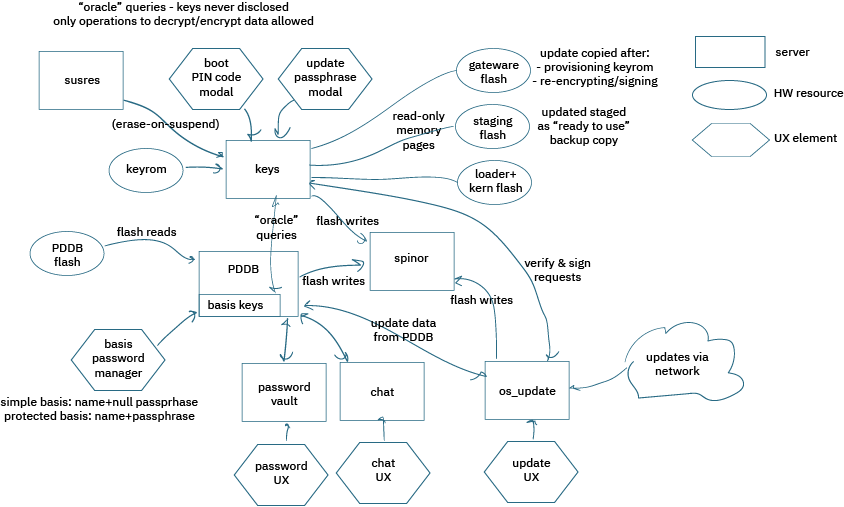
Above is a notional diagram that illustrates the relationship between the various servers involved in cryptographic matters.
This server, keys, has the following responsibilities:
- Maps the KEYROM hardware block, preventing other processes from reading it
- Responds to "oracle" style queries, which never disclose a key from the KEYROM; it can:
- encrypt requested data
- decrypt requested data
- sign a data block
- It communicates with the TRNG to provision and create keys if the KEYROM is initially blank
- It communicates with
xous_namesto confirm that the system has fully booted and that all servers with limited connection slots have their connections filled prior to allowing any sensitive operations. - Manages the state of the two unlock passwords for the KEYROM
- Boot PIN code: secures the root application keys
- Update passphrase: secures updates
- The passwords are prompted automatically by
keysas a result of third-party API calls requesting services ofkeysthat would require their entry. - Passwords are hashed with
bcryptprior to use. In line with OWASP reccommendations, we opt to use the older, battle-testedbcryptalgorithm because the limited memory of Precursor does not allow us to use other algorithms with parameters that impart substial security advantages. - The passwords are entered via simple pop-up modal dialog boxes that plug directly into the
keysmemory space
- Listens to the susres server to enforce password retirement policies
- Plaintext copies of the password are mapped into a deliberate page of memory that is zero-ized on
Drop,suspend, or other system states depending upon user policy.
- Plaintext copies of the password are mapped into a deliberate page of memory that is zero-ized on
- Maps the regions of ROM that contain the gateware (SoC bitstream), loader (except font planes), and kernel. This effectively keeps other processes from reading these spaces.
- Note that the font planes, which are part of the loader, are mapped into the
gfx-servermemory space for computational efficiency reasons. - This does make verifying the loader a bit more complicated as it requires assistance and trust of the
gfx-server, and it means that an attacker could potentially spoof the font map.
- Note that the font planes, which are part of the loader, are mapped into the
- Claims the "SoC" token on the
spinorserver, which gives it exclusive access to write to the sensitive gateware area.- Note that the
keyscan allow access for third-party process to write to thestagingarea, so that another program can handle acquiring the update data (but it can also revoke access once the image has been submitted for verification). - Also, any process can write the kernel and loader area, but this is "okay" because the digital signature check should hamper attempts to patch and modify these regions without authorization.
- Note that the
- Prepares gateware that is staged for updating
- Injects a copy of the
KEYROMinto the staged bitstream - Re-encrypts the gateware to the local eFuse or BBRAM key, if any
- Adds digital signatures to the blocks if self-signing is enabled
- Validates the staged gateware for integrity (decrypt & HMAC check)
- Copies the prepared gateware to the "live" location, once validated
- Injects a copy of the
- Generates & writes self-signing loader and xous signatures
Shortcomings:
- Anyone can attempt to initiate an update by calling the library API on
keys. However, the update can not proceed without user consent via password. - Fonts are mapped into the
gfx-servermemory space, which complicates loader.bin verification and validation. It also creates a potential for exploits that swap out fonts to create false messagse to users. - There's a lot of complexity in this server, which makes it harder to analyze; see "Background" section above, for a discussion of the trade-offs that lead to this decision.