
51 KiB
16-bit table chip for SHA-256
This chip implementation is based around a single 16-bit lookup table. It requires a
minimum of 2^{16} circuit rows, and is therefore suitable for use in larger circuits.
We target a maximum constraint degree of 9. That will allow us to handle constraining
carries and "small pieces" to a range of up to \{0..7\} in one row.
Compression round
\begin{array}{rcl}
Ch(E, F, G) &=& (E \wedge F) \oplus (¬E \wedge G) \
Maj(A, B, C) &=& (A \wedge B) \oplus (A \wedge C) \oplus (B \wedge C) \
&=& count(A, B, C) \geq 2 \
\Sigma_0(A) &=& (A ⋙ 2) \oplus (A ⋙ 13) \oplus (A ⋙ 22) \
\Sigma_1(E) &=& (E ⋙ 6) \oplus (E ⋙ 11) \oplus (E ⋙ 25) \
H' &=& H + Ch(E, F, G) + \Sigma_1(E) + K_t + W_t \
E_{new} &=& reduce_6(H' + D) \
A_{new} &=& reduce_7(H' + Maj(A, B, C) + \Sigma_0(A))
\end{array}
where reduce_i must handle a carry in \{0, \ldots, i-1\}.
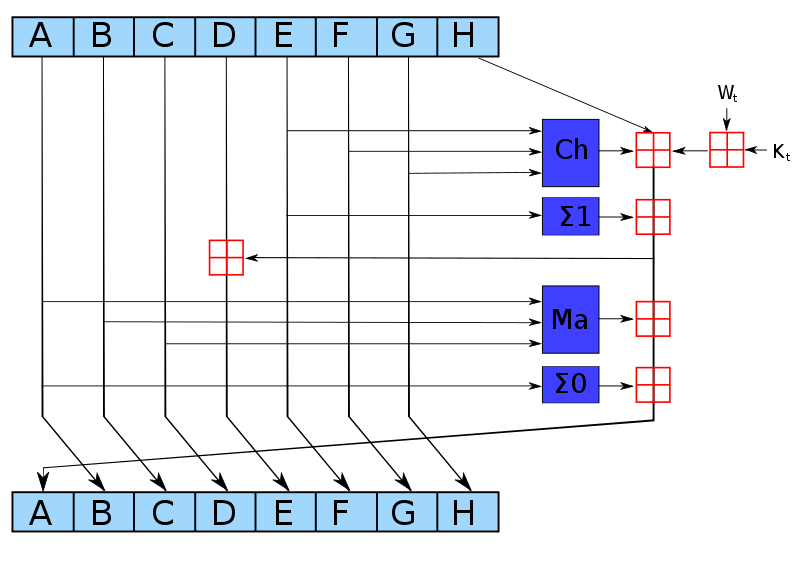
There are 64 compression rounds. A, B, C, D, E, F, G, H are 32 bits each. Note that
we will rely on having each of these words in both "dense" and "spread" forms; this is
explained below.
(a_L, a_H) \boxplus (b_L, b_H) = (c_L, c_H), where
\hspace{3em}\_ \cdot 2^{32} + (c_H : \mathbb{Z}_{2^{16}}) \cdot 2^{16} + (c_L : \mathbb{Z}_{2^{16}}) = (a_H + b_H) \cdot 2^{16} + a_L + b_L
Note that this correctly handles the carry from a_L + b_L.
More generally any bit-decomposition of the output can be used, not just a decomposition into $16$-bit chunks.
Define \mathtt{spread} as a table mapping a $16$-bit input to an output interleaved with
zero bits. We do not require a separate table for range checks because \mathtt{spread}
can be used.
In fact, this way we additionally get the "spread" form of the output for free; in
particular this is true for the output of the bottom-right \boxplus which becomes
A_{new}, and the output of the leftmost \boxplus which becomes E_{new}. We will use
this below to optimize Maj and Ch.
Maj function
Maj can be done in 4 lookups: 2\; \mathtt{spread} * 2 chunks
- As mentioned above, after the first round we already have
Ain spread formA'. Similarly,BandCare equal to theAandBrespectively of the previous round, and therefore in the steady state we already have them in spread formB'andC'. In fact we can also assume we have them in spread form in the first round, either from the fixed IV or from the use of\mathtt{spread}to reduce the output of the feedforward in the previous block. - Add the spread forms in the field:
M' = A' + B' + C';- We can add them as $32$-bit words or in pieces; it's equivalent
- Witness the compressed even bits
M^{even}_iand the compressed odd bitsM^{odd}_ifori = \{0..1\}; - Constrain
M' = \mathtt{spread}(M^{even}_0) + 2 \cdot \mathtt{spread}(M^{odd}_0) + 2^{32} \cdot \mathtt{spread}(M^{even}_1) + 2^{33} \cdot \mathtt{spread}(M^{odd}_1), whereM^{odd}_iis theMajfunction output.
Note: by "even" bits we mean the bits of weight an even-power of
2, i.e. of weight2^0, 2^2, \ldots. Similarly by "odd" bits we mean the bits of weight an odd-power of2.
Ch function
TODO: can probably be optimised to
4or5lookups using an additional table.
Ch can be done in 8 lookups: 4\; \mathtt{spread} * 2 chunks
- As mentioned above, after the first round we already have
Ein spread formE'. Similarly,FandGare equal to theEandFrespectively of the previous round, and therefore in the steady state we already have them in spread formF'andG'. In fact we can also assume we have them in spread form in the first round, either from the fixed IV or from the use of\mathtt{spread}to reduce the output of the feedforward in the previous block. - Calculate
P' = E' + F'andQ' = (evens - E') + G', whereevens = \mathtt{spread}(2^{32} - 1).- We can add them as $32$-bit words or in pieces; it's equivalent.
evens - E'works to compute the spread of¬Eeven though negation and\mathtt{spread}do not commute in general. It works because each spread bit inE'is subtracted from1, so there are no borrows.
- Witness
P^{even}_i, P^{odd}_i, Q^{even}_i, Q^{odd}_isuch thatP' = \mathtt{spread}(P^{even}_0) + 2 \cdot \mathtt{spread}(P^{odd}_0) + 2^{32} \cdot \mathtt{spread}(P^{even}_1) + 2^{33} \cdot \mathtt{spread}(P^{odd}_1), and similarly forQ'. \{P^{odd}_i + Q^{odd}_i\}_{i=0..1}is theChfunction output.
Σ_0 function
\Sigma_0(A) can be done in 6 lookups.
To achieve this we first split A into pieces (a, b, c, d), of lengths (2, 11, 9, 10)
bits respectively counting from the little end. At the same time we obtain the spread
forms of these pieces. This can all be done in two PLONK rows, because the 10 and
$11$-bit pieces can be handled using \mathtt{spread} lookups, and the $9$-bit piece can
be split into $3 * 3$-bit subpieces. The latter and the remaining $2$-bit piece can be
range-checked by polynomial constraints in parallel with the two lookups, two small pieces
in each row. The spread forms of these small pieces are found by interpolation.
Note that the splitting into pieces can be combined with the reduction of A_{new}, i.e.
no extra lookups are needed for the latter. In the last round we reduce A_{new} after
adding the feedforward (requiring a carry of \{0, \ldots, 7\} which is fine).
(A ⋙ 2) \oplus (A ⋙ 13) \oplus (A ⋙ 22) is equivalent to
(A ⋙ 2) \oplus (A ⋙ 13) \oplus (A ⋘ 10):
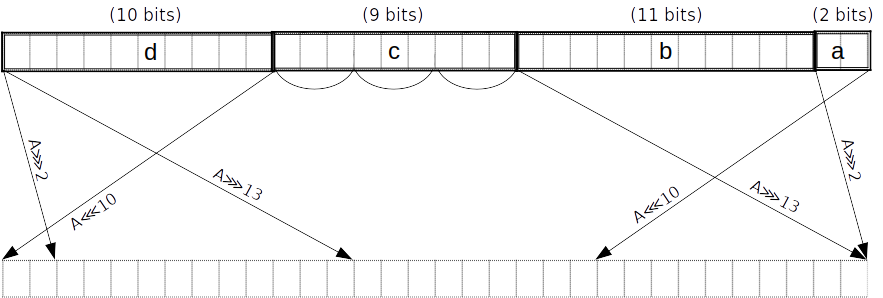
Then, using 4 more \mathtt{spread} lookups we obtain the result as the even bits of a
linear combination of the pieces:
\begin{array}{rcccccccl}
& (a &||& d &||& c &||& b) & \oplus \
& (b &||& a &||& d &||& c) & \oplus \
& (c &||& b &||& a &||& d) & \
&&&&\Downarrow \
R' = & 4^{30} a &+& 4^{20} d &+& 4^{11} c &+& b;&+ \
& 4^{21} b &+& 4^{19} a &+& 4^{ 9} d &+& c;&+ \
& 4^{23} c &+& 4^{12} b &+& 4^{10} a &+& d;&
\end{array}
That is, we witness the compressed even bits R^{even}_i and the compressed odd bits
R^{odd}_i, and constrain
R' = \mathtt{spread}(R^{even}_0) + 2 \cdot \mathtt{spread}(R^{odd}_0) + 2^{32} \cdot \mathtt{spread}(R^{even}_1) + 2^{33} \cdot \mathtt{spread}(R^{odd}_1)where \{R^{even}_i\}_{i=0..1} is the \Sigma_0 function output.
Σ_1 function
\Sigma_1(E) can be done in 6 lookups.
To achieve this we first split E into pieces (a, b, c, d), of lengths (6, 5, 14, 7)
bits respectively counting from the little end. At the same time we obtain the spread
forms of these pieces. This can all be done in two PLONK rows, because the 7 and
$14$-bit pieces can be handled using \mathtt{spread} lookups, the $5$-bit piece can be
split into 3 and $2$-bit subpieces, and the $6$-bit piece can be split into $2 * 3$-bit
subpieces. The four small pieces can be range-checked by polynomial constraints in
parallel with the two lookups, two small pieces in each row. The spread forms of these
small pieces are found by interpolation.
Note that the splitting into pieces can be combined with the reduction of E_{new}, i.e.
no extra lookups are needed for the latter. In the last round we reduce E_{new} after
adding the feedforward (requiring a carry of \{0, \ldots, 6\} which is fine).
(E ⋙ 6) \oplus (E ⋙ 11) \oplus (E ⋙ 25) is equivalent to
(E ⋙ 6) \oplus (E ⋙ 11) \oplus (E ⋘ 7).
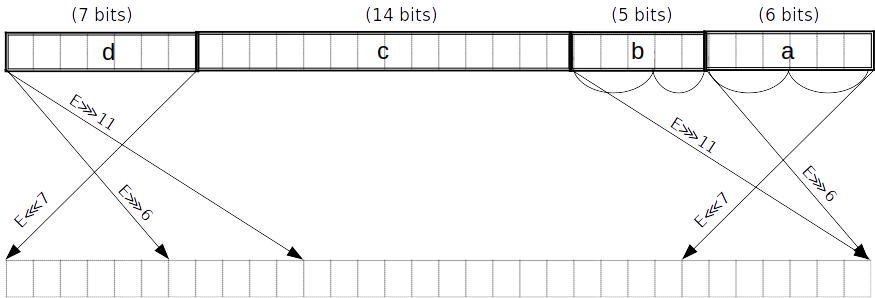
Then, using 4 more \mathtt{spread} lookups we obtain the result as the even bits of a
linear combination of the pieces, in the same way we did for \Sigma_0:
\begin{array}{rcccccccl}
& (a &||& d &||& c &||& b) & \oplus \
& (b &||& a &||& d &||& c) & \oplus \
& (c &||& b &||& a &||& d) & \
&&&&\Downarrow \
R' = & 4^{26} a &+& 4^{19} d &+& 4^{ 5} c &+& b;&+ \
& 4^{27} b &+& 4^{21} a &+& 4^{14} d &+& c;&+ \
& 4^{18} c &+& 4^{13} b &+& 4^{ 7} a &+& d;&
\end{array}
That is, we witness the compressed even bits R^{even}_i and the compressed odd bits
R^{odd}_i, and constrain
R' = \mathtt{spread}(R^{even}_0) + 2 \cdot \mathtt{spread}(R^{odd}_0) + 2^{32} \cdot \mathtt{spread}(R^{even}_1) + 2^{33} \cdot \mathtt{spread}(R^{odd}_1)where \{R^{even}_i\}_{i=0..1} is the \Sigma_1 function output.
Block decomposition
For each block M \in \{0,1\}^{512} of the padded message, 64 words of 32 bits each
are constructed as follows:
- The first
16are obtained by splittingMinto $32$-bit blocksM = W_0 || W_1 || \cdots || W_{14} || W_{15}; - The remaining
48words are constructed using the formula:W_i = \sigma_1(W_{i-2}) \boxplus W_{i-7} \boxplus \sigma_0(W_{i-15}) \boxplus W_{i-16},fori = 17, \ldots, 64.
Note: $0$-based numbering is used for the
Wword indices.
\begin{array}{ccc}
\sigma_0(X) &=& (X ⋙ 7) \oplus (X ⋙ 18) \oplus (X ≫ 3) \
\sigma_1(X) &=& (X ⋙ 17) \oplus (X ⋙ 19) \oplus (X ≫ 10) \
\end{array}
Note:
≫is a right-shift, not a rotation.
σ_0 function
(X ⋙ 7) \oplus (X ⋙ 18) \oplus (X ≫ 3) is equivalent to
(X ⋙ 7) \oplus (X ⋘ 14) \oplus (X ≫ 3).
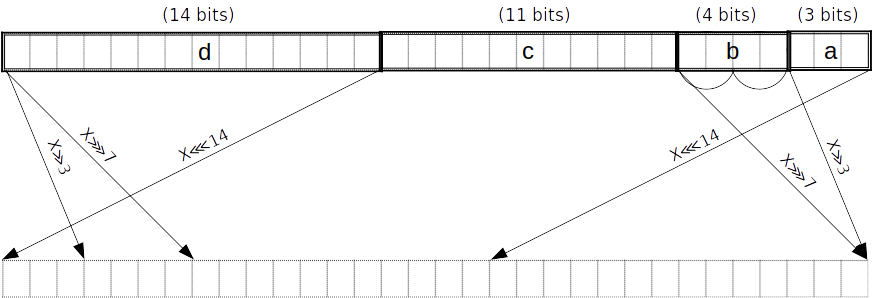
As above but with pieces (a, b, c, d) of lengths (3, 4, 11, 14) counting from the
little end. Split b into two $2$-bit subpieces.
\begin{array}{rcccccccl}
& (0^{[3]} &||& d &||& c &||& b) & \oplus \
& (;;;b &||& a &||& d &||& c) & \oplus \
& (;;;c &||& b &||& a &||& d) & \
&&&&\Downarrow \
R' = & & & 4^{15} d &+& 4^{ 4} c &+& b;&+ \
& 4^{28} b &+& 4^{25} a &+& 4^{11} d &+& c;&+ \
& 4^{21} c &+& 4^{17} b &+& 4^{14} a &+& d;&
\end{array}
σ_1 function
(X ⋙ 17) \oplus (X ⋙ 19) \oplus (X ≫ 10) is equivalent to
(X ⋘ 15) \oplus (X ⋘ 13) \oplus (X ≫ 10).
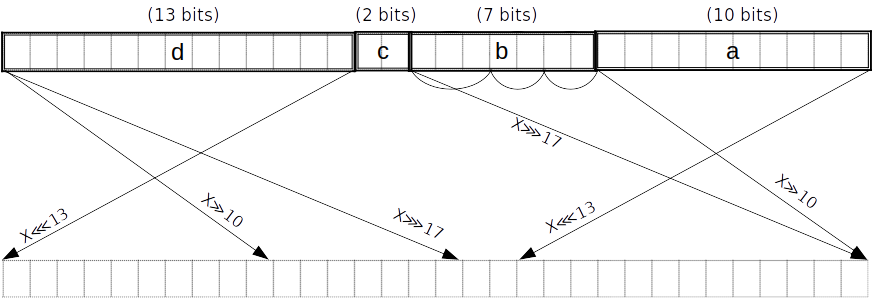
TODO: this diagram doesn't match the expression on the right. This is just for consistency with the other diagrams.
As above but with pieces (a, b, c, d) of lengths (10, 7, 2, 13) counting from the
little end. Split b into $(3, 2, 2)$-bit subpieces.
\begin{array}{rcccccccl}
& (0^{[10]}&||& d &||& c &||& b) & \oplus \
& (;;;b &||& a &||& d &||& c) & \oplus \
& (;;;c &||& b &||& a &||& d) & \
&&&&\Downarrow \
R' = & & & 4^{ 9} d &+& 4^{ 7} c &+& b;&+ \
& 4^{25} b &+& 4^{15} a &+& 4^{ 2} d &+& c;&+ \
& 4^{30} c &+& 4^{23} b &+& 4^{13} a &+& d;&
\end{array}
Message scheduling
We apply \sigma_0 to W_{1..48}, and \sigma_1 to W_{14..61}. In order to avoid
redundant applications of \mathtt{spread}, we can merge the splitting into pieces for
\sigma_0 and \sigma_1 in the case of W_{14..48}. Merging the piece lengths
(3, 4, 11, 14) and (10, 7, 2, 13) gives pieces of lengths (3, 4, 3, 7, 1, 1, 13).
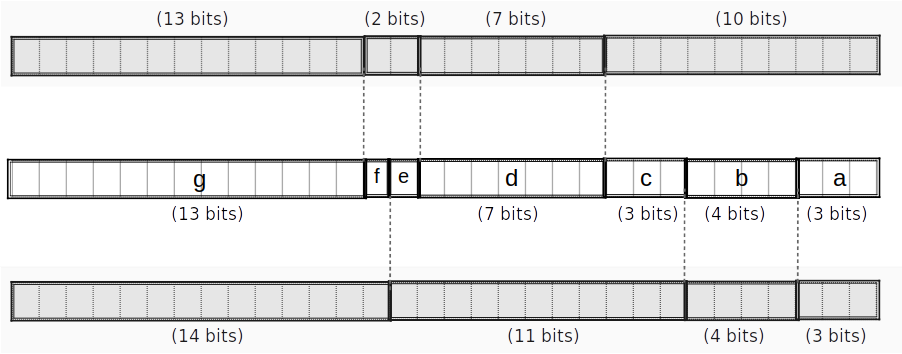
If we can do the merged split in 3 rows (as opposed to a total of 4 rows when
splitting for \sigma_0 and \sigma_1 separately), we save 35 rows.
These might even be doable in
2rows; not sure. [name=Daira]
We can merge the reduction mod 2^{32} of W_{16..61} into their splitting when they are
used to compute subsequent words, similarly to what we did for A and E in the round
function.
We will still need to reduce W_{62..63} since they are not split. (Technically we could
leave them unreduced since they will be reduced later when they are used to compute
A_{new} and E_{new} -- but that would require handling a carry of up to 10 rather
than 6, so it's not worth the complexity.)
The resulting message schedule cost is:
2rows to constrainW_0to32bits- This is technically optional, but let's do it for robustness, since the rest of the input is constrained for free.
13*2rows to splitW_{1..13}into $(3, 4, 11, 14)$-bit pieces35*3rows to splitW_{14..48}into $(3, 4, 3, 7, 1, 1, 13)$-bit pieces (merged with a reduction forW_{16..48})13*2rows to splitW_{49..61}into $(10, 7, 2, 13)$-bit pieces (merged with a reduction)4*48rows to extract the results of\sigma_0forW_{1..48}4*48rows to extract the results of\sigma_1forW_{14..61}2*2rows to reduceW_{62..63}= 547rows.
Overall cost
For each round:
8rows forCh4rows forMaj6rows for\Sigma_06rows for\Sigma_1reduce_6andreduce_7are always free= 24per round
This gives 24*64 = 1792 rows for all of "step 3", to which we need to add:
547rows for message scheduling2*8rows for8reductions mod2^{32}in "step 4"
giving a total of 2099 rows.
Tables
We only require one table \mathtt{spread}, with 2^{16} rows and 3 columns. We need a
tag column to allow selecting $(7, 10, 11, 13, 14)$-bit subsets of the table for
\Sigma_{0..1} and \sigma_{0..1}.
spread table
| row | tag | table (16b) | spread (32b) |
|---|---|---|---|
0 |
0 | 0000000000000000 | 00000000000000000000000000000000 |
1 |
0 | 0000000000000001 | 00000000000000000000000000000001 |
2 |
0 | 0000000000000010 | 00000000000000000000000000000100 |
3 |
0 | 0000000000000011 | 00000000000000000000000000000101 |
| ... | 0 | ... | ... |
2^{7} - 1 |
0 | 0000000001111111 | 00000000000000000001010101010101 |
2^{7} |
1 | 0000000010000000 | 00000000000000000100000000000000 |
| ... | 1 | ... | ... |
2^{10} - 1 |
1 | 0000001111111111 | 00000000000001010101010101010101 |
| ... | 2 | ... | ... |
2^{11} - 1 |
2 | 0000011111111111 | 00000000010101010101010101010101 |
| ... | 3 | ... | ... |
2^{13} - 1 |
3 | 0001111111111111 | 00000001010101010101010101010101 |
| ... | 4 | ... | ... |
2^{14} - 1 |
4 | 0011111111111111 | 00000101010101010101010101010101 |
| ... | 5 | ... | ... |
2^{16} - 1 |
5 | 1111111111111111 | 01010101010101010101010101010101 |
For example, to do an $11$-bit \mathtt{spread} lookup, we polynomial-constrain the tag
to be in \{0, 1, 2\}. For the most common case of a $16$-bit lookup, we don't need to
constrain the tag. Note that we can fill any unused rows beyond 2^{16} with a duplicate
entry, e.g. all-zeroes.
Gates
Choice gate
Input from previous operations:
E', F', G',64-bit spread forms of 32-bit wordsE, F, G, assumed to be constrained by previous operations- in practice, we'll have the spread forms of
E', F', G'after they've been decomposed into 16-bit subpieces
- in practice, we'll have the spread forms of
evensis defined as\mathtt{spread}(2^{32} - 1)evens_0 = evens_1 = \mathtt{spread}(2^{16} - 1)
| sn | sc | a_0 |
a_1 |
a_2 |
a_3 |
a_4 |
|---|---|---|---|---|---|---|
| 0 | 0 | {0,1,2,3,4,5} | P_0^{even} |
\texttt{spread}(P_0^{even}) |
\mathtt{spread}(E^{lo}) |
\mathtt{spread}(E^{hi}) |
| 0 | 1 | {0,1,2,3,4,5} | P_0^{odd} |
\texttt{spread}(P_0^{odd}) |
\texttt{spread}(P_1^{odd}) |
|
| 0 | 0 | {0,1,2,3,4,5} | P_1^{even} |
\texttt{spread}(P_1^{even}) |
\mathtt{spread}(F^{lo}) |
\mathtt{spread}(F^{hi}) |
| 0 | 0 | {0,1,2,3,4,5} | P_1^{odd} |
\texttt{spread}(P_1^{odd}) |
evens_0 |
evens_1 |
| 1 | 0 | {0,1,2,3,4,5} | Q_0^{even} |
\texttt{spread}(Q_0^{even}) |
\mathtt{spread}(E^{lo}) |
\mathtt{spread}(E^{hi}) |
| 0 | 0 | {0,1,2,3,4,5} | Q_0^{odd} |
\texttt{spread}(Q_0^{odd}) |
evens_0 - \mathtt{spread}(E^{lo}) |
evens_1 - \mathtt{spread}(E^{hi}) |
| 0 | 1 | {0,1,2,3,4,5} | Q_1^{even} |
\texttt{spread}(Q_1^{even}) |
\texttt{spread}(Q_1^{odd}) |
|
| 0 | 0 | {0,1,2,3,4,5} | Q_1^{odd} |
\texttt{spread}(Q_1^{odd}) |
\mathtt{spread}(G^{lo}) |
\mathtt{spread}(G^{hi}) |
Constraints:
sc(choice):LHS - RHS = 0LHS = a_3 \omega^{-1} + a_3 \omega + 2^{32}(a_4 \omega^{-1} + a_4 \omega)RHS = a_2 \omega^{-1} + 2* a_2 + 2^{32}(a_2 \omega + 2* a_3)
sn(negation):a_3\omega^{-1} - a_3 - a_3\omega = 0a_4\omega^{-1} - a_4 - a_4\omega = 0
\mathtt{spread}lookup on(a_0, a_1, a_2)- permutation between
(a_2, a_3)
Output: Ch(E, F, G) = P^{odd} + Q^{odd} = (P_0^{odd} + Q_0^{odd}) + 2^{16} (P_1^{odd} + Q_1^{odd})
Majority gate
Input from previous operations:
A', B', C',64-bit spread forms of 32-bit wordsA, B, C, assumed to be constrained by previous operations- in practice, we'll have the spread forms of
A', B', C'after they've been decomposed into $16$-bit subpieces
- in practice, we'll have the spread forms of
| sm | a_0 |
a_1 |
a_2 |
a_3 |
a_4 |
a_5 |
|---|---|---|---|---|---|---|
| 0 | {0,1,2,3,4,5} | M_0^{even} |
\texttt{spread}(M_0^{even}) |
\mathtt{spread}(A^{lo}) |
\mathtt{spread}(A^{hi}) |
|
| 1 | {0,1,2,3,4,5} | M_0^{odd} |
\texttt{spread}(M_0^{odd}) |
\texttt{spread}(M_1^{odd}) |
\mathtt{spread}(B^{lo}) |
\mathtt{spread}(B^{hi}) |
| 0 | {0,1,2,3,4,5} | M_1^{even} |
\texttt{spread}(M_1^{even}) |
\mathtt{spread}(C^{lo}) |
\mathtt{spread}(C^{hi}) |
|
| 0 | {0,1,2,3,4,5} | M_1^{odd} |
\texttt{spread}(M_1^{odd}) |
Constraints:
sm(majority):LHS - RHS = 0LHS = \mathtt{spread}(M^{even}_0) + 2 \cdot \mathtt{spread}(M^{odd}_0) + 2^{32} \cdot \mathtt{spread}(M^{even}_1) + 2^{33} \cdot \mathtt{spread}(M^{odd}_1)RHS = A' + B' + C'
\mathtt{spread}lookup on(a_0, a_1, a_2)- permutation between
(a_2, a_3)
Output: Maj(A,B,C) = M^{odd} = M_0^{odd} + 2^{16} M_1^{odd}
Σ_0 gate
A is a 32-bit word split into $(2,11,9,10)$-bit chunks, starting from the little end. We refer to these chunks as (a,b,c,d) respectively, and further split c into three 3-bit chunks c_0, c_1, c_2. a' and \{c'_i\}_{i=0}^2 are the spread versions of the small chunks.
\begin{array}{ccc}
\Sigma_0(A) &=& (A ⋙ 2) \oplus (A ⋙ 13) \oplus (A ⋙ 22) \
&=& (A ⋙ 2) \oplus (A ⋙ 13) \oplus (A ⋘ 10)
\end{array}
| ss | s23 | s33 | a_0 |
a_1 |
a_2 |
a_3 |
a_4 |
a_5 |
a_6 |
|---|---|---|---|---|---|---|---|---|---|
| 0 | 1 | 0 | {0,1} | d |
\texttt{spread}(d) |
a |
a' |
c_0 |
c'_0 |
| 1 | 0 | 0 | {0,1,2,3,4,5} | R_0^{even} |
\texttt{spread}(R_0^{even}) |
A |
\texttt{spread}(R_0^{odd}) |
\texttt{spread}(R_1^{even}) |
\texttt{spread}(R_1^{odd}) |
| 0 | 0 | 1 | {0,1,2} | b |
\texttt{spread}(b) |
c_1 |
c'_1 |
c_2 |
c'_2 |
| 0 | 0 | 0 | {0,1,2,3,4,5} | R_0^{odd} |
\texttt{spread}(R_0^{odd}) |
||||
| 0 | 0 | 0 | {0,1,2,3,4,5} | R_1^{even} |
\texttt{spread}(R_1^{even}) |
||||
| 0 | 0 | 0 | {0,1,2,3,4,5} | R_1^{odd} |
\texttt{spread}(R_1^{odd}) |
Constraints:
ss(\Sigma_0constraint):LHS - RHS + tag + decompose = 0
\begin{array}{ccc}
tag &=& constrain_1(a_0\omega^{-1}) + constrain_2(a_0\omega) \
decompose &=& a + 2^2 b + 2^{13} c_0 + 2^{16} c_1 + 2^{19} c_2 + 2^{22} d- A\
LHS &=& \mathtt{spread}(R^{even}_0) + 2 \cdot \mathtt{spread}(R^{odd}_0) + 2^{32} \cdot \mathtt{spread}(R^{even}_1) + 2^{33} \cdot \mathtt{spread}(R^{odd}_1)
\end{array}
\begin{array}{rcccccccccl}
RHS = & 4^{30} a' &+& 4^{20} \texttt{spread}(d) &+& 4^{17} c'_2 &+& 4^{14} c'_1 &+& 4^{11} c'_0 &+& \texttt{spread}(b);&+ \
& 4^{21} \texttt{spread}(b) &+& 4^{19} a' &+& 4^{9} \texttt{spread}(d) &+& 4^{6} c'_2 &+& 4^{3} c'_1 &+& c'_0;&+ \
& 4^{29} c'_2 &+& 4^{26} c'_1 &+& 4^{23} c'_0 &+& 4^{12} \texttt{spread}(b) &+& 4^{10} a' &+& \texttt{spread}(d);&
\end{array}
\mathtt{spread}lookup ona_0, a_1, a_2s22:sr2andsr2(two 2-bit range checks)ss2andss2(two 2-bit spreads)
s23:sr2(2-bit range check) andsr3(3-bit range check)ss2(2-bit spread) andss3(3-bit spread) (see section Helper gates)
Output: \Sigma_0(A) = R^{even} = R_0^{even} + 2^{16} R_1^{even}
Σ_1 gate
E is a 32-bit word split into $(6,5,14,7)$-bit chunks, starting from the little end. We refer to these chunks as (a,b,c,d) respectively, and further split a into two 3-bit chunks a_0, a_1 and b into (2,3)-bit chunks b_0, b_1. \{a'_i\}_{i=0}^1,\{b'_j\}_{j=0}^1 are the spread versions of the small chunks.
\begin{array}{ccc}
\Sigma_1(E) &=& (E ⋙ 6) \oplus (E ⋙ 11) \oplus (E ⋙ 25) \
&=& (E ⋙ 6) \oplus (E ⋙ 11) \oplus (E ⋘ 7)
\end{array}
| ss | s23 | s33 | a_0 |
a_1 |
a_2 |
a_3 |
a_4 |
a_5 |
a_6 |
|---|---|---|---|---|---|---|---|---|---|
| 0 | 1 | 0 | 0 | d |
\texttt{spread}(d) |
b_0 |
b'_0 |
b_1 |
b'_1 |
| 1 | 0 | 0 | {0,1,2,3,4,5} | R_0^{even} |
\texttt{spread}(R_0^{even}) |
E |
\texttt{spread}(R_0^{odd}) |
\texttt{spread}(R_1^{even}) |
\texttt{spread}(R_1^{odd}) |
| 0 | 0 | 1 | {0,1,2,3,4} | c |
\texttt{spread}(c) |
a_0 |
a'_0 |
a_1 |
a'_1 |
| 0 | 0 | 0 | {0,1,2,3,4,5} | R_0^{odd} |
\texttt{spread}(R_0^{odd}) |
||||
| 0 | 0 | 0 | {0,1,2,3,4,5} | R_1^{even} |
\texttt{spread}(R_1^{even}) |
||||
| 0 | 0 | 0 | {0,1,2,3,4,5} | R_1^{odd} |
\texttt{spread}(R_1^{odd}) |
Constraints:
ss(\Sigma_1constraint):LHS - RHS + tag + decompose = 0
\begin{array}{ccc}
tag &=& a_0\omega^{-1} + constrain_4(a_0\omega) \
decompose &=& a_0 + 2^3 a_1 + 2^6 b_0 + 2^8 b_1 + 2^{11} c + 2^{25} d - E \
LHS &=& \mathtt{spread}(R^{even}_0) + 2 \cdot \mathtt{spread}(R^{odd}_0) + 2^{32} \cdot \mathtt{spread}(R^{even}_1) + 2^{33} \cdot \mathtt{spread}(R^{odd}_1)
\end{array}
\begin{array}{rcccccccccl}
RHS = & 4^{29} a'_1 &+& 4^{26} a'_0 &+& 4^{19} \texttt{spread}(d) &+& 4^{ 5} \texttt{spread}(c) &+& 4^{2} b'_1 &+& b'_0;&+ \
& 4^{29} b'_1 &+& 4^{27} b'_0 &+& 4^{24} a'_1 &+& 4^{21} a'_0 &+& 4^{14} \texttt{spread}(d) &+& \texttt{spread}(c);&+ \
& 4^{18} \texttt{spread}(c) &+& 4^{15} b'_1 &+& 4^{13} b'_0 &+& 4^{10} a'_1 &+& 4^{7} a'_0 &+& \texttt{spread}(d);&
\end{array}
\mathtt{spread}lookup ona_0, a_1, a_2s23:sr2(2-bit range check) andsr3(3-bit range check)ss2(2-bit spread) andss3(3-bit spread)
s33:sr3andsr3(two 3-bit range checks)ss3andss3(two 3-bit spreads) (see section Helper gates)
Output: \Sigma_1(E) = R^{even} = R_0^{even} + 2^{16} R_1^{even}
σ_0 gate
v1
v1 of the \sigma_0 gate takes in a word that's split into $(3, 4, 11, 14)$-bit chunks (already constrained by message scheduling). We refer to these chunks respectively as (a, b, c, d). b is further split into two 2-bit chunks b_0,b_1. a',\{b'_i\}_{i=0}^1 are the spread versions of the small chunks. We already have \texttt{spread}(c) and \texttt{spread}(d) from the message scheduling.
| sr | ss | s22 | s23 | a_0 |
a_1 |
a_2 |
a_3 |
a_4 |
a_5 |
a_6 |
|---|---|---|---|---|---|---|---|---|---|---|
| 0 | 0 | 1 | 0 | {0,1,2,3,4,5} | R_0^{even} |
\texttt{spread}(R_0^{even}) |
b_0 |
b'_0 |
b_1 |
b'_1 |
| 0 | 1 | 0 | 0 | {0,1,2,3,4,5} | R_0^{odd} |
\texttt{spread}(R_0^{odd}) |
\texttt{spread}(R_1^{odd}) |
\texttt{spread}(c) |
\texttt{spread}(d) |
|
| 0 | 0 | 0 | 1 | {0,1,2,3,4,5} | R_1^{even} |
\texttt{spread}(R_1^{even}) |
b_1 |
b'_1 |
a |
a' |
| 1 | 0 | 0 | 0 | {0,1,2,3,4,5} | R_1^{odd} |
\texttt{spread}(R_1^{odd}) |
R_1 |
R_0 |
R_0^{even} |
R_0^{odd} |
Constraints:
ss(\sigma_0v1 constraint):LHS - RHS = 0
\begin{array}{ccc}
LHS &=& \mathtt{spread}(R^{even}_0) + 2 \cdot \mathtt{spread}(R^{odd}_0) + 2^{32} \cdot \mathtt{spread}(R^{even}_1) + 2^{33} \cdot \mathtt{spread}(R^{odd}_1)
\end{array}
\begin{array}{rccccccccl}
RHS = & & & 4^{15} d &+& 4^{ 4} c &+& 4^2 b_1 &+& b_0;&+ \
& 4^{30} b_1 &+& 4^{28} b_0 &+& 4^{25} a &+& 4^{11} d &+& c;&+ \
& 4^{21} c &+& 4^{19} b_1 &+& 4^{17} b_0 &+& 4^{14} a &+& d;&
\end{array}
sr(reduce):R_1^{even} + 2*R_1^{odd} - R_1 = 0R_0^{even} + 2*R_0^{odd} - R_0 = 0
\mathtt{spread}lookup ona_0, a_1, a_2s2:sr2(2-bit range check)ss2(2-bit spread)
s3:sr3(3-bit range check)ss3(3-bit spread) (see section Helper gates)
v2
v2 of the \sigma_0 gate takes in a word that's split into $(3, 4, 3, 7, 1, 1, 13)$-bit chunks (already constrained by message scheduling). We refer to these chunks respectively as (a, b, c, d, e, f, g). We already have \mathtt{spread}(e), \mathtt{spread}(g) from the message scheduling. The 1-bit e,f remain unchanged by the spread operation and can be used directly. We further split b into two 2-bit chunks b_0, b_1. a', b'_0, b'_1, c' are the spread versions of the small chunks.
| sr | ss | s23 | a_0 |
a_1 |
a_2 |
a_3 |
a_4 |
a_5 |
a_6 |
a_7 |
|---|---|---|---|---|---|---|---|---|---|---|
| 0 | 0 | 1 | {0,1,2,3,4,5} | R_0^{even} |
\texttt{spread}(R_0^{even}) |
b_0 |
b'_0 |
a |
a' |
e |
| 0 | 1 | 0 | {0,1,2,3,4,5} | R_0^{odd} |
\texttt{spread}(R_0^{odd}) |
\texttt{spread}(R_1^{odd}) |
\texttt{spread}(d) |
\texttt{spread}(g) |
||
| 0 | 0 | 1 | {0,1,2,3,4,5} | R_1^{even} |
\texttt{spread}(R_1^{even}) |
b_1 |
b'_1 |
c |
c' |
f |
| 1 | 0 | 0 | {0,1,2,3,4,5} | R_1^{odd} |
\texttt{spread}(R_1^{odd}) |
R_1 |
R_0 |
R_0^{even} |
R_0^{odd} |
Constraints:
ss(\sigma_0v2 constraint):LHS - RHS = 0
\begin{array}{ccc}
LHS &=& \mathtt{spread}(R^{even}_0) + 2 \cdot \mathtt{spread}(R^{odd}_0) + 2^{32} \cdot \mathtt{spread}(R^{even}_1) + 2^{33} \cdot \mathtt{spread}(R^{odd}_1)
\end{array}
\begin{array}{rcccccccccccl}
RHS = & & & 4^{16} g &+& 4^{15} f &+& 4^{ 14} e &+& 4^{ 7} d &+& 4^{ 4} c &+& 4^2 b_1 &+& b_0;&+ \
& 4^{30} b_1 &+& 4^{28} b_0 &+& 4^{25} a &+& 4^{12} g &+& 4^{11} f &+& 4^{10} e &+& 4^{3} d &+& c;&+ \
& 4^{31} e &+& 4^{24} d &+& 4^{21} c &+& 4^{19} b_1 &+& 4^{17} b_0 &+& 4^{14} a &+& 4^{1} g &+& f;&
\end{array}
sr(reduce):R_1^{even} + 2*R_1^{odd} - R_1 = 0R_0^{even} + 2*R_0^{odd} - R_0 = 0
s23:sr2(2-bit range check) andsr3(3-bit range check)ss2(2-bit spread) andss3(3-bit spread)
σ_1 gate
v1
v1 of the \sigma_1 gate takes in a word that's split into $(10,7,2,13)$-bit chunks (already constrained by message scheduling). We refer to these chunks respectively as (a, b, c, d). b is further split into (2,2,3)-bit chunks b_0,b_1,b_2. \{b'_i\}_{i=0}^2, c' are the spread versions of the small chunks. We already have \texttt{spread}(a) and \texttt{spread}(d) from the message scheduling.
| sr | ss | s22 | s23 | a_0 |
a_1 |
a_2 |
a_3 |
a_4 |
a_5 |
a_6 |
|---|---|---|---|---|---|---|---|---|---|---|
| 0 | 0 | 1 | 0 | {0,1,2,3,4,5} | R_0^{even} |
\texttt{spread}(R_0^{even}) |
b_0 |
b'_0 |
b_1 |
b'_1 |
| 0 | 1 | 0 | 0 | {0,1,2,3,4,5} | R_0^{odd} |
\texttt{spread}(R_0^{odd}) |
\texttt{spread}(R_1^{odd}) |
\texttt{spread}(a) |
\texttt{spread}(d) |
|
| 0 | 0 | 0 | 1 | {0,1,2,3,4,5} | R_1^{even} |
\texttt{spread}(R_1^{even}) |
b_2 |
b'_2 |
c |
c' |
| 1 | 0 | 0 | 0 | {0,1,2,3,4,5} | R_1^{odd} |
\texttt{spread}(R_1^{odd}) |
R_0 |
R_1 |
R_0^{even} |
R_0^{odd} |
Constraints:
ss(\sigma_1v1 constraint):LHS - RHS = 0
\begin{array}{ccc}
LHS &=& \mathtt{spread}(R^{even}_0) + 2 \cdot \mathtt{spread}(R^{odd}_0) + 2^{32} \cdot \mathtt{spread}(R^{even}_1) + 2^{33} \cdot \mathtt{spread}(R^{odd}_1)
\end{array}
\begin{array}{rcccccccccl}
RHS = & & & 4^{ 9} d &+& 4^{ 7} c &+& 4^{4} b_2 &+& 4^{2} b_1 &+& b_0;&+ \
& 4^{29} b_2 &+& 4^{27} b_1 &+& 4^{25} b_0 &+& 4^{15} a &+& 4^{ 2} d &+& c;&+ \
& 4^{30} c &+& 4^{27} b_2 &+& 4^{25} b_1 &+& 4^{23} b_0 &+& 4^{13} a &+& d;&
\end{array}
sr(reduce):R_1^{even} + 2*R_1^{odd} - R_1 = 0R_0^{even} + 2*R_0^{odd} - R_0 = 0
s23:sr2(2-bit range check) andsr3(3-bit range check)ss2(2-bit spread) andss3(3-bit spread)
s22:sr2andsr2(two 2-bit range checks)ss2andss2(two 2-bit spreads)
v2
v2 of the \sigma_1 gate takes in a word that's split into $(3, 4, 3, 7, 1, 1, 13)$-bit chunks (already constrained by message scheduling). We refer to these chunks respectively as (a, b, c, d, e, f, g). We already have \mathtt{spread}(e), \mathtt{spread}(g) from the message scheduling. The 1-bit e,f remain unchanged by the spread operation and can be used directly. We further split b into two 2-bit chunks b_0, b_1. a', b'_0, b'_1, c' are the spread versions of the small chunks.
| ss | s23 | a_0 |
a_1 |
a_2 |
a_3 |
a_4 |
a_5 |
a_6 |
a_7 |
|---|---|---|---|---|---|---|---|---|---|
| 0 | 1 | {0,1,2,3,4,5} | R_0^{even} |
\texttt{spread}(R_0^{even}) |
b_0 |
b'_0 |
a |
a' |
e |
| 1 | 0 | {0,1,2,3,4,5} | R_0^{odd} |
\texttt{spread}(R_0^{odd}) |
\texttt{spread}(R_1^{odd}) |
\texttt{spread}(d) |
\texttt{spread}(g) |
||
| 0 | 1 | {0,1,2,3,4,5} | R_1^{even} |
\texttt{spread}(R_1^{even}) |
b_1 |
b'_1 |
c |
c' |
f |
| 0 | 0 | {0,1,2,3,4,5} | R_1^{odd} |
\texttt{spread}(R_1^{odd}) |
R_0 |
R_1 |
R_0^{even} |
R_0^{odd} |
Constraints:
ss(\sigma_1v2 constraint):LHS - RHS = 0
\begin{array}{ccc}
LHS &=& \mathtt{spread}(R^{even}_0) + 2 \cdot \mathtt{spread}(R^{odd}_0) + 2^{32} \cdot \mathtt{spread}(R^{even}_1) + 2^{33} \cdot \mathtt{spread}(R^{odd}_1)
\end{array}
\begin{array}{rccccccccccccl}
RHS = & &&&& & & 4^{ 9} g &+& 4^{ 7} f &+& 4^{ 7} e &+& d;&+ \
& 4^{25} d &+& 4^{22} c &+& 4^{18} b &+& 4^{15} a &+& 4^{ 2} g &+& 4^{1}f &+& e;&+ \
& 4^{31} f &+& 4^{30} e &+& 4^{23} d &+& 4^{20} c &+& 4^{16} b &+& 4^{13} a &+& g;&
\end{array}
sr(reduce):R_1^{even} + 2*R_1^{odd} - R_1 = 0R_0^{even} + 2*R_0^{odd} - R_0 = 0
s23:sr2(2-bit range check) andsr3(3-bit range check)ss2(2-bit spread) andss3(3-bit spread)
Helper gates
Small range constraints
Let constrain_n(x) = \prod_{i=0}^n (x-i). Constraining this expression to equal zero enforces that x is in [0..n].
2-bit range check
sr2: (a - 3)(a - 2)(a - 1)(a) = 0
| sr2 | a_0 |
|---|---|
| 1 | a |
2-bit spread
ss2: l_1(a) + 4*l_2(a) + 5*l_3(a) - a' = 0
| ss2 | a_0 |
a_1 |
|---|---|---|
| 1 | a | a' |
with interpolation polynomials:
l_0(a) = \frac{(a - 3)(a - 2)(a - 1)}{(-3)(-2)(-1)}(\mathtt{spread}(00) = 0000)l_1(a) = \frac{(a - 3)(a - 2)(a)}{(-2)(-1)(1)}(\mathtt{spread}(01) = 0001)l_2(a) = \frac{(a - 3)(a - 1)(a)}{(-1)(1)(2)}(\mathtt{spread}(10) = 0100)l_3(a) = \frac{(a - 2)(a - 1)(a)}{(1)(2)(3)}(\mathtt{spread}(11) = 0101)
3-bit range check
sr3: (a - 7)(a - 6)(a - 5)(a - 4)(a - 3)(a - 2)(a - 1)(a) = 0
| sr3 | a_0 |
|---|---|
| 1 | a |
3-bit spread
ss3: l_1(a) + 4*l_2(a) + 5*l_3(a) + 16*l_4(a) + 17*l_5(a) + 20*l_6(a) + 21*l_7(a) - a' = 0
| ss3 | a_0 |
a_1 |
|---|---|---|
| 1 | a | a' |
with interpolation polynomials:
l_0(a) = \frac{(a - 7)(a - 6)(a - 5)(a - 4)(a - 3)(a - 2)(a - 1)}{(-7)(-6)(-5)(-4)(-3)(-2)(-1)}(\mathtt{spread}(000) = 000000)l_1(a) = \frac{(a - 7)(a - 6)(a - 5)(a - 4)(a - 3)(a - 2)(a)}{(-6)(-5)(-4)(-3)(-2)(-1)(1)}(\mathtt{spread}(001) = 000001)l_2(a) = \frac{(a - 7)(a - 6)(a - 5)(a - 4)(a - 3)(a - 1)(a)}{(-5)(-4)(-3)(-2)(-1)(1)(2)}(\mathtt{spread}(010) = 000100)l_3(a) = \frac{(a - 7)(a - 6)(a - 5)(a - 3)(a - 2)(a - 1)(a)}{(-4)(-3)(-2)(-1)(1)(2)(3)}(\mathtt{spread}(011) = 000101)l_4(a) = \frac{(a - 7)(a - 6)(a - 5)(a - 3)(a - 2)(a - 1)(a)}{(-3)(-2)(-1)(1)(2)(3)(4)}(\mathtt{spread}(100) = 010000)l_5(a) = \frac{(a - 7)(a - 6)(a - 4)(a - 3)(a - 2)(a - 1)(a)}{(-2)(-1)(1)(2)(3)(4)(5)}(\mathtt{spread}(101) = 010001)l_6(a) = \frac{(a - 7)(a - 5)(a - 4)(a - 3)(a - 2)(a - 1)(a)}{(-1)(1)(2)(3)(4)(5)(6)}(\mathtt{spread}(110) = 010100)l_7(a) = \frac{(a - 6)(a - 5)(a - 4)(a - 3)(a - 2)(a - 1)(a)}{(1)(2)(3)(4)(5)(6)(7)}(\mathtt{spread}(111) = 010101)
reduce_6 gate
Addition \pmod{2^{32}} of 6 elements
Input:
E\{e_i^{lo}, e_i^{hi}\}_{i=0}^5carry
Check: E = e_0 + e_1 + e_2 + e_3 + e_4 + e_5 \pmod{32}
Assume inputs are constrained to 16 bits.
- Addition gate (sa):
a_0 + a_1 + a_2 + a_3 + a_4 + a_5 + a_6 - a_7 = 0
- Carry gate (sc):
2^{16} a_6 \omega^{-1} + a_6 + [(a_6 - 5)(a_6 - 4)(a_6 -3)(a_6 - 2)(a_6 - 1)(a_6)] = 0
| sa | sc | a_0 |
a_1 |
a_2 |
a_3 |
a_4 |
a_5 |
a_6 |
a_7 |
|---|---|---|---|---|---|---|---|---|---|
| 1 | 0 | e_0^{lo} |
e_1^{lo} |
e_2^{lo} |
e_3^{lo} |
e_4^{lo} |
e_5^{lo} |
-carry*2^{16} |
E^{lo} |
| 1 | 1 | e_0^{hi} |
e_1^{hi} |
e_2^{hi} |
e_3^{hi} |
e_4^{hi} |
e_5^{hi} |
carry |
E^{hi} |
Assume inputs are constrained to 16 bits.
- Addition gate (sa):
a_0 \omega^{-1} + a_1 \omega^{-1} + a_2 \omega^{-1} + a_0 + a_1 + a_2 + a_3 \omega^{-1} - a_3 = 0
- Carry gate (sc):
2^{16} a_3 \omega + a_3 \omega^{-1} = 0
| sa | sc | a_0 |
a_1 |
a_2 |
a_3 |
|---|---|---|---|---|---|
| 0 | 0 | e_0^{lo} |
e_1^{lo} |
e_2^{lo} |
-carry*2^{16} |
| 1 | 1 | e_3^{lo} |
e_4^{lo} |
e_5^{lo} |
E^{lo} |
| 0 | 0 | e_0^{hi} |
e_1^{hi} |
e_2^{hi} |
carry |
| 1 | 0 | e_3^{hi} |
e_4^{hi} |
e_5^{hi} |
E^{hi} |
reduce_7 gate
Addition \pmod{2^{32}} of 7 elements
Input:
E\{e_i^{lo}, e_i^{hi}\}_{i=0}^6carry
Check: E = e_0 + e_1 + e_2 + e_3 + e_4 + e_5 + e_6 \pmod{32}
Assume inputs are constrained to 16 bits.
- Addition gate (sa):
a_0 + a_1 + a_2 + a_3 + a_4 + a_5 + a_6 + a_7 - a_8 = 0
- Carry gate (sc):
2^{16} a_7 \omega^{-1} + a_7 + [(a_7 - 6)(a_7 - 5)(a_7 - 4)(a_7 -3)(a_7 - 2)(a_7 - 1)(a_7)] = 0
| sa | sc | a_0 |
a_1 |
a_2 |
a_3 |
a_4 |
a_5 |
a_6 |
a_7 |
a_8 |
|---|---|---|---|---|---|---|---|---|---|---|
| 1 | 0 | e_0^{lo} |
e_1^{lo} |
e_2^{lo} |
e_3^{lo} |
e_4^{lo} |
e_5^{lo} |
e_6^{lo} |
-carry*2^{16} |
E^{lo} |
| 1 | 1 | e_0^{hi} |
e_1^{hi} |
e_2^{hi} |
e_3^{hi} |
e_4^{hi} |
e_5^{hi} |
e_6^{hi} |
carry |
E^{hi} |
Message scheduling region
For each block M \in \{0,1\}^{512} of the padded message, 64 words of 32 bits each are constructed as follows:
- the first
16are obtained by splittingMinto $32$-bit blocksM = W_1 || W_2 || \cdots || W_{15} || W_{16}; - the remaining
48words are constructed using the formula:W_i = \sigma_1(W_{i-2}) \boxplus W_{i-7} \boxplus \sigma_0(W_{i-15}) \boxplus W_{i-16},fori = 17, \ldots, 64.
| sw | sd0 | sd1 | sd2 | sd3 | sr | ss0 | ss0_v2 | ss1 | ss1_v2 | s22 | s23 | a_0 |
a_1 |
a_2 |
a_3 |
a_4 |
a_5 |
a_6 |
a_7 |
a_8 |
|---|---|---|---|---|---|---|---|---|---|---|---|---|---|---|---|---|---|---|---|---|
| 0 | 1 | 0 | 0 | 0 | 0 | 0 | 0 | 0 | 0 | 0 | 0 | {0,1,2,3,4,5} | W_{1}^{lo} |
\texttt{spread}(W_{1}^{lo}) |
W_{1} |
\sigma_0(W_2)^{lo} |
\sigma_1(W_{15})^{lo} |
W_{10}^{lo} |
||
| 1 | 0 | 0 | 0 | 0 | 0 | 0 | 0 | 0 | 0 | 0 | 0 | {0,1,2,3,4,5} | W_{1}^{hi} |
\texttt{spread}(W_{1}^{hi}) |
W_{1}^{lo} |
W_{1}^{hi} |
W_{17} |
\sigma_0(W_2)^{hi} |
\sigma_1(W_{15})^{hi} |
W_{10}^{hi} |
| 0 | 0 | 1 | 0 | 0 | 0 | 0 | 0 | 0 | 0 | 0 | 0 | {0,1,2,3,4} | W_{2}^{d(14)} |
\texttt{spread}(W_{2}^{d(14)}) |
W_{2}^{a(3)} |
W_{2}^{b(4)} |
W_{2} |
\sigma_0(W_3)^{lo} |
\sigma_1(W_{16})^{lo} |
W_{11}^{lo} |
| 1 | 0 | 0 | 0 | 0 | 0 | 0 | 0 | 0 | 0 | 0 | 0 | {0,1,2} | W_{2}^{c(11)} |
\texttt{spread}(W_{2}^{c(11)}) |
W_{2}^{lo} |
W_{2}^{hi} |
W_{18} |
\sigma_0(W_3)^{hi} |
\sigma_1(W_{16})^{hi} |
W_{11}^{hi} |
| 0 | 0 | 0 | 0 | 0 | 0 | 0 | 0 | 0 | 0 | 1 | 0 | {0,1,2,3,4,5} | R_0^{even} |
\texttt{spread}(R_0^{even}) |
W_{2}^{b(4)lo} |
\texttt{spread}(W_{2}^{b(4)lo}) |
W_{2}^{b(4) hi} |
\texttt{spread}(W_{2}^{b(4)hi}) |
||
| 0 | 0 | 0 | 0 | 0 | 1 | 0 | 0 | 0 | 0 | 0 | 0 | {0,1,2,3,4,5} | R_1^{odd} |
\texttt{spread}(R_1^{odd}) |
\sigma_0 v1 R_1 |
\sigma_0 v1 R_0 |
\sigma_0 v1 R_0^{even} |
\sigma_0 v1 R_0^{odd} |
||
| 0 | 0 | 0 | 0 | 0 | 0 | 1 | 0 | 0 | 0 | 0 | 0 | {0,1,2,3,4,5} | R_0^{odd} |
\texttt{spread}(R_0^{odd}) |
\texttt{spread}(R_1^{odd}) |
\texttt{spread}(W_{2}^{c(11)}) |
\texttt{spread}(W_{2}^{d(14)}) |
|||
| 0 | 0 | 0 | 0 | 0 | 0 | 0 | 0 | 0 | 0 | 0 | 1 | {0,1,2,3,4,5} | R_1^{even} |
\texttt{spread}(R_1^{even}) |
W_{2}^{b(4)hi} |
\texttt{spread}(W_{2}^{b(4)hi}) |
W_{2}^{a(3)} |
\texttt{spread}(W_{2}^{a(3)}) |
||
| .. | ... | ... | ... | ... | ... | ... | ... | ... | ... | ... | ... | ... | ... | ... | ... | ... | ... | ... | ... | ... |
| 0 | 0 | 0 | 0 | 0 | 0 | 0 | 0 | 0 | 0 | 0 | 0 | {0,1,2,3} | W_{15}^{g(13)} |
\texttt{spread}(W_{15}^{g(13)}) |
W_{15}^{a(3)} |
W_{15}^{c(3)} |
||||
| 0 | 0 | 0 | 1 | 0 | 0 | 0 | 0 | 0 | 0 | 0 | 0 | 0 | W_{15}^{d(7)} |
\texttt{spread}(W_{15}^{d(7)}) |
W_{15}^{e(1)} |
W_{15}^{f(1)} |
W_{15} |
\sigma_0(W_{16})^{lo} |
\sigma_1(W_{29})^{lo} |
W_{24}^{lo} |
| 1 | 0 | 0 | 0 | 0 | 0 | 0 | 0 | 0 | 0 | 0 | 0 | 0 | W_{15}^{b(4)} |
\texttt{spread}(W_{15}^{b(4)}) |
W_{15}^{lo} |
W_{15}^{hi} |
W_{31} |
\sigma_0(W_{16})^{hi} |
\sigma_1(W_{29})^{hi} |
W_{24}^{hi} |
| 0 | 0 | 0 | 0 | 0 | 0 | 0 | 0 | 0 | 0 | 0 | 1 | {0,1,2,3,4,5} | R_0^{even} |
\texttt{spread}(R_0^{even}) |
W_{15}^{b(4)lo} |
\texttt{spread}(W_{15}^{b(4)lo}) |
W_{15}^{a(3)} |
\texttt{spread}(W_{15}^{a(3)}) |
W_{15}^{e(1)} |
|
| 0 | 0 | 0 | 0 | 0 | 0 | 0 | 1 | 0 | 0 | 0 | 0 | {0,1,2,3,4,5} | R_0^{odd} |
\texttt{spread}(R_0^{odd}) |
\texttt{spread}(R_1^{odd}) |
\texttt{spread}(W_{15}^{d(7)}) |
\texttt{spread}(W_{15}^{g(13)}) |
|||
| 0 | 0 | 0 | 0 | 0 | 0 | 0 | 0 | 0 | 0 | 0 | 1 | {0,1,2,3,4,5} | R_1^{even} |
\texttt{spread}(R_1^{even}) |
W_{15}^{b(4) hi} |
\texttt{spread}(W_{15}^{b(4)hi}) |
W_{15}^{c(3)} |
\texttt{spread}(W_{15}^{c(3)}) |
W_{15}^{f(1)} |
|
| 0 | 0 | 0 | 0 | 0 | 1 | 0 | 0 | 0 | 0 | 0 | 0 | {0,1,2,3,4,5} | R_1^{odd} |
\texttt{spread}(R_1^{odd}) |
\sigma_0 v2 R_0 |
\sigma_0 v2 R_1 |
\sigma_0 v2 R_0^{even} |
\sigma_0 v2 R_0^{odd} |
||
| 0 | 0 | 0 | 0 | 0 | 1 | 0 | 0 | 0 | 0 | 0 | 1 | {0,1,2,3,4,5} | R_0^{even} |
\texttt{spread}(R_0^{even}) |
W_{15}^{b(4)lo} |
\texttt{spread}(W_{15}^{b(4)lo}) |
W_{15}^{a(3)} |
\texttt{spread}(W_{15}^{a(3)}) |
W_{15}^{e(1)} |
|
| 0 | 0 | 0 | 0 | 0 | 1 | 0 | 0 | 0 | 1 | 0 | 0 | {0,1,2,3,4,5} | R_0^{odd} |
\texttt{spread}(R_0^{odd}) |
\texttt{spread}(R_1^{odd}) |
\texttt{spread}(d) |
\texttt{spread}(g) |
|||
| 0 | 0 | 0 | 0 | 0 | 1 | 0 | 0 | 0 | 0 | 0 | 1 | {0,1,2,3,4,5} | R_1^{even} |
\texttt{spread}(R_1^{even}) |
W_{15}^{b(4) hi} |
\texttt{spread}(W_{15}^{b(4)hi}) |
W_{15}^{c(3)} |
\texttt{spread}(W_{15}^{c(3)}) |
W_{15}^{f(1)} |
|
| 0 | 0 | 0 | 0 | 0 | 1 | 0 | 0 | 0 | 0 | 0 | 0 | {0,1,2,3,4,5} | R_1^{odd} |
\texttt{spread}(R_1^{odd}) |
\sigma_1 v2 R_0 |
\sigma_1 v2 R_1 |
\sigma_1 v2 R_0^{even} |
\sigma_1 v2 R_0^{odd} |
||
| .. | ... | ... | ... | ... | ... | ... | ... | ... | ... | ... | ... | ... | ... | ... | ... | ... | ... | ... | ... | ... |
| 0 | 0 | 0 | 0 | 1 | 0 | 0 | 0 | 0 | 0 | 0 | 0 | {0,1,2,3} | W_{50}^{d(13)} |
\texttt{spread}(W_{50}^{d(13)}) |
W_{50}^{c(2} |
W_{50}^{b(7)} |
W_{50} |
|||
| 0 | 0 | 0 | 0 | 0 | 0 | 0 | 0 | 0 | 0 | 0 | 0 | {0,1} | W_{50}^{a(10)} |
\texttt{spread}(W_{50}^{a(10)}) |
W_{50}^{lo} |
W_{50}^{hi} |
||||
| 0 | 0 | 0 | 0 | 0 | 0 | 0 | 0 | 0 | 0 | 0 | 0 | insert \sigma_1(W_{14}) v1 |
||||||||
| .. | ... | ... | ... | ... | ... | ... | ... | ... | ... | ... | ... | ... | ... | ... | ... | ... | ... | ... | ... | ... |
| 0 | 1 | 0 | 0 | 0 | 0 | 0 | 0 | 0 | 0 | 0 | 0 | {0,1,2,3,4,5} | W_{63}^{lo} |
\texttt{spread}(W_{63}^{lo}) |
W_{63} |
|||||
| 0 | 0 | 0 | 0 | 0 | 0 | 0 | 0 | 0 | 0 | 0 | 0 | {0,1,2,3,4,5} | W_{63}^{hi} |
\texttt{spread}(W_{63}^{hi}) |
||||||
| 0 | 1 | 0 | 0 | 0 | 0 | 0 | 0 | 0 | 0 | 0 | 0 | {0,1,2,3,4,5} | W_{64}^{lo} |
\texttt{spread}(W_{64}^{lo}) |
W_{64} |
|||||
| 0 | 0 | 0 | 0 | 0 | 0 | 0 | 0 | 0 | 0 | 0 | 0 | {0,1,2,3,4,5} | W_{64}^{hi} |
\texttt{spread}(W_{64}^{hi}) |
Constraints:
sw: construct word usingreduce_4sd0: decomposition gate forW_1, W_{63}, W_{64}W^{lo} + 2^{16} W^{hi} - W = 0
sd1: decomposition gate forW_{2..14}(split into $(3,4,11,14)$-bit pieces)W^{3b} + 2^3 W^{4b} + 2^7 W^{11b} + 2^{18} W^{14b} - W = 0W^{lo} + 2^{16} W^{hi} - W = 0
sd2: decomposition gate forW_{15..49}(split into $(3,4,3,7,1,1 ,13)$-bit pieces)sd3: decomposition gate forW_{50..62}(split into $(10,7,2,13)$-bit pieces)
Compression region
+----------------------------------------------------------+
|                                                          |
|                                                          |
|                                                          |
|          Σ_0(A)                                          |
|                                                          |
|                                                          |
|                                                          |
|                  +---------------------------------------+
|                  |                                       |
|                  |                                       |
|                  |                                       |
|                  |        reduce_7() to get A            |
|                  |                                       |
|                  |                                       |
|                  |                                       |
+------------------+---------------------------------------+
|                                                          |
|                       Maj(A,B,C)                         |
|                                                          |
+----------------------------------------------------------+
|                                                          |
|                                                          |
|                                                          |
|          Σ_1(E)                                          |
|                                                          |
|                                                          |
|                                                          |
|                  +---------------------------------------+
|                  |                                       |
|                  |                                       |
|                  |                                       |
|                  |        reduce_6() to get E            |
|                  |                                       |
|                  |                                       |
|                  |                                       |
+------------------+---------------------------------------+
|                                                          |
|                        Ch(E,F,G)                         |
|                                                          |
+----------------------------------------------------------+
Round 1
- decompose
AintoA_0, A_116-bit subpieces \Sigma_0(A)- decomposes
Ainto $(2, 11, 3, 3, 3, 10)$-bit subpieces - spreads each of the subpieces
- outputs
R_0^{even}, R_1^{even}
- decomposes
- decompose
B- into $16$-bit subpieces
- spread each of the subpieces
- decompose
C- into $16$-bit subpieces
- spread each of the subpieces
Maj(A,B,C)- takes in the 16-bit spread subpieces of
A,B,C - outputs
M_0^{odd}, M_1^{odd}
- takes in the 16-bit spread subpieces of
- decompose
EintoE_0, E_116-bit subpieces \Sigma_1(E)- decomposes
Einto $(3, 3, 2, 3, 13, 7)$-bit subpieces - spreads each of the subpieces
- outputs
R_0^{even}, R_1^{even}
- decomposes
- decompose
F- into $16$-bit subpieces
- spread each of the subpieces
- decompose
G- into $16$-bit subpieces
- spread each of the subpieces
Ch(E,F,G)- takes in the 16-bit spread subpieces of
E,F,G - outputs
P_0^{odd}, Q_0^{odd}, P_1^{odd}, Q_1^{odd}
- takes in the 16-bit spread subpieces of
- decompose
Hinto $16$-bit subpieces
Round 2 (steady-state)
reduce_7to getAH' = H_{prev} + Ch(E_{prev}, F_{prev}, G_{prev}) + \Sigma_1(E_{prev}) + K_1 + W_1reduce_7(H' + Maj(A_{prev}, B_{prev}, C_{prev}) + \Sigma_0(A_{prev}))- outputs
A_0, A_116-bit subpieces
\Sigma_0(A)- decomposes
Ainto $(2, 11, 3, 3, 3, 10)$-bit subpieces - spreads each of the subpieces
- outputs
R_0^{even}, R_1^{even}
- decomposes
B = A_{prev}C = B_{prev}Maj(A,B,C)- takes in the 16-bit spread subpieces of
A,B,C - outputs
M_0^{odd}, M_1^{odd}
- takes in the 16-bit spread subpieces of
reduce_6to getEH' = H_{prev} + Ch(E_{prev}, F_{prev}, G_{prev}) + \Sigma_1(E_{prev}) + K_1 + W_1reduce_6(H' + D_{prev})- outputs
E_0, E_116-bit subpieces
\Sigma_1(E)- decomposes
Einto $(3, 3, 2, 3, 13, 7)$-bit subpieces - spreads each of the subpieces
- outputs
R_0^{even}, R_1^{even}
- decomposes
F = E_{prev}G = F_{prev}Ch(E,F,G)- takes in the 16-bit spread subpieces of
E,F,G - outputs
P_0^{odd}, Q_0^{odd}, P_1^{odd}, Q_1^{odd}
- takes in the 16-bit spread subpieces of
H = G_{prev}