### Description
Improve the profile explorer by enabling shape sensitivity for GPU
kernels.


### Motivation and Context
Due to problems with the ROCM profiler, it was previously challenging to
retrieve the shapes corresponding to a GPU kernel event. [PR
13546](https://github.com/microsoft/onnxruntime/pull/13549) addresses
these problems, so it's now possible to retrieve shapes from the ORT
ROCM/CUDA profilers. This PR leverages [PR
13546](https://github.com/microsoft/onnxruntime/pull/13549) to enable
shape-sensitive GPU kernel ranking.

Co-authored-by: Abhishek Udupa <abhishek.udupa@microsoft.com>
### Description
ignore dirty state of submodule XNNPACK


### Motivation and Context
ONNX Runtime WebAssembly build will apply a patch to XNNPACK so it is
considered 'dirty' state in the submodule. We want to ignore this when
checking the workspace using `git status`.
### Description
In some case, we can't get node's shape to do pre-process.


### Motivation and Context
<!-- - Why is this change required? What problem does it solve?
- If it fixes an open issue, please link to the issue here. -->
### Description
This ensures that the graph is re-resolved after a free dimension shape
is overridden according to session options.

### Motivation and Context
This ensures that shape inference occurs, which is necessary to apply
the optimation and ensure it the session is compatible with bound
shapes. This bug seems to only have affected a small fraction of models.
### Description
Update pylint config to include valid short names
Also disabled `too-many-arguments` and `too-many-locals`


### Motivation and Context
Refine config to reduce lint noise
### Description
round 4, There are 436 more togo.


### Motivation and Context
<!-- - Why is this change required? What problem does it solve?
- If it fixes an open issue, please link to the issue here. -->
Fix React Native CI build.
Recently the build started picking up a more recent version of React Native that was published to Maven Central.
More details here: https://github.com/facebook/react-native/issues/35210
### Description
The existing ROCM profiler has a few shortcomings, which this PR fixes.

### Motivation and Context
The existing ROCM profiler:
1. Is not thread-safe
2. Is not session-aware: i.e., if multiple inference sessions enable
profiling, then events (esp GPU events) get mixed up between the
sessions
3. Has some issues with respect to coding standards.

This PR addresses all of the above by cleanly re-implementing parts of
the ROCM profiler as required.

Attached are 4 profile outputs from a multi-session run of the
StableDiffusion model, as well as a quick-and-dirty script that checks
the profile outputs for the invariants claimed.


[sd_profile_outputs.tar.gz](https://github.com/microsoft/onnxruntime/files/9924608/sd_profile_outputs.tar.gz)


[check_profile_output_wellformedness.zip](https://github.com/microsoft/onnxruntime/files/9924614/check_profile_output_wellformedness.zip)

Co-authored-by: Abhishek Udupa <abhishek.udupa@microsoft.com>
I built a new test infra for CUDA EP in #13016 but forgot adding the
test to onnxruntime_test_all. Here is the missing file. Now, the
`TestAll` function is really called in CI.
### Description
Revert DML's CPU fallback logic from
https://github.com/microsoft/onnxruntime/pull/13442.

### Motivation and Context
Although the logic works great in many models that have good DML
coverage, it makes perf worse in some models where many operators are
missing DML coverage (e.g. int64). Overall, the right fix seems to
instead implement the operator on DML even though it almost always falls
back to the CPU, just for the sake of having a registration.
### Description
<!-- Describe your changes. -->


### Motivation and Context
<!-- - Why is this change required? What problem does it solve?
- If it fixes an open issue, please link to the issue here. -->
### Description
Fix round 4. Still have about 632 to go.


### Motivation and Context
<!-- - Why is this change required? What problem does it solve?
- If it fixes an open issue, please link to the issue here. -->
### Description
<!-- Describe your changes. -->


### Motivation and Context
<!-- - Why is this change required? What problem does it solve?
- If it fixes an open issue, please link to the issue here. -->
### Description
<!-- Describe your changes. -->
Introduce Gemm weights pre-pack.

### Motivation and Context
A 1-P customer requested a performance improvement for DeepGru which
consumes a bulk of CPU in their model. This provides measurable
performance improvements.

Customer model numbers.

gru: mean = 356 us; 1ms = 99.8 prctile; 99th prctile = 665 ms
(yuslepukhin/deep_gru_opt)
main: mean = 375 us; 1ms = 99.8 prctile; 99th prctile = 695 ms (where
yuslepukhin/deep_gru_opt branched off main)
1.13.1: mean = 391 us; 1ms = 99.6 prctile; 99th prctile = 744 ms
On AMD Instinct MI200 GPUs, the FP16 and BF16 V_DOT2 and MFMA matrix
instructions flush input and output denormal values to zero. When
training using FP16 precision, some models may fail to converge with
FP16 denorms flushed to zero. The affected instructions are only used by
rocBLAS (GEMM) and MIOpen (convolution) kernels; all other onnxruntime
operations will not encounter this behavior. All other supported AMD
GPUs will not encounter this behavior.

rocBLAS and MIOpen provide alternate implementations for affected FP16
operations. Alternate implementations for BF16 operations are not
provided; BF16 numbers have a larger dynamic range than FP16 numbers and
are less likely to encounter denormal values. For the FP16 alternate
implementations, FP16 input values are cast to an intermediate BF16
value and then cast back to FP16 output after the accumulate FP32
operations. In this way, the input and output types are unchanged.

Denormal values more frequently occur in the backward pass of training
during gradient calculation. Therefore, it is necessary to track when
the backward pass of training is executing. For the ROCm EP only, the
`__backwardpass` attribute is added to all Nodes after the YieldOp is
detected. This takes place in a level1 graph optimization pass. The
attribute is forwarded to any newly created FusedMatMul Nodes. In
addition, the scope-based helper class `BackwardPassGuard` is provided
to toggle state for rocblas. This behavior of using the alternate
implementations during the backward pass is made automatic with this PR.
This default behavior can be overridden using environment variables,
ROCBLAS_INTERNAL_FP16_ALT_IMPL and
MIOPEN_DEBUG_CONVOLUTION_ATTRIB_FP16_ALT_IMPL. The behavior of these
environment variables is as follows:

|              | forward   | backward  |
|--------------|-----------|-----------|
| Env unset    | original  | alternate |
| Env set to 1 | alternate | alternate |
| Env set to 0 | original  | original  |

See also:


https://pytorch.org/docs/stable/notes/numerical_accuracy.html#reduced-precision-fp16-and-bf16-gemms-and-convolutions-on-amd-instinct-mi200-devices
### Description
Redo the round using gsl:narrow and SafeInt


### Motivation and Context
<!-- - Why is this change required? What problem does it solve?
- If it fixes an open issue, please link to the issue here. -->
### Description
Add a DML registration for Shape to avoid copying back to the CPU just
to get the shape of a GPU tensor.


### Motivation and Context
When using free dimensions, many Transformers models extensively use the
`Shape` operator. This causes hundreds of GPU->CPU copy that should be
completely avoidable. Note that this change also uses the same
heuristics as other providers (e.g. CUDA) to force some tensors on the
CPU in certain situations.

Co-authored-by: Patrice Vignola <pavignol@microsoft.com>
### Description
Properly cleans up all temporary resources created while running
benchmarks.

Details:
- Dump all temporary artifacts (TRT engines, TRT profiles, inference
profiles, fp16 models) into a temp directory in `/tmp/`. Each model/EP
combination has its own temp directory that is deleted after validation
and benchmarking.
- Allow running both validation and benchmarking in one invocation of
the benchmark.py script. This is necessary to allow the benchmarking
step to reuse artifacts (e.g., TRT engines) created during validation.
Before this PR, we ran validation on all model/EP combinations before
running benchmarks on all combinations again. This required us to keep
all temporary artifacts for all model/EP combinations throughout the
entire run (expensive).
- Create individual functions for validation and benchmarking (split-up
large function that did it all)

### Motivation and Context
The EP Perf pipeline failed to run because the script generated too much
output and the VM ran out of disk space.
Pytorch was added to inference pipelines in PR #8027. But, actually
these pipelines do not use PyTorch. PyTorch is huge, here we need to
install it for 4 different Python versions. If we remove PyTorch, we
will significantly reduce the image size. And, now downloading a pytorch
package often takes more than 1 hour. If we do it 4 times, it may take 4
hours.

Valgrind was added by me long time back, and it was not used too. Now we
run Linux tests outside of docker containers. So, when we have the need,
we could install it through apt-get on Ubuntu instead of doing it in the
CentOS container.
The old runtime optimization format is not readily convertible to the new one without extra information for translating kernel def hashes.
Ignore such saved runtime optimizations and output a warning for now.
### Description
In the TVM EP, this adds more entries to the conversion from
`ONNXTensorElementDataType` to `DLDataType`. Additionally, it removes an
unused function and updates the TVM revision to allow running models
from recent revisions of TVM.

### Motivation and Context
In the TVM EP, the mapping from `ONNXTensorElementDataType` to
`DLDataType` was incomplete and neglected several integer types (in
particular `ONNX_TENSOR_ELEMENT_DATA_TYPE_UINT8` and
`ONNX_TENSOR_ELEMENT_DATA_TYPE_INT8`) which prevented some models from
running.

Co-authored-by: Peter Salas <psalas@octoml.ai>
1. Remove the cmake option onnxruntime_DEV_MODE and replace it with
"--compile-no-warning-as-error"
2. Suppress some GSL warnings because now we treat nvcc diag warnings as
errors
### Description
Upgrade cmake version to 3.24 because I need to use a new feature that
is only provided in that version and later. Starting from cmake 3.24,
the
[FetchContent](https://cmake.org/cmake/help/latest/module/FetchContent.html#module:FetchContent)
module and the
[find_package()](https://cmake.org/cmake/help/latest/command/find_package.html#command:find_package)
command now support integration capabilities, which means calls to
"FetchContent" can be implicitly redirected to "find_package", and vice
versa. Users can use a cmake variable to control the behavior. So, we
don't need to provide such a build option. We can delete our
"onnxruntime_PREFER_SYSTEM_LIB" build option and let cmake handle it.
And it would be easier for who wants to use vcpkg.


### Motivation and Context

Provide a unified package management method, and get aligned with the
community. This change is split from #13523 for easier review.
### Description
* Add getter/setter to access and update C# OrtEnv log level
* Add C API about updating ort env with custom log level to support the
setter above (Following [pybind
implementation](952c99304a/onnxruntime/python/onnxruntime_pybind_state.cc (L923-L924)))
* Add test case to verify getter & setter


### Motivation and Context
* For C++/Python, the log level can be adjusted via OrtEnv, and this
feature is missing in C# binding
### Description
 This adds bfloat16 support to the oneDNN ep.

When using the oneDNN ep this enables bfloat16 support for the following
ops:

Exp, Sigmoid, Tanh, Relu, MatMul, Gelu, BiasGelu, Add, Sub,
Mul, Div, Div, Sqrt, Pow, ReduceMean,  Abs, Cast, Equal, Exp,
FastGelu, FusedMatMul, Gemm, Greter, GreaterOrEqual, LeakyRelu,
Less, LessOrEqual, LRN, ReduceOps, Reshape, Squeeze, Transpose,
 and Unsqueeze.

LayerNorm with some internal casting.
BatchNorm only enabled BFloat16 for input and output, scale and bias
still need fp32 input.

Added bfloat16 unit tests for all of the operators in question. When
possible we reused the already existing unit tests that were added by
CUDA and ROCM eps.

In many of the unit tests an unusual pattern will be seen

    #if defined(USE_DNNL)
    TEST(Test, bfloat16_test) {
      #if defined(USE_DNNL)
        // oneDNN ep specific code
      #endif
       //test code
    }
    #endif

Although it looks unusual this was purposely done if another ep
implements bfloat16 support for that operator they will be able to
enable the unit test by adding there execution provider to the first
line without needing to edit inside the test.

Example: `#if defined(USE_CUDA) || defined(USE_DNNL)` see the
MatMul_float16 test in matmul_test.cc for and example of how this is
useful.

Additionally two new ISA checks (AVX512_BF16 and AMX-BF16) were added to
the cpuid_info code in. This was important to detecting is bfloat16
operations are supported by the CPU.

### Motivation and Context
This expands the capabilities of the oneDNN execution provider to
support models containing bfloat16 operations.

Signed-off-by: George Nash <george.nash@intel.com>
Signed-off-by: Ruihan-Yin <ruihan.yin@intel.com>
### Add guidelines for ORTModule

As title.

Feel free to let me know if I missed something.

### Motivation and Context
<!-- - Why is this change required? What problem does it solve?
- If it fixes an open issue, please link to the issue here. -->
### Description
The failed tests are:
```
 [  FAILED  ] ModelTests/ModelTest.Run/cpu__models_zoo_opset7_ResNet101_DUC_HDC_ResNet101DUC7, where GetParam() = L"cpu_..\\models\\zoo\\opset7\\ResNet101_DUC_HDC\\ResNet101-DUC-7.onnx"
[  FAILED  ] ModelTests/ModelTest.Run/cpu__models_zoo_opset12_ResNet101_DUC_HDC12_ResNet101DUC12, where GetParam() = L"cpu_..\\models\\zoo\\opset12\\ResNet101_DUC_HDC-12\\ResNet101-DUC-12.onnx"
[  FAILED  ] ModelTests/ModelTest.Run/cpu__models_zoo_opset11_FCN_ResNet101_model, where GetParam() = L"cpu_..\\models\\zoo\\opset11\\FCN ResNet-101\\model.onnx"
[  FAILED  ] ModelTests/ModelTest.Run/cpu__models_zoo_opset10_SSD_model, where GetParam() = L"cpu_..\\models\\zoo\\opset10\\SSD\\model.onnx"

```
They are instable. Sometimes they fail with error "Message: bad
allocation".

Sample job:
https://dev.azure.com/onnxruntime/onnxruntime/_build/results?buildId=797861&view=logs&j=cceb3ef3-4a22-5fef-c5e9-ef6abe6579ed&t=fa89271b-d780-55e6-8822-71317e62ce21
Customer reported this issue: they see many warnings when doing hte
evaluation using ORTModule.

After investigation, we found the `training_mode` is exported to a wrong
value in evaluation mode, it's value should be 0, but we found it is 1.
Fix:
fix pythonop training mode
if training_mode's type is torch._C._onnx.TrainingMode, then not matter
it is EVAL or TRAINING, "if training_mode" will always be true
### Description
<!-- Describe your changes. -->


### Motivation and Context
<!-- - Why is this change required? What problem does it solve?
- If it fixes an open issue, please link to the issue here. -->
1. Update CK to its latest develop branch
2. `-mllvm -amdgpu-early-inline-all=true` is critical to CK's
performance, ensure it is properly configured.
- The flags are propagated from target `hip-lang::device`'s
`INTERFACE_COMPILE_OPTIONS`, we must not manually add the flags.
- Instead, we must ensure this target is properly configured by checking
_CMAKE_HIP_DEVICE_RUNTIME_TARGET is set.

TL,DR

`hip-lang::device` sometime will be not be properly configured if our
`CMAKE_PREFIX_PATH` is not configured carefully. In the CI docker, the
configuration is in good state, but on dev machine it is not, which then
silently result poor performance for kernels. We fixed it in this PR and
add a guard to avoid unsuccessful future editing and to prevent
convoluted debugging process.

`_CMAKE_HIP_DEVICE_RUNTIME_TARGET ` is shared in
`/opt/rocm/lib/cmake/hip-lang/hip-lang-config.cmake` and it is internal
to
[CMake](https://gitlab.kitware.com/cmake/cmake/-/merge_requests/6121/diffs),
the variable name will not be changed in the foreseeable future.
**Description**: Subgraph-level recompute
This PR adds an optional capability trading additional re-computation
for better memory efficiency. Specifically, a pre-defined operator list
used to iterate the Graph to find some subgraphs for recompute, to
reduce some stashed activations whose lifetime across forward and
backward pass.
When training with ORTModule, by default, the graph transformer will
scan the execution graph to find all eligible subgraph to recompute,
along with sizes that can save. An example looks like below.
If we want to enable some of them to recompute, we can define env
variable this way:
`export
ORTMODULE_ENABLE_MEMORY_ALLEVIATION="Mul+FusedMatMul+Cast+Unsqueeze+Unsqueeze+Cast+Sub+Mul+Add+BiasSoftmaxDropout+Cast+:1:-1,BiasGelu+:1:-1,BitmaskDropout+Cast+:1:-1,FusedMatMul+:1:-1,Cast+:1:-1,Mul+Add+:1:-1,Mul+Sub+:1:-1"`
```
[1,0]<stderr>:2,022-10-12 14:47:39.302,954,530 [W:onnxruntime:, memory_alleviation.cc:595 PrintSummary]
[1,0]<stderr>:MemoryAlleviation Summary:
[1,0]<stderr>: User config:
[1,0]<stderr>: Mul+FusedMatMul+Cast+Unsqueeze+Unsqueeze+Cast+Sub+Mul+Add+BiasSoftmaxDropout+Cast+:1,BiasGelu+:1,BitmaskDropout+Cast+:1,FusedMatMul+:1,Cast+:1,Mul+Add+:1,Mul+Sub+:1
[1,0]<stderr>: =================================
[1,0]<stderr>: Subgraph: BitmaskDropout+
[1,0]<stderr>: AlleviationType: Disabled
[1,0]<stderr>: Patterns:
[1,0]<stderr>: PatternShape:input_ids_dim0 x 1,024 x Frequency:1
[1,0]<stderr>: --------------------------------
[1,0]<stderr>: Subgraph: BiasGelu+
[1,0]<stderr>: AlleviationType: Recompute
[1,0]<stderr>: Patterns:
[1,0]<stderr>: PatternShape:input_ids_dim0 x input_ids_dim1 x 4,096 x Frequency:24
[1,0]<stderr>: --------------------------------
[1,0]<stderr>: Subgraph: Reshape[1,0]<stderr>:+
[1,0]<stderr>: AlleviationType: Disabled
[1,0]<stderr>: Patterns:
[1,0]<stderr>: PatternShape:labels_dim0 x Frequency:1
[1,0]<stderr>: --------------------------------
[1,0]<stderr>: Subgraph: Unsqueeze+Unsqueeze+Cast+Sub+Mul+Mul+FusedMatMul+Cast+Add+BiasSoftmaxDropout+Cast+
[1,0]<stderr>: AlleviationType: Disabled
[1,0]<stderr>: Patterns:
[1,0]<stderr>: PatternShape:input_ids_dim0 x 16 x input_ids_dim1 x input_ids_dim1 x Frequency:23
[1,0]<stderr>: --------------------------------
[1,0]<stderr>: Subgraph: Mul+FusedMatMul+Cast+Unsqueeze+Unsqueeze+Cast+Sub+Mul+Add+BiasSoftmaxDropout+Cast+
[1,0]<stderr>: AlleviationType: Recompute
[1,0]<stderr>: Patterns:
[1,0]<stderr>: PatternShape:input_ids_dim0 x 16 x input_ids_dim1 x input_ids_dim1 x Frequency:1
[1,0]<stderr>: --------------------------------
[1,0]<stderr>: Subgraph: Mul+Add+
[1,0]<stderr>: AlleviationType: Recompute
[1,0]<stderr>: Patterns:
[1,0]<stderr>: PatternShape:input_ids_dim0 x 16 x input_ids_dim1 x 1 x Frequency:24
[1,0]<stderr>: --------------------------------
[1,0]<stderr>: Subgraph: FusedMatMul+Cast+Add+Reshape+Cast+
[1,0]<stderr>: AlleviationType: Disabled
[1,0]<stderr>: Patterns:
[1,0]<stderr>: PatternShape:input_ids_dim0 x 16 x input_ids_dim1 x 2 x 4 x Frequency:24
[1,0]<stderr>: --------------------------------
[1,0]<stderr>: Subgraph: Mul+Sub+
[1,0]<stderr>: AlleviationType: Recompute
[1,0]<stderr>: Patterns:
[1,0]<stderr>: PatternShape:input_ids_dim0 x 16 x input_ids_dim1 x 1 x Frequency:24
[1,0]<stderr>: --------------------------------
[1,0]<stderr>: Subgraph: Cast+
[1,0]<stderr>: AlleviationType: Recompute
[1,0]<stderr>: Patterns:
[1,0]<stderr>: PatternShape:1,024 x 1,024 x Frequency:97
[1,0]<stderr>: PatternShape:3 x 1,024 x Frequency:1
[1,0]<stderr>: PatternShape:8 x 64 x Frequency:24
[1,0]<stderr>: PatternShape:1,024 x 4,096 x Frequency:24
[1,0]<stderr>: PatternShape:4,096 x Frequency:24
[1,0]<stderr>: PatternShape:4,096 x 1,024 x Frequency:24
[1,0]<stderr>: --------------------------------
[1,0]<stderr>: Subgraph: FusedMatMul+
[1,0]<stderr>: AlleviationType: Recompute
[1,0]<stderr>: Patterns:
[1,0]<stderr>: PatternShape:input_ids_dim0 x input_ids_dim1 x 4,096 x Frequency:24
[1,0]<stderr>: --------------------------------
[1,0]<stderr>: =================================
```
"Type config:" whether recompute is enabled by users. 0 - disable, 1-
enable.
"Subgraph" means what kind of subgraph will be recomputed, in this case,
it is a single node "Gelu", and it will be "Recompute".
"Shape && Frequency" means, for this recompute, one tensor of size
(batch size, 500) will be saved because it will be recomputed.
**Baseline**
On a 1P model (DEBERTA V2), sequence length 256, training with 16 A100
GPUs. With latest main branch, we can run batch size 16, and the maximum
batch size < 32. So 16 is usually chosen by data scientists. 65% of 40GB
memory is used during training. The SamplesPerSec=479.2543353561354.

**With this PR**
Gelu is recomputed for saving memory peak, batch size 32 can be run. The
97% of 40GB A100 is used, the SamplesPerSec=562.041593991271 (**1.17X**
of baseline).
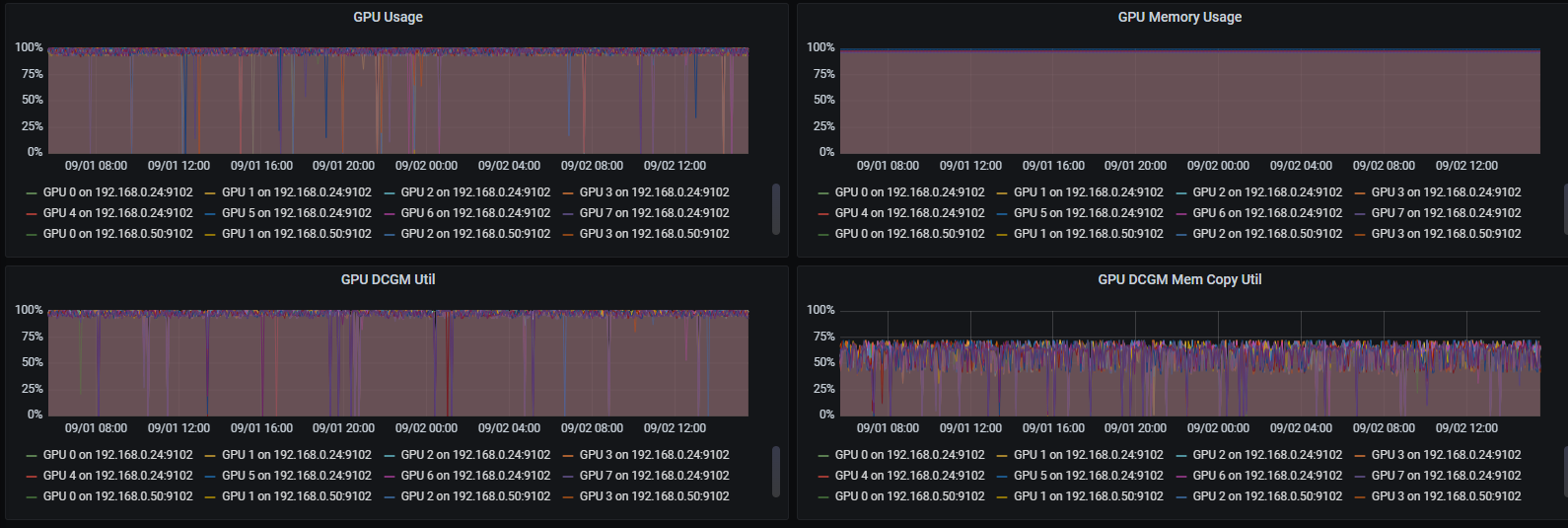
**Motivation and Context**
- Why is this change required? What problem does it solve?
- If it fixes an open issue, please link to the issue here.
The oneDNN 2.7.1 release includes multiple functional and performance
improvements.

Signed-off-by: George Nash <george.nash@intel.com>

### Description
Update the oneDNN library from 2.7.0 to 2.7.1. This contains multiple
functional and performance improvements.


### Motivation and Context
This is a minor point release from the oneDNN library that gives
performance and functional fixes that were found in the oneDNN 2.7
library shortly after release.

Signed-off-by: George Nash <george.nash@intel.com>
### Description
It missed a space there.

### Motivation and Context
Right now the pipeline is failing because GSL was just converted from a
submodule to a cmake external project.
This PR enables ORT to execute graphs captured by TorchDynamo. Major compilation code is in `OrtBackend.compile` in ort_backend.py. `register_backend.py` is for plugging `OrtBackend` into TorchDynamo as a compiler.



