### Description
Completing some missing parts of some test cases for python bindings

### Motivation and Context
Some test cases like test_training_module_checkpoint and test_optimizer
step were not completed before because we had no access to parameters to
check if the parameters are changing after the optimizer step or that
the checkpoint saved parameters remains the same.
now that we have access to the vector or parameters by exposing
get_contiguous_parameters() method.
we can complete the tests.
### Description
Right now prepacking code is not compiled when training is enabled. Our
partners want a single build of ort which can do both optimized
inference + training on device. This PR enables prepacking code in a
training build and controls whether it is enabled or not using already
existing session option - kOrtSessionOptionsConfigDisablePrepacking

For Inference scenarios - prepacking will be turned on by default and
this behavior remains the same after this PR too.
For training scenarios - prepacking will be disabled by default and if
user explicitly enables it then an error will be thrown.


### Motivation and Context
Enable both optimized inference as well as on device training in a
single build. For on device training use flag --enable_training_apis.
### Description
<!-- Describe your changes. -->
Opset 18 Split changes. Adds ability to specify num_outputs which also
allows uneven splitting.

https://github.com/onnx/onnx/releases/tag/v1.13.0

### Motivation and Context
<!-- - Why is this change required? What problem does it solve?
- If it fixes an open issue, please link to the issue here. -->
Support ONNX opset 18.
### Description
Enable creating dedicated build for on device training. With this PR we
can build a lean binary for on device training using flag
--enable_training_apis. This binary includes only the essentials like
training ops, optimizers etc and NOT features like Aten fallback,
strided tensors, gradient builders etc . This binary also removes all
the deprecated components like training::TrainingSession and OrtTrainer
etc

### Motivation and Context
This enables our partners to create a lean binary for on device
training.
### Description
- Adds a new C API `OrtApi::RegisterCustomOpsLibrary_V2` that manages
the lifetime of dynamic library handles (i.e., calls `dlclose` or
`FreeLibrary`).
- Deprecates C API `OrtApi::RegisterCustomOpsLibrary`.
- Adds C++ API wrapper for convenient registering of custom op
libraries.
- `PySessionOptions` is now an alias of `OrtSessionOptions`

### Motivation and Context
The current API for registering custom op libraries loads dynamic
libraries but requires users to handle the release of the corresponding
library handles. Additionally, the user has to make sure to release the
library handle _after_ the session has been destroyed (or the program
segfaults).

The new API automatically cleans up the library and allows the user to
write more straightforward code.
### Description
This PR is to address follow-up comments for the multi-stream pr
https://github.com/microsoft/onnxruntime/pull/13495

Changes including:

- Make StreamAwareArena transparent to minimal build
- Make DeviceStreamCollection transparent to minimal build
- Replace ORT_MUST_USE_RESULT with [[nodiscard]]
- Remove unnecessary shared_ptr


### Motivation and Context
This PR is to address follow-up comments for the multi-stream pr
https://github.com/microsoft/onnxruntime/pull/13495

Co-authored-by: Lei Cao <leca@microsoft.com>
### Description
1. Renames all references of on device training to training apis. This
is to keep the naming general. Nothing really prevents us from using the
same apis on servers\non-edge devices.
2. Update ENABLE_TRAINING option: With this PR when this option is
enabled, training apis and torch interop is also enabled.
3. Refactoring for onnxruntime_ENABLE_TRAINING_TORCH_INTEROP option:
   -  Removed user facing option
- Setting onnxruntime_ENABLE_TRAINING_TORCH_INTEROP to ON when
onnxruntime_ENABLE_TRAINING is ON as we always build with torch interop.

Once this PR is merged when --enable_training is selected we will do a
"FULL Build" for training (with all the training entry points and
features).
Training entry points include:
1. ORTModule
2. Training APIs

Features include:
1. ATen Fallback
2. All Training OPs includes communication and collectives
3. Strided Tensor Support
4. Python Op (torch interop)
5. ONNXBlock (Front end tools for training artifacts prep when using
trianing apis)

### Motivation and Context
Intention is to simply the options for building training enabled builds.
This is part of the larger work item to create dedicated build for
learning on the edge scenarios with just training apis enabled.
PyTorch removed upsample_nearest related backward functions with "vec"
overload name since 1.13. The functions without overload name are
available for all versions, though they are not that convienent to use.
This PR changes the gradient builder code to use functions without
overload name for ATen upsample_nearest nodes.

This PR also fixed a bug for ORTModule's corner case introduced by the
multi-stream PR. There is some code to execute the barrier step for
triggered downsteam is the barrier is out of range. But this should be
applied to triggered downstream only. If it's a normal run with start
step as a barrier step but out of range, we should not apply the logic.
For example, for ORTModule, if the barrier is the 1st step of whole CPU
plan, and the forward part is empty, then the forward normal run will
run step from start-0 to end-0 (actually nothing), and step-0 is the
barrier, then we should not execute the barrier in such case.
`numpy.bool` has been removed as from 1.24.0.

It was before an alias for python's `bool`.

Fixes https://github.com/huggingface/optimum/issues/610

### Motivation and Context

Numpy 1.24.0 breaks for example IO binding helpers.
To perform QAT in onnxruntime, `FakeQuant` op was introduced in #13649.

The onnxruntime quantization tool generates a post training static
quantization onnx model with `QuantizeLinear`->`DequantizeLinear` nodes.
To perform QAT, this pattern needs to be transformed to `FakeQuant`.

This pull request introduces a graph transformer that looks for the
`Q->DQ` pattern and fuses it to a `FakeQuant` node.
### Optimize computation orders

In `Roberta/Electra`, when `ClassificationHead` is used, there is
slicing operation on features on sequence_length dimensions, then loss
calculations only depend on this sliced data. This is a slicing at axis
1. Before slicing the shape is [batch, sequence_length, hidden], after
slicing, it becomes [batch , hidden_stage]

We had opportunities to bring this slicing earlier as much as possible,
by passing through simple elementwise ops (like Add/Div), or
Layernorm/Softmax(if their reduce axis is after the slicing axis), or
even MatMul's the left operand (if only it did not affect the last
dims).

For operators like Reshape/Transpose, it is special since they have
either data specified (after slicing we need update), or they have perm
specified, which requires the input rank remain unchanged. So for those
kinds of operators, we can remain the original rank, but just leave the
sliced dim to be 1, after the compute completed, we do a Squeeze.

```
class RobertaClassificationHead(nn.Module):
    """Head for sentence-level classification tasks."""

    def __init__(self, config):
        super().__init__()
        self.dense = nn.Linear(config.hidden_size, config.hidden_size)
        classifier_dropout = (
            config.classifier_dropout if config.classifier_dropout is not None else config.hidden_dropout_prob
        )
        self.dropout = nn.Dropout(classifier_dropout)
        self.out_proj = nn.Linear(config.hidden_size, config.num_labels)

    def forward(self, features, **kwargs):
        x = features[:, 0, :]  # take <s> token (equiv. to [CLS])
        x = self.dropout(x)
        x = self.dense(x)
        x = torch.tanh(x)
        x = self.dropout(x)
        x = self.out_proj(x)
        return x
```

src\transformers\models\roberta\modeling_roberta.py
src\transformers\models\electra\modeling_electra.py

#### Benchmark

A simple benchmark shows Robeta training latency dropped from 208ms ~
199ms. 4.5+% reduction.
More comprehensive tests are on the way.

### Motivation and Context
<!-- - Why is this change required? What problem does it solve?
- If it fixes an open issue, please link to the issue here. -->
**Description**: This PR including following works:
1. provide stream and related synchronization abstractions in
onnxruntime.
2. enhance onnxruntime's execution planner / executor / memory arena to
support execute multiple streams in parallel.
3. deprecate the parallel executor for cpu.
4. deprecate the Fence mechanism.
5. update the cuda / tensorrt EP to support the stream mechanism,
support running different request in different cuda stream.

**Motivation and Context**
- Why is this change required?
currently, the execution plan is just a linear list of those primitives,
ort will execute them step by step. For any given graph, ORT will
serialize it to a fixed execution order. This sequential execution
design simplifies most scenarios, but it has the following limitations:
1. it is difficult to enable inter-node parallelization, we have a
half-baked parallel executor but it is very difficult to make it work
with GPU.
2. The fence mechanism can work with single gpu stream + cpu thread
case, but when extend to multiple stream, it is difficult to manage the
cross GPU stream synchronizations.
3. our cuda EP rely on the BFCArena to make the memory management work
with the GPU async kernels, but current BFCArena is not aware of the
streams, so it doesn't behavior correctly when run with multiple
streams.

This PR enhance our existing execution plan and executor to support
multiple stream execution. we use an unified algorithm to mange both
single stream and multiple stream scenarios.
This PR mainly focus on the infrastructure support for multiple stream
execution, that is said, given a valid stream assignment, onnxruntime
can execute it correctly. How to generate a good stream assignment for a
given model will be in the future PR.

Co-authored-by: Cheng Tang <chenta@microsoft.com@orttrainingdev9.d32nl1ml4oruzj4qz3bqlggovf.px.internal.cloudapp.net>
Co-authored-by: Cheng Tang <chenta@microsoft.com>
Co-authored-by: RandySheriffH <48490400+RandySheriffH@users.noreply.github.com>
Co-authored-by: Randy Shuai <rashuai@microsoft.com>
Co-authored-by: cao lei <jslhcl@gmail.com>
Co-authored-by: Lei Cao <leca@microsoft.com>
### Description
Fix usage of enable_training_ops and reduce ifdef complexity for
training builds.


### Motivation and Context
This is the second refactoring PR towards creating a dedicated build for
on device training. This PR aims to reduce some complexity. We can set
ENABLE_TRAINING_OPS in cmake when either ENABLE_TRAINING or
ENABLE_TRAINING_ON_DEVICE is selected, this way we dont have to use if
defined(ENABLE_TRAINING) || defined(ENABLE_TRAINING_ON_DEVICE )
everywhere in the code.

- If it fixes an open issue, please link to the issue here. -->
### Description
This PR fixes some typos in the training apis.

We need to add more tests and make sure they are all run on the CIs to
capture such issues. These changes are out of scope of this PR.


### Motivation and Context
<!-- - Why is this change required? What problem does it solve?
- If it fixes an open issue, please link to the issue here. -->

Co-authored-by: Ashwini Khade <askhade@microsoft.com@orttrainingdev8.d32nl1ml4oruzj4qz3bqlggovf.px.internal.cloudapp.net>
### Description
Add cuda support to the on device training python bindings.


### Motivation and Context
Now users can set the execution provider (cpu or cuda) when using python
bindings for on device training apis.
### Description
Decouple strided tensor support from ENABLE_TRAINING

### Motivation and Context
This is step 1 for creating a dedicated build for on device training.
Intention is

1. We can set ENABLE_STRIDED_TENSORS in cmake when either
ENABLE_TRAINING or ENABLE_TRAINING_ON_DEVICE is selected, this way we
dont have to use if defined(ENABLE_TRAINING) ||
defined(ENABLE_TRAINING_ON_DEVICE ) everywhere in the code.

2. This also paves the way to easily enable strided tensor support for
inference in future (if required).
### Description
The proposed change is useful for ORTModule when the output graph has
multiple outputs.


### Motivation and Context
performance

Signed-off-by: xadupre <xadupre@microsoft.com>
The PR optimizes Slice CUDA kernel by two ways:
- Coalesce dimensions so less divmod during the kernel compute
- Split data load and write for better memory throughput

Below shows some perf results (cycles number from Nsight Compute) in
V100 using real cases from Huggingface's XLNet model:

  | Old | New
-- | -- | --
[8,12,2048,1024], axis=2, start=1, end=2048 | 1838687| 1539846
[8,12,1024,2047], axis=3, start=0, end=1024 | 951383| 722203
Right now we fix the warnings in an ad-hoc way. We run static analysis
in nightly builds, then create work items for the finding it found. Our
CI build pipelines run the same scan but do not break the build. So,
this PR will fix the remaining findings in the CPU EP(including the
training part) and enforce the check. Later on we can continue to expand
the scope.

We still have some warnings left in the JNI part. I will try to address
them later in the next month.
Motivation:
PythonOp is saving input for backward, it's risky since ONNX Runtime
backend is not aware of this, the tensor buffer may be "released" by
ORT, then potentially modified by other operators before backward
function executes.

Fix:
This pr just clone all input of PythonOp before forward is invoked. This
may be high overhead, it's just a workaround before a better fix.
### Fix training convergence issues

#### Problem:

Huggingface Transformers: 4.22.0
PyTorch Lightning: 1.6.3
PyTorch: v1.12.1, cuda 11.6
ORT: main branch, cuda 11.6

Model: RobertaForSequenceClassification @
models/roberta/modeling_roberta.py
Mixed Precision training with `torch.autocast`:
a64e1dfd7d/pytorch_lightning/plugins/precision/native_amp.py (L99)

Under this amp autocast context, forward + loss computation run. Here is
a snippet of loss computation.

```
        if labels is not None:
                ...
            if self.config.problem_type == "regression":
                loss_fct = MSELoss()
                if self.num_labels == 1:
                   ...
            elif self.config.problem_type == "single_label_classification":
                loss_fct = CrossEntropyLoss()
                **loss = loss_fct(logits.view(-1, self.num_labels), labels.view(-1))**
            elif self.config.problem_type == "multi_label_classification":
                ...

        return SequenceClassifierOutput(
            loss=loss,
            logits=logits,
            hidden_states=outputs.hidden_states,
            attentions=outputs.attentions,
        )
```

It is found after forward run, loss is 1.0850 in float16, looks good..
Then it did a scaling up here:
a64e1dfd7d/pytorch_lightning/plugins/precision/native_amp.py (L62),
the scaler is 65536. then we get a scaled loss 71104 in float type
(because float16 loss multiple fp32 scaler, type got promoted to fp32).
Then backward started with initial grads to be 1, then 1 (float32) *
65536 (float32) as the backward step, generating a float16 gradient,
then we got a `inf`. The problem occurs. With `inf`, the backward feed
the `inf` into crossentropygradient op, generating `nan`s. Then all
gradients got `nan` in back propagation.

So we see training with ORTModule (it almost always `overflow`, the loss
did not drop too much, as compared with PyTorch).

#### Analysis for the UT (when autocast enabled)

PyTorch trace graph looks like this :

```
graph(%0 : Float(16, 3, strides=[3, 1], requires_grad=0, device=cuda:0),
      %target : Long(16, strides=[1], requires_grad=0, device=cuda:0),
      %2 : Float(3, 3, strides=[3, 1], requires_grad=1, device=cuda:0)):
  %9 : int = prim::Constant[value=5]() # /opt/conda/envs/ptca/lib/python3.8/site-packages/torch/nn/modules/linear.py:114:0
  %10 : bool = prim::Constant[value=0]() # /opt/conda/envs/ptca/lib/python3.8/site-packages/torch/nn/modules/linear.py:114:0
  %11 : bool = prim::Constant[value=0]() # /opt/conda/envs/ptca/lib/python3.8/site-packages/torch/nn/modules/linear.py:114:0
  %12 : NoneType = prim::Constant()
  %13 : Half(3, 3, strides=[3, 1], requires_grad=0, device=cuda:0) = aten::to(%2, %9, %10, %11, %12) # /opt/conda/envs/ptca/lib/python3.8/site-packages/torch/nn/modules/linear.py:114:0
  %14 : int = prim::Constant[value=5]() # /opt/conda/envs/ptca/lib/python3.8/site-packages/torch/nn/modules/linear.py:114:0
  %15 : bool = prim::Constant[value=0]() # /opt/conda/envs/ptca/lib/python3.8/site-packages/torch/nn/modules/linear.py:114:0
  %16 : bool = prim::Constant[value=0]() # /opt/conda/envs/ptca/lib/python3.8/site-packages/torch/nn/modules/linear.py:114:0
  %17 : NoneType = prim::Constant()
  %18 : Half(16, 3, strides=[3, 1], requires_grad=0, device=cuda:0) = aten::to(%0, %14, %15, %16, %17) # /opt/conda/envs/ptca/lib/python3.8/site-packages/torch/nn/modules/linear.py:114:0
  %19 : NoneType = prim::Constant()
  %input : Half(16, 3, strides=[3, 1], requires_grad=0, device=cuda:0) = aten::linear(%18, %13, %19) # /opt/conda/envs/ptca/lib/python3.8/site-packages/torch/nn/modules/linear.py:114:0
  %21 : NoneType = prim::Constant()
  %22 : int = prim::Constant[value=1]() # /opt/conda/envs/ptca/lib/python3.8/site-packages/torch/nn/functional.py:3,014:0
  %23 : int = prim::Constant[value=-100]() # /opt/conda/envs/ptca/lib/python3.8/site-packages/torch/nn/functional.py:3,014:0
  %24 : float = prim::Constant[value=0.]() # /opt/conda/envs/ptca/lib/python3.8/site-packages/torch/nn/functional.py:3,014:0
  %data : Float(requires_grad=0, device=cuda:0) = **aten::cross_entropy_loss(%input, %target, %21, %22, %23, %24) # /opt/conda/envs/ptca/lib/python3.8/site-packages/torch/nn/functional.py:3,014:0**
  %27 : Float(requires_grad=0, device=cuda:0) = ^_OutputIdentityOp()(%data) # /opt/conda/envs/ptca/lib/python3.8/site-packages/onnxruntime/training/ortmodule/_io.py:430:0
  return (%27)
```

The most important lines

%target : Long(16, strides=[1], requires_grad=0, device=cuda:0),
%input : **_Half_**(16, 3, strides=[3, 1], requires_grad=0,
device=cuda:0) = aten::linear(%18, %13, %19) #
/opt/conda/envs/ptca/lib/python3.8/site-packages/torch/nn/modules/linear.py:114:0
**_Float_**(requires_grad=0, device=cuda:0) =
aten::cross_entropy_loss(**%_input_**, %target, %21, %22, %23, %24) #
/opt/conda/envs/ptca/lib/python3.8/site-packages/torch/nn/functional.py:3,014:0


`aten::cross_entropy_loss` takes Half input, and return Float output. As
said in doc:
https://pytorch.org/docs/stable/amp.html#cuda-ops-that-can-autocast-to-float32,
`cross_entropy` in autocast mode will run in fp32 mode, e.g. convert its
input to fp32 (if it is not), do the compute and return fp32 result. The
other hand, ORT's `SoftmaxCrossEntropyLossInternal` take same types of
input and output, and our code
31cb3cb254/orttraining/orttraining/python/training/ortmodule/_custom_op_symbolic_registry.py (L68)
when exporting `aten::cross_entropy_loss` assumed this, and set the
output to be fp16 either. So this is the reason we have the problem.

#### Possible Fixes
1. Enhance `SoftmaxCrossEntropyLossInternal` to support different types
of input and output.
2. Check the input and output when exporting, add the input case
explicitly if there is type promotion from input to output.

This PR used the 2nd approach. We can start 1st approach when needed
later.

TODO: revisit all other exporter functions, add the checks, etc.


### Motivation and Context
<!-- - Why is this change required? What problem does it solve?
- If it fixes an open issue, please link to the issue here. -->
`aten::_to_copy` is not exportable to ONNX. In DORT, so it's replaced in
`_replace_to_copy_with_to`. This replacement logic becomes incorrect in latest PyTorch
commit, and this PR is a fix.

Basically, we examine more key-word attributes passed to
`aten::_to_copy` and if they lead to a type casting operator (i.e.,
mapped to ONNX's Cast), we replace that `aten::_to_copy` with
`aten::to`. Unsupported attributes are removed (with a low risk of
breaking FX graph's assumptions).
### Add guidelines for ORTModule

As title.

Feel free to let me know if I missed something.

### Motivation and Context
<!-- - Why is this change required? What problem does it solve?
- If it fixes an open issue, please link to the issue here. -->
Customer reported this issue: they see many warnings when doing hte
evaluation using ORTModule.

After investigation, we found the `training_mode` is exported to a wrong
value in evaluation mode, it's value should be 0, but we found it is 1.
Fix:
fix pythonop training mode
if training_mode's type is torch._C._onnx.TrainingMode, then not matter
it is EVAL or TRAINING, "if training_mode" will always be true
**Description**: Subgraph-level recompute
This PR adds an optional capability trading additional re-computation
for better memory efficiency. Specifically, a pre-defined operator list
used to iterate the Graph to find some subgraphs for recompute, to
reduce some stashed activations whose lifetime across forward and
backward pass.
When training with ORTModule, by default, the graph transformer will
scan the execution graph to find all eligible subgraph to recompute,
along with sizes that can save. An example looks like below.
If we want to enable some of them to recompute, we can define env
variable this way:
`export
ORTMODULE_ENABLE_MEMORY_ALLEVIATION="Mul+FusedMatMul+Cast+Unsqueeze+Unsqueeze+Cast+Sub+Mul+Add+BiasSoftmaxDropout+Cast+:1:-1,BiasGelu+:1:-1,BitmaskDropout+Cast+:1:-1,FusedMatMul+:1:-1,Cast+:1:-1,Mul+Add+:1:-1,Mul+Sub+:1:-1"`
```
[1,0]<stderr>:2,022-10-12 14:47:39.302,954,530 [W:onnxruntime:, memory_alleviation.cc:595 PrintSummary]
[1,0]<stderr>:MemoryAlleviation Summary:
[1,0]<stderr>: User config:
[1,0]<stderr>: Mul+FusedMatMul+Cast+Unsqueeze+Unsqueeze+Cast+Sub+Mul+Add+BiasSoftmaxDropout+Cast+:1,BiasGelu+:1,BitmaskDropout+Cast+:1,FusedMatMul+:1,Cast+:1,Mul+Add+:1,Mul+Sub+:1
[1,0]<stderr>: =================================
[1,0]<stderr>: Subgraph: BitmaskDropout+
[1,0]<stderr>: AlleviationType: Disabled
[1,0]<stderr>: Patterns:
[1,0]<stderr>: PatternShape:input_ids_dim0 x 1,024 x Frequency:1
[1,0]<stderr>: --------------------------------
[1,0]<stderr>: Subgraph: BiasGelu+
[1,0]<stderr>: AlleviationType: Recompute
[1,0]<stderr>: Patterns:
[1,0]<stderr>: PatternShape:input_ids_dim0 x input_ids_dim1 x 4,096 x Frequency:24
[1,0]<stderr>: --------------------------------
[1,0]<stderr>: Subgraph: Reshape[1,0]<stderr>:+
[1,0]<stderr>: AlleviationType: Disabled
[1,0]<stderr>: Patterns:
[1,0]<stderr>: PatternShape:labels_dim0 x Frequency:1
[1,0]<stderr>: --------------------------------
[1,0]<stderr>: Subgraph: Unsqueeze+Unsqueeze+Cast+Sub+Mul+Mul+FusedMatMul+Cast+Add+BiasSoftmaxDropout+Cast+
[1,0]<stderr>: AlleviationType: Disabled
[1,0]<stderr>: Patterns:
[1,0]<stderr>: PatternShape:input_ids_dim0 x 16 x input_ids_dim1 x input_ids_dim1 x Frequency:23
[1,0]<stderr>: --------------------------------
[1,0]<stderr>: Subgraph: Mul+FusedMatMul+Cast+Unsqueeze+Unsqueeze+Cast+Sub+Mul+Add+BiasSoftmaxDropout+Cast+
[1,0]<stderr>: AlleviationType: Recompute
[1,0]<stderr>: Patterns:
[1,0]<stderr>: PatternShape:input_ids_dim0 x 16 x input_ids_dim1 x input_ids_dim1 x Frequency:1
[1,0]<stderr>: --------------------------------
[1,0]<stderr>: Subgraph: Mul+Add+
[1,0]<stderr>: AlleviationType: Recompute
[1,0]<stderr>: Patterns:
[1,0]<stderr>: PatternShape:input_ids_dim0 x 16 x input_ids_dim1 x 1 x Frequency:24
[1,0]<stderr>: --------------------------------
[1,0]<stderr>: Subgraph: FusedMatMul+Cast+Add+Reshape+Cast+
[1,0]<stderr>: AlleviationType: Disabled
[1,0]<stderr>: Patterns:
[1,0]<stderr>: PatternShape:input_ids_dim0 x 16 x input_ids_dim1 x 2 x 4 x Frequency:24
[1,0]<stderr>: --------------------------------
[1,0]<stderr>: Subgraph: Mul+Sub+
[1,0]<stderr>: AlleviationType: Recompute
[1,0]<stderr>: Patterns:
[1,0]<stderr>: PatternShape:input_ids_dim0 x 16 x input_ids_dim1 x 1 x Frequency:24
[1,0]<stderr>: --------------------------------
[1,0]<stderr>: Subgraph: Cast+
[1,0]<stderr>: AlleviationType: Recompute
[1,0]<stderr>: Patterns:
[1,0]<stderr>: PatternShape:1,024 x 1,024 x Frequency:97
[1,0]<stderr>: PatternShape:3 x 1,024 x Frequency:1
[1,0]<stderr>: PatternShape:8 x 64 x Frequency:24
[1,0]<stderr>: PatternShape:1,024 x 4,096 x Frequency:24
[1,0]<stderr>: PatternShape:4,096 x Frequency:24
[1,0]<stderr>: PatternShape:4,096 x 1,024 x Frequency:24
[1,0]<stderr>: --------------------------------
[1,0]<stderr>: Subgraph: FusedMatMul+
[1,0]<stderr>: AlleviationType: Recompute
[1,0]<stderr>: Patterns:
[1,0]<stderr>: PatternShape:input_ids_dim0 x input_ids_dim1 x 4,096 x Frequency:24
[1,0]<stderr>: --------------------------------
[1,0]<stderr>: =================================
```
"Type config:" whether recompute is enabled by users. 0 - disable, 1-
enable.
"Subgraph" means what kind of subgraph will be recomputed, in this case,
it is a single node "Gelu", and it will be "Recompute".
"Shape && Frequency" means, for this recompute, one tensor of size
(batch size, 500) will be saved because it will be recomputed.
**Baseline**
On a 1P model (DEBERTA V2), sequence length 256, training with 16 A100
GPUs. With latest main branch, we can run batch size 16, and the maximum
batch size < 32. So 16 is usually chosen by data scientists. 65% of 40GB
memory is used during training. The SamplesPerSec=479.2543353561354.

**With this PR**
Gelu is recomputed for saving memory peak, batch size 32 can be run. The
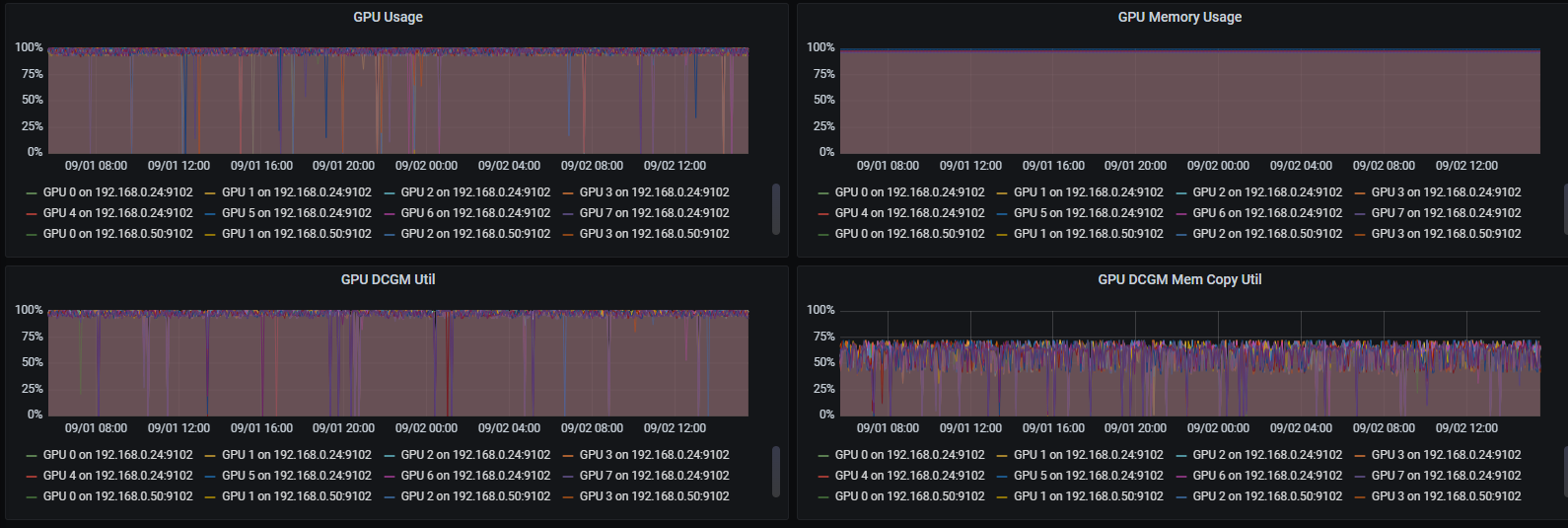
97% of 40GB A100 is used, the SamplesPerSec=562.041593991271 (**1.17X**
of baseline).
**Motivation and Context**
- Why is this change required? What problem does it solve?
- If it fixes an open issue, please link to the issue here.
This PR enables ORT to execute graphs captured by TorchDynamo. Major compilation code is in `OrtBackend.compile` in ort_backend.py. `register_backend.py` is for plugging `OrtBackend` into TorchDynamo as a compiler.



