### Description
<!-- Describe your changes. -->


### Motivation and Context
<!-- - Why is this change required? What problem does it solve?
- If it fixes an open issue, please link to the issue here. -->

https://github.com/microsoft/onnxruntime/issues/12843

Co-authored-by: Ubuntu <wy@v100-2.0cdb2e52twzevn1i4fi45bylyg.jx.internal.cloudapp.net>
### Description
<!-- Describe your changes. -->
1. add an optional input to pass in seed
2. two UTs. one for top_p=0.5, another for top_p=0.01(create greedy
search result, in convert_generation.py)
3. fix a bug in cpu kernel

### Motivation and Context
<!-- - Why is this change required? What problem does it solve?
- If it fixes an open issue, please link to the issue here. -->

Co-authored-by: Ubuntu <wy@v100-2.0cdb2e52twzevn1i4fi45bylyg.jx.internal.cloudapp.net>
This PR registers ScatterND-16 to the DML EP

- CPU fallback is added if the reduction attribute is in use, as this is
not yet supported by DML.

Co-authored-by: Numfor Mbiziwo-Tiapo <numform@microsoft.com>
### Description
Changes to incorporate OpenVINO EP 2022.3


### Motivation and Context
This change is required to incorportate OpenVINO EP 2022.3
- If it fixes an open issue, please link to the issue here. -->

Co-authored-by: mohsinmx <mohsinx.mohammad@intel.com>
Co-authored-by: Preetha Veeramalai <preetha.veeramalai@intel.com>
Co-authored-by: Aravind <aravindx.gunda@intel.com>
Co-authored-by: mayavijx <mayax.vijayan@intel.com>
Co-authored-by: flexci <mohsinmx>
### Description
<!-- Describe your changes. -->
Opset 18 Split changes. Adds ability to specify num_outputs which also
allows uneven splitting.

https://github.com/onnx/onnx/releases/tag/v1.13.0

### Motivation and Context
<!-- - Why is this change required? What problem does it solve?
- If it fixes an open issue, please link to the issue here. -->
Support ONNX opset 18.
### Description
<!-- Describe your changes. -->

rename the CrossAttention to MultiheadAttention since this op can also
be used as self attention

### Motivation and Context
<!-- - Why is this change required? What problem does it solve?
- If it fixes an open issue, please link to the issue here. -->

Co-authored-by: Ubuntu <wy@v100-2.0cdb2e52twzevn1i4fi45bylyg.jx.internal.cloudapp.net>
This PR Registers Identity-16 to the DML EP.

ONNX Backend tests and optional type tests were skipped pending future
additions.

Co-authored-by: Numfor Mbiziwo-Tiapo <numform@microsoft.com>
### Description

This cuda op implements the compute_bias() method in T5 Attention
including the permutation.

note:
1. bias_table needs to be saved in col-major. be careful when
implementing fusion script
2. second input(sequence length) is placed on cpu. (using Shape node's
output should be good)
3. the first dimension of output is 1, so extra_add_qk in attention
should support broadcasting
4. compute_bias() only used in self-attn in t5

TODO: docs change will be applied later

### Motivation and Context
It's part of the process of optimizing t5 attention as well as t5 based
generation model

Co-authored-by: Ubuntu <wy@v100-2.0cdb2e52twzevn1i4fi45bylyg.jx.internal.cloudapp.net>
Move separated Q, K and V (without input projection) from Attention to a
new operator CrossAttention.

The Attention operator is hard to maintain when we need support with and
without input projection in one class. Add a new operator according to
feedback.

Some change might need in the future, but not in this PR:
(1) bias could be optional (We will not proceed that route unless
experiments show that fusing Add bias with MatMul instead of this op
could improve performance).
(2) support packed KV. There are two ways to support it: when key and
value are same Tensor, they are packed; or we can make value as
optional, and use packed mode when value is empty and the key has packed
K/V.
(3) support cached key and value, and other (like relative position
bias), or more attention mask format. They can be added easily without
breaking backward compatible.
(4) ROCm/CPU implementation of this op.
### Description
1. The graph pattern search introduced in
https://github.com/microsoft/onnxruntime/pull/13914/ needs to be
enhanced so that SkipLayerNormalization is supported

2. Fix fp32 parity for GPT-2 while using `SkipLayerNormalization`
fusion. The optional output of SLN needs to also include the bias (if
present) and the added output should be a sum of `input + skip + (bias)`

### Motivation and Context
Fix some breaking tests
### Description

T5 uses a layer_norm which only scales and doesn't shift, which is also
known as Root Mean Square Layer Normalization.
ORT already have the simplified_layer_norm which is the RMS layer_norm.
This PR extends this T5 layer_norm with support of skip/bias and the
residual output.
This new op is named SkipSimplifiedLayerNorm and has similar interface
as SkipLayerNorm but removes the beta as input


### Motivation and Context
<!-- - Why is this change required? What problem does it solve?
- If it fixes an open issue, please link to the issue here. -->

Co-authored-by: Ubuntu <wy@v100-2.0cdb2e52twzevn1i4fi45bylyg.jx.internal.cloudapp.net>
### Description
1. Renames all references of on device training to training apis. This
is to keep the naming general. Nothing really prevents us from using the
same apis on servers\non-edge devices.
2. Update ENABLE_TRAINING option: With this PR when this option is
enabled, training apis and torch interop is also enabled.
3. Refactoring for onnxruntime_ENABLE_TRAINING_TORCH_INTEROP option:
   -  Removed user facing option
- Setting onnxruntime_ENABLE_TRAINING_TORCH_INTEROP to ON when
onnxruntime_ENABLE_TRAINING is ON as we always build with torch interop.

Once this PR is merged when --enable_training is selected we will do a
"FULL Build" for training (with all the training entry points and
features).
Training entry points include:
1. ORTModule
2. Training APIs

Features include:
1. ATen Fallback
2. All Training OPs includes communication and collectives
3. Strided Tensor Support
4. Python Op (torch interop)
5. ONNXBlock (Front end tools for training artifacts prep when using
trianing apis)

### Motivation and Context
Intention is to simply the options for building training enabled builds.
This is part of the larger work item to create dedicated build for
learning on the edge scenarios with just training apis enabled.
### Description
<!-- Describe your changes. -->

Sampling op for cpu and cuda
support huggingface case and custom case


### Motivation and Context
<!-- - Why is this change required? What problem does it solve?
- If it fixes an open issue, please link to the issue here. -->

Co-authored-by: Ubuntu <wy@v100-2.0cdb2e52twzevn1i4fi45bylyg.jx.internal.cloudapp.net>
### Optimize computation orders

In `Roberta/Electra`, when `ClassificationHead` is used, there is
slicing operation on features on sequence_length dimensions, then loss
calculations only depend on this sliced data. This is a slicing at axis
1. Before slicing the shape is [batch, sequence_length, hidden], after
slicing, it becomes [batch , hidden_stage]

We had opportunities to bring this slicing earlier as much as possible,
by passing through simple elementwise ops (like Add/Div), or
Layernorm/Softmax(if their reduce axis is after the slicing axis), or
even MatMul's the left operand (if only it did not affect the last
dims).

For operators like Reshape/Transpose, it is special since they have
either data specified (after slicing we need update), or they have perm
specified, which requires the input rank remain unchanged. So for those
kinds of operators, we can remain the original rank, but just leave the
sliced dim to be 1, after the compute completed, we do a Squeeze.

```
class RobertaClassificationHead(nn.Module):
    """Head for sentence-level classification tasks."""

    def __init__(self, config):
        super().__init__()
        self.dense = nn.Linear(config.hidden_size, config.hidden_size)
        classifier_dropout = (
            config.classifier_dropout if config.classifier_dropout is not None else config.hidden_dropout_prob
        )
        self.dropout = nn.Dropout(classifier_dropout)
        self.out_proj = nn.Linear(config.hidden_size, config.num_labels)

    def forward(self, features, **kwargs):
        x = features[:, 0, :]  # take <s> token (equiv. to [CLS])
        x = self.dropout(x)
        x = self.dense(x)
        x = torch.tanh(x)
        x = self.dropout(x)
        x = self.out_proj(x)
        return x
```

src\transformers\models\roberta\modeling_roberta.py
src\transformers\models\electra\modeling_electra.py

#### Benchmark

A simple benchmark shows Robeta training latency dropped from 208ms ~
199ms. 4.5+% reduction.
More comprehensive tests are on the way.

### Motivation and Context
<!-- - Why is this change required? What problem does it solve?
- If it fixes an open issue, please link to the issue here. -->
### Description
Update CUDA ArgMin/ArgMax op kernels to have end version 11 since opset
12+ is not supported yet.
With the way these kernels are currently registered, the documentation
shows support for opset 11+. This is not accurate.
### Motivation and Context
Fix#13781
This PR Registers the following operators for opset 16 to the DML EP:

- LeakyRelu-16
- PRelu-16
- Where-16
- GreaterOrEqual-16
- LessOrEqual-16

Identity-16 was not added in this PR due to pipeline failures

Co-authored-by: Numfor Mbiziwo-Tiapo <numform@microsoft.com>
Implement reuse kv_cache past and present tensor in Attention Ops.
Unit test for abover feature.
Utilize the reuse kv_cache for past and present tensor in Greedy Search.
Correctness test for it.

Co-authored-by: Zhang Lei <phill.zhang@gmail.com>
### Description
This PR adds support for `float64` kernels in the latest versions of
operators: Floor, Ceil and IsNaN.
### Motivation and Context
The lack of these kernels is non-trivial to work around and easily lead
to performance losses when it is attempted. When equivalence with an
existing implementation is required, precision is easily lost when
casting to `float32` instead.
IsNaN is common when cleaning up data in an ML pipeline. Floor and Ceil
have uses for discretising values and single-precision floats are
insufficient to round well when values get larger than a few million.
According to my measurement this only increases the binary size by a few
kilobytes (on the Python wheel of RelWithDebInfo).
Closes#13673 (Round already has float64 support)
Partially solves #8791 (Looks like there's parallel issues/PR open for
Split, but it is also hard to work around and hence useful)
Signed-off-by: jbachurski <kbachurski@gmail.com>
Split copies data - we can add support for all data types without too much binary size impact by using data type size-based implementations. The DispatchStridedCopy() function used here does this.
### Description
Add the NonZero op for DML


### Motivation and Context
NonZero is used in a few transformer models, so having a DML
implementation will stop large tensors from being transferred to the CPU
and back to the GPU
### Description
Add mixed datatype support for DML's LayerNorm contrib op.


### Motivation and Context
The fusion logic removes casts around LayerNorm in the graph because the
contrib version of the op supports mixed datatypes. Scale, Bias and
Output's datatypes must match, but input's datatype can be different.
### Description
<!-- Describe your changes. -->


### Motivation and Context
<!-- - Why is this change required? What problem does it solve?
- If it fixes an open issue, please link to the issue here. -->

fix https://github.com/microsoft/onnxruntime/issues/13508
### Description
Add a DML registration for Shape to avoid copying back to the CPU just
to get the shape of a GPU tensor.


### Motivation and Context
When using free dimensions, many Transformers models extensively use the
`Shape` operator. This causes hundreds of GPU->CPU copy that should be
completely avoidable. Note that this change also uses the same
heuristics as other providers (e.g. CUDA) to force some tensors on the
CPU in certain situations.

Co-authored-by: Patrice Vignola <pavignol@microsoft.com>
### Add guidelines for ORTModule

As title.

Feel free to let me know if I missed something.

### Motivation and Context
<!-- - Why is this change required? What problem does it solve?
- If it fixes an open issue, please link to the issue here. -->
**Description**: Subgraph-level recompute
This PR adds an optional capability trading additional re-computation
for better memory efficiency. Specifically, a pre-defined operator list
used to iterate the Graph to find some subgraphs for recompute, to
reduce some stashed activations whose lifetime across forward and
backward pass.
When training with ORTModule, by default, the graph transformer will
scan the execution graph to find all eligible subgraph to recompute,
along with sizes that can save. An example looks like below.
If we want to enable some of them to recompute, we can define env
variable this way:
`export
ORTMODULE_ENABLE_MEMORY_ALLEVIATION="Mul+FusedMatMul+Cast+Unsqueeze+Unsqueeze+Cast+Sub+Mul+Add+BiasSoftmaxDropout+Cast+:1:-1,BiasGelu+:1:-1,BitmaskDropout+Cast+:1:-1,FusedMatMul+:1:-1,Cast+:1:-1,Mul+Add+:1:-1,Mul+Sub+:1:-1"`
```
[1,0]<stderr>:2,022-10-12 14:47:39.302,954,530 [W:onnxruntime:, memory_alleviation.cc:595 PrintSummary]
[1,0]<stderr>:MemoryAlleviation Summary:
[1,0]<stderr>: User config:
[1,0]<stderr>: Mul+FusedMatMul+Cast+Unsqueeze+Unsqueeze+Cast+Sub+Mul+Add+BiasSoftmaxDropout+Cast+:1,BiasGelu+:1,BitmaskDropout+Cast+:1,FusedMatMul+:1,Cast+:1,Mul+Add+:1,Mul+Sub+:1
[1,0]<stderr>: =================================
[1,0]<stderr>: Subgraph: BitmaskDropout+
[1,0]<stderr>: AlleviationType: Disabled
[1,0]<stderr>: Patterns:
[1,0]<stderr>: PatternShape:input_ids_dim0 x 1,024 x Frequency:1
[1,0]<stderr>: --------------------------------
[1,0]<stderr>: Subgraph: BiasGelu+
[1,0]<stderr>: AlleviationType: Recompute
[1,0]<stderr>: Patterns:
[1,0]<stderr>: PatternShape:input_ids_dim0 x input_ids_dim1 x 4,096 x Frequency:24
[1,0]<stderr>: --------------------------------
[1,0]<stderr>: Subgraph: Reshape[1,0]<stderr>:+
[1,0]<stderr>: AlleviationType: Disabled
[1,0]<stderr>: Patterns:
[1,0]<stderr>: PatternShape:labels_dim0 x Frequency:1
[1,0]<stderr>: --------------------------------
[1,0]<stderr>: Subgraph: Unsqueeze+Unsqueeze+Cast+Sub+Mul+Mul+FusedMatMul+Cast+Add+BiasSoftmaxDropout+Cast+
[1,0]<stderr>: AlleviationType: Disabled
[1,0]<stderr>: Patterns:
[1,0]<stderr>: PatternShape:input_ids_dim0 x 16 x input_ids_dim1 x input_ids_dim1 x Frequency:23
[1,0]<stderr>: --------------------------------
[1,0]<stderr>: Subgraph: Mul+FusedMatMul+Cast+Unsqueeze+Unsqueeze+Cast+Sub+Mul+Add+BiasSoftmaxDropout+Cast+
[1,0]<stderr>: AlleviationType: Recompute
[1,0]<stderr>: Patterns:
[1,0]<stderr>: PatternShape:input_ids_dim0 x 16 x input_ids_dim1 x input_ids_dim1 x Frequency:1
[1,0]<stderr>: --------------------------------
[1,0]<stderr>: Subgraph: Mul+Add+
[1,0]<stderr>: AlleviationType: Recompute
[1,0]<stderr>: Patterns:
[1,0]<stderr>: PatternShape:input_ids_dim0 x 16 x input_ids_dim1 x 1 x Frequency:24
[1,0]<stderr>: --------------------------------
[1,0]<stderr>: Subgraph: FusedMatMul+Cast+Add+Reshape+Cast+
[1,0]<stderr>: AlleviationType: Disabled
[1,0]<stderr>: Patterns:
[1,0]<stderr>: PatternShape:input_ids_dim0 x 16 x input_ids_dim1 x 2 x 4 x Frequency:24
[1,0]<stderr>: --------------------------------
[1,0]<stderr>: Subgraph: Mul+Sub+
[1,0]<stderr>: AlleviationType: Recompute
[1,0]<stderr>: Patterns:
[1,0]<stderr>: PatternShape:input_ids_dim0 x 16 x input_ids_dim1 x 1 x Frequency:24
[1,0]<stderr>: --------------------------------
[1,0]<stderr>: Subgraph: Cast+
[1,0]<stderr>: AlleviationType: Recompute
[1,0]<stderr>: Patterns:
[1,0]<stderr>: PatternShape:1,024 x 1,024 x Frequency:97
[1,0]<stderr>: PatternShape:3 x 1,024 x Frequency:1
[1,0]<stderr>: PatternShape:8 x 64 x Frequency:24
[1,0]<stderr>: PatternShape:1,024 x 4,096 x Frequency:24
[1,0]<stderr>: PatternShape:4,096 x Frequency:24
[1,0]<stderr>: PatternShape:4,096 x 1,024 x Frequency:24
[1,0]<stderr>: --------------------------------
[1,0]<stderr>: Subgraph: FusedMatMul+
[1,0]<stderr>: AlleviationType: Recompute
[1,0]<stderr>: Patterns:
[1,0]<stderr>: PatternShape:input_ids_dim0 x input_ids_dim1 x 4,096 x Frequency:24
[1,0]<stderr>: --------------------------------
[1,0]<stderr>: =================================
```
"Type config:" whether recompute is enabled by users. 0 - disable, 1-
enable.
"Subgraph" means what kind of subgraph will be recomputed, in this case,
it is a single node "Gelu", and it will be "Recompute".
"Shape && Frequency" means, for this recompute, one tensor of size
(batch size, 500) will be saved because it will be recomputed.
**Baseline**
On a 1P model (DEBERTA V2), sequence length 256, training with 16 A100
GPUs. With latest main branch, we can run batch size 16, and the maximum
batch size < 32. So 16 is usually chosen by data scientists. 65% of 40GB
memory is used during training. The SamplesPerSec=479.2543353561354.

**With this PR**
Gelu is recomputed for saving memory peak, batch size 32 can be run. The
97% of 40GB A100 is used, the SamplesPerSec=562.041593991271 (**1.17X**
of baseline).
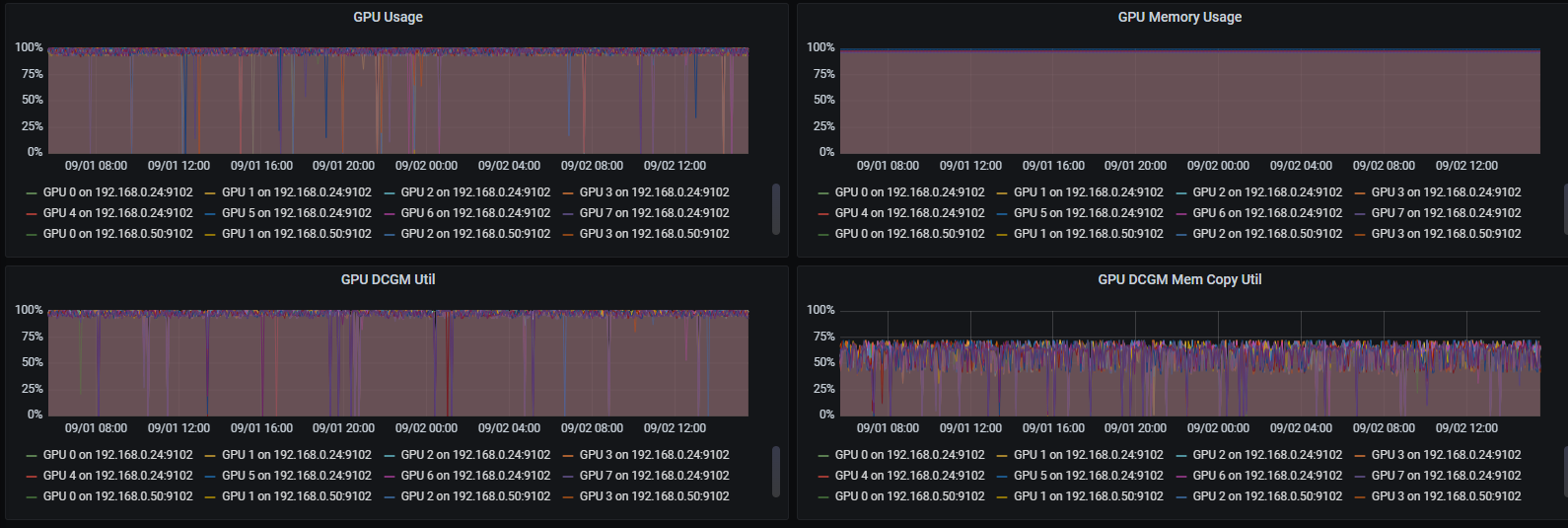
**Motivation and Context**
- Why is this change required? What problem does it solve?
- If it fixes an open issue, please link to the issue here.
Some models have QuickGelu(x)=x*sigmoid(1.702x), which has 3 Ops for
forward and 5 Ops for backward. The PR is to fuse this to a single Op
named QuickGelu and its gradient QuickGeluGrad.
For CUDA, tested in V100 using input tensor with shape [64,128,2048] and
float16 type:
Before, FW takes 335us, BW takes 614us

After, FW takes 115us, BW takes 139us, which is much faster.

For CPU kernel, using same shape and float type:
Before, FW takes 10us, BW takes 49us
Mul: 3480[µs]
Sigmoid: 1996[µs]
Mul: 4789[µs]
Mul: 4642[µs]
Mul: 4195[µs]
SigmoidGrad: 18328[µs]
Mul: 2988[µs]
Sum: 18576[µs]
After, FW takes 4us, BW takes 5us, which is also much faster.
QuickGelu: 3939[µs]
QuickGeluGrad: 5089[µs]
Co-authored-by: Vincent Wang <weicwang@microsoft.com>
### Description
<!-- Describe your changes. -->
Fix document generation CI. It's not currently updating the docs as
we're skipping the tests, which is the invocation of build.py that would
have generated the documentation.

Setup specific task to generate documentation for greater clarity.

### Motivation and Context
<!-- - Why is this change required? What problem does it solve?
- If it fixes an open issue, please link to the issue here. -->
Operator kernel documentation is not getting updated and is now out of
date.
### Description
Allow separated Q, K and V inputs to support cross attention:
* Q: [batch_size, sequence_length, hidden_size]
* K: [batch_size, kv_sequence_length, hidden_size]
* V: [batch_size, kv_sequence_length, v_hidden_size]
* Output: [batch_size, sequence_length, v_hidden_size]

To use separated Q/K/V inputs, the input tensor is for query, and two
optional inputs are added for key and value. Weights for input
projection is not included for now, so the MatMul of input projection
shall be done out of Attention operator, but Add bias is included for
performance consideration.
### Description
Bumping up version number to 1.14.0


### Motivation and Context
<!-- - Why is this change required? What problem does it solve?
- If it fixes an open issue, please link to the issue here. -->
### Description
<!-- Describe your changes. -->

Fix a bug in GreedySearch Op when batch > 1
Support custom attention mask in GreedySearch and BeamSearch with GPT2


### Motivation and Context
<!-- - Why is this change required? What problem does it solve?
- If it fixes an open issue, please link to the issue here. -->
### Description
<!-- Describe your changes. -->
fix some typo in docs


### Motivation and Context
singed vs signed
succeding vs succeeding
fileter vs filter
kernal vs kernel
libary vs library
* Change block dimension type to Int from Ints.
* In response to feedback that the block dimension corresponds to the
reduction dimension of the consuming matrix multiplication. There is
always only 1 reduction dimension.
### Description
binraries ==> binaries


### Motivation and Context
<!-- - Why is this change required? What problem does it solve?
- If it fixes an open issue, please link to the issue here. -->




