### Description

Add stable diffusion CUDA kernel optimizations.

The following are included:
(1) GroupNorm operator. This kernel is from TensorRT 8.5.
(2) BiasSplitGelu operator. This kernel is modified from SplitGelu of
TensorRT 8.5. We added bias to the SplitGelu.
(3) NhwcConv operator. This adds support of NHWC format (ONNX Conv
operator uses NCHW format).
(3) Update MultiHeadAttention (packed kv and no bias) for cross
attention. This could avoid transpose of kv for TRT fused cross
attention kernel.
(4) Optimization and benchmark script

Not included:
(1) Script to convert Conv to NhwcConv in onnx graph.
(2) Update symbolic shape inference for NhwcConv.
(3) Add SeqLen2Spatial operator
(4) Documents

Limitations: GroupNorm, BiasSplitGelu and NhwcConv kernels are
implemented based on stable diffusion usage. They might not be
applicable to any input size or dimensions. For example, BiasSplitGelu
requires hidden size to be 2560 | 5120 | 10240, and NhwcConv assumes 4D
input/weight.

There is minor increasement of binary size. For SM=75 only, python
package wheel size adds (33757K - 33640K) = 117 KB. It is possible to
move NHWC from template parameter to constructor to reduce binary size
(with slight cost of performance).

Note: for RTX 4090/4080/4070 Ti, need build with CUDA 11.8 and latest
cuDNN to get best performance.
This PR registers ScatterElements-16 to the DML EP
- CPU fallback is added if the reduction attribute is in use, as this is
not yet supported by DML.

---------

Co-authored-by: Numfor Mbiziwo-Tiapo <numform@microsoft.com>
Signed-off-by: Liqun Fu <liqfu@microsoft.com>

### Description
To support LpPool (18)


### Motivation and Context
for Ort 1.14 release

Signed-off-by: Liqun Fu <liqfu@microsoft.com>
### Description
<!-- Describe your changes. -->
Remove exclusions for ONNX model tests that now pass due to kernels
being implemented.
Update ONNX update doc to point to correct location for tests.

### Motivation and Context
<!-- - Why is this change required? What problem does it solve?
- If it fixes an open issue, please link to the issue here. -->
Run as many tests as possible.

Co-authored-by: Edward Chen <18449977+edgchen1@users.noreply.github.com>
### Description
<!-- Describe your changes. -->


### Motivation and Context
<!-- - Why is this change required? What problem does it solve?
- If it fixes an open issue, please link to the issue here. -->
### Description
<!-- Describe your changes. -->


### Motivation and Context
<!-- - Why is this change required? What problem does it solve?
- If it fixes an open issue, please link to the issue here. -->

Co-authored-by: Ubuntu <wy@v100-2.0cdb2e52twzevn1i4fi45bylyg.jx.internal.cloudapp.net>
### Description
<!-- Describe your changes. -->


### Motivation and Context
<!-- - Why is this change required? What problem does it solve?
- If it fixes an open issue, please link to the issue here. -->

https://github.com/microsoft/onnxruntime/issues/12843

Co-authored-by: Ubuntu <wy@v100-2.0cdb2e52twzevn1i4fi45bylyg.jx.internal.cloudapp.net>
### Description
<!-- Describe your changes. -->
1. add an optional input to pass in seed
2. two UTs. one for top_p=0.5, another for top_p=0.01(create greedy
search result, in convert_generation.py)
3. fix a bug in cpu kernel

### Motivation and Context
<!-- - Why is this change required? What problem does it solve?
- If it fixes an open issue, please link to the issue here. -->

Co-authored-by: Ubuntu <wy@v100-2.0cdb2e52twzevn1i4fi45bylyg.jx.internal.cloudapp.net>
This PR registers ScatterND-16 to the DML EP

- CPU fallback is added if the reduction attribute is in use, as this is
not yet supported by DML.

Co-authored-by: Numfor Mbiziwo-Tiapo <numform@microsoft.com>
### Description
Changes to incorporate OpenVINO EP 2022.3


### Motivation and Context
This change is required to incorportate OpenVINO EP 2022.3
- If it fixes an open issue, please link to the issue here. -->

Co-authored-by: mohsinmx <mohsinx.mohammad@intel.com>
Co-authored-by: Preetha Veeramalai <preetha.veeramalai@intel.com>
Co-authored-by: Aravind <aravindx.gunda@intel.com>
Co-authored-by: mayavijx <mayax.vijayan@intel.com>
Co-authored-by: flexci <mohsinmx>
### Description
<!-- Describe your changes. -->
Opset 18 Split changes. Adds ability to specify num_outputs which also
allows uneven splitting.

https://github.com/onnx/onnx/releases/tag/v1.13.0

### Motivation and Context
<!-- - Why is this change required? What problem does it solve?
- If it fixes an open issue, please link to the issue here. -->
Support ONNX opset 18.
### Description
<!-- Describe your changes. -->

rename the CrossAttention to MultiheadAttention since this op can also
be used as self attention

### Motivation and Context
<!-- - Why is this change required? What problem does it solve?
- If it fixes an open issue, please link to the issue here. -->

Co-authored-by: Ubuntu <wy@v100-2.0cdb2e52twzevn1i4fi45bylyg.jx.internal.cloudapp.net>
This PR Registers Identity-16 to the DML EP.

ONNX Backend tests and optional type tests were skipped pending future
additions.

Co-authored-by: Numfor Mbiziwo-Tiapo <numform@microsoft.com>
### Description

This cuda op implements the compute_bias() method in T5 Attention
including the permutation.

note:
1. bias_table needs to be saved in col-major. be careful when
implementing fusion script
2. second input(sequence length) is placed on cpu. (using Shape node's
output should be good)
3. the first dimension of output is 1, so extra_add_qk in attention
should support broadcasting
4. compute_bias() only used in self-attn in t5

TODO: docs change will be applied later

### Motivation and Context
It's part of the process of optimizing t5 attention as well as t5 based
generation model

Co-authored-by: Ubuntu <wy@v100-2.0cdb2e52twzevn1i4fi45bylyg.jx.internal.cloudapp.net>
Move separated Q, K and V (without input projection) from Attention to a
new operator CrossAttention.

The Attention operator is hard to maintain when we need support with and
without input projection in one class. Add a new operator according to
feedback.

Some change might need in the future, but not in this PR:
(1) bias could be optional (We will not proceed that route unless
experiments show that fusing Add bias with MatMul instead of this op
could improve performance).
(2) support packed KV. There are two ways to support it: when key and
value are same Tensor, they are packed; or we can make value as
optional, and use packed mode when value is empty and the key has packed
K/V.
(3) support cached key and value, and other (like relative position
bias), or more attention mask format. They can be added easily without
breaking backward compatible.
(4) ROCm/CPU implementation of this op.
### Description
1. The graph pattern search introduced in
https://github.com/microsoft/onnxruntime/pull/13914/ needs to be
enhanced so that SkipLayerNormalization is supported

2. Fix fp32 parity for GPT-2 while using `SkipLayerNormalization`
fusion. The optional output of SLN needs to also include the bias (if
present) and the added output should be a sum of `input + skip + (bias)`

### Motivation and Context
Fix some breaking tests
### Description

T5 uses a layer_norm which only scales and doesn't shift, which is also
known as Root Mean Square Layer Normalization.
ORT already have the simplified_layer_norm which is the RMS layer_norm.
This PR extends this T5 layer_norm with support of skip/bias and the
residual output.
This new op is named SkipSimplifiedLayerNorm and has similar interface
as SkipLayerNorm but removes the beta as input


### Motivation and Context
<!-- - Why is this change required? What problem does it solve?
- If it fixes an open issue, please link to the issue here. -->

Co-authored-by: Ubuntu <wy@v100-2.0cdb2e52twzevn1i4fi45bylyg.jx.internal.cloudapp.net>
### Description
1. Renames all references of on device training to training apis. This
is to keep the naming general. Nothing really prevents us from using the
same apis on servers\non-edge devices.
2. Update ENABLE_TRAINING option: With this PR when this option is
enabled, training apis and torch interop is also enabled.
3. Refactoring for onnxruntime_ENABLE_TRAINING_TORCH_INTEROP option:
   -  Removed user facing option
- Setting onnxruntime_ENABLE_TRAINING_TORCH_INTEROP to ON when
onnxruntime_ENABLE_TRAINING is ON as we always build with torch interop.

Once this PR is merged when --enable_training is selected we will do a
"FULL Build" for training (with all the training entry points and
features).
Training entry points include:
1. ORTModule
2. Training APIs

Features include:
1. ATen Fallback
2. All Training OPs includes communication and collectives
3. Strided Tensor Support
4. Python Op (torch interop)
5. ONNXBlock (Front end tools for training artifacts prep when using
trianing apis)

### Motivation and Context
Intention is to simply the options for building training enabled builds.
This is part of the larger work item to create dedicated build for
learning on the edge scenarios with just training apis enabled.
### Description
<!-- Describe your changes. -->

Sampling op for cpu and cuda
support huggingface case and custom case


### Motivation and Context
<!-- - Why is this change required? What problem does it solve?
- If it fixes an open issue, please link to the issue here. -->

Co-authored-by: Ubuntu <wy@v100-2.0cdb2e52twzevn1i4fi45bylyg.jx.internal.cloudapp.net>
### Optimize computation orders

In `Roberta/Electra`, when `ClassificationHead` is used, there is
slicing operation on features on sequence_length dimensions, then loss
calculations only depend on this sliced data. This is a slicing at axis
1. Before slicing the shape is [batch, sequence_length, hidden], after
slicing, it becomes [batch , hidden_stage]

We had opportunities to bring this slicing earlier as much as possible,
by passing through simple elementwise ops (like Add/Div), or
Layernorm/Softmax(if their reduce axis is after the slicing axis), or
even MatMul's the left operand (if only it did not affect the last
dims).

For operators like Reshape/Transpose, it is special since they have
either data specified (after slicing we need update), or they have perm
specified, which requires the input rank remain unchanged. So for those
kinds of operators, we can remain the original rank, but just leave the
sliced dim to be 1, after the compute completed, we do a Squeeze.

```
class RobertaClassificationHead(nn.Module):
    """Head for sentence-level classification tasks."""

    def __init__(self, config):
        super().__init__()
        self.dense = nn.Linear(config.hidden_size, config.hidden_size)
        classifier_dropout = (
            config.classifier_dropout if config.classifier_dropout is not None else config.hidden_dropout_prob
        )
        self.dropout = nn.Dropout(classifier_dropout)
        self.out_proj = nn.Linear(config.hidden_size, config.num_labels)

    def forward(self, features, **kwargs):
        x = features[:, 0, :]  # take <s> token (equiv. to [CLS])
        x = self.dropout(x)
        x = self.dense(x)
        x = torch.tanh(x)
        x = self.dropout(x)
        x = self.out_proj(x)
        return x
```

src\transformers\models\roberta\modeling_roberta.py
src\transformers\models\electra\modeling_electra.py

#### Benchmark

A simple benchmark shows Robeta training latency dropped from 208ms ~
199ms. 4.5+% reduction.
More comprehensive tests are on the way.

### Motivation and Context
<!-- - Why is this change required? What problem does it solve?
- If it fixes an open issue, please link to the issue here. -->
### Description
Update CUDA ArgMin/ArgMax op kernels to have end version 11 since opset
12+ is not supported yet.
With the way these kernels are currently registered, the documentation
shows support for opset 11+. This is not accurate.
### Motivation and Context
Fix#13781
This PR Registers the following operators for opset 16 to the DML EP:

- LeakyRelu-16
- PRelu-16
- Where-16
- GreaterOrEqual-16
- LessOrEqual-16

Identity-16 was not added in this PR due to pipeline failures

Co-authored-by: Numfor Mbiziwo-Tiapo <numform@microsoft.com>
Implement reuse kv_cache past and present tensor in Attention Ops.
Unit test for abover feature.
Utilize the reuse kv_cache for past and present tensor in Greedy Search.
Correctness test for it.

Co-authored-by: Zhang Lei <phill.zhang@gmail.com>
### Description
This PR adds support for `float64` kernels in the latest versions of
operators: Floor, Ceil and IsNaN.
### Motivation and Context
The lack of these kernels is non-trivial to work around and easily lead
to performance losses when it is attempted. When equivalence with an
existing implementation is required, precision is easily lost when
casting to `float32` instead.
IsNaN is common when cleaning up data in an ML pipeline. Floor and Ceil
have uses for discretising values and single-precision floats are
insufficient to round well when values get larger than a few million.
According to my measurement this only increases the binary size by a few
kilobytes (on the Python wheel of RelWithDebInfo).
Closes#13673 (Round already has float64 support)
Partially solves #8791 (Looks like there's parallel issues/PR open for
Split, but it is also hard to work around and hence useful)
Signed-off-by: jbachurski <kbachurski@gmail.com>
Split copies data - we can add support for all data types without too much binary size impact by using data type size-based implementations. The DispatchStridedCopy() function used here does this.
### Description
Add the NonZero op for DML


### Motivation and Context
NonZero is used in a few transformer models, so having a DML
implementation will stop large tensors from being transferred to the CPU
and back to the GPU
### Description
Add mixed datatype support for DML's LayerNorm contrib op.


### Motivation and Context
The fusion logic removes casts around LayerNorm in the graph because the
contrib version of the op supports mixed datatypes. Scale, Bias and
Output's datatypes must match, but input's datatype can be different.
### Description
<!-- Describe your changes. -->


### Motivation and Context
<!-- - Why is this change required? What problem does it solve?
- If it fixes an open issue, please link to the issue here. -->

fix https://github.com/microsoft/onnxruntime/issues/13508
### Description
Add a DML registration for Shape to avoid copying back to the CPU just
to get the shape of a GPU tensor.


### Motivation and Context
When using free dimensions, many Transformers models extensively use the
`Shape` operator. This causes hundreds of GPU->CPU copy that should be
completely avoidable. Note that this change also uses the same
heuristics as other providers (e.g. CUDA) to force some tensors on the
CPU in certain situations.

Co-authored-by: Patrice Vignola <pavignol@microsoft.com>
### Add guidelines for ORTModule

As title.

Feel free to let me know if I missed something.

### Motivation and Context
<!-- - Why is this change required? What problem does it solve?
- If it fixes an open issue, please link to the issue here. -->
**Description**: Subgraph-level recompute
This PR adds an optional capability trading additional re-computation
for better memory efficiency. Specifically, a pre-defined operator list
used to iterate the Graph to find some subgraphs for recompute, to
reduce some stashed activations whose lifetime across forward and
backward pass.
When training with ORTModule, by default, the graph transformer will
scan the execution graph to find all eligible subgraph to recompute,
along with sizes that can save. An example looks like below.
If we want to enable some of them to recompute, we can define env
variable this way:
`export
ORTMODULE_ENABLE_MEMORY_ALLEVIATION="Mul+FusedMatMul+Cast+Unsqueeze+Unsqueeze+Cast+Sub+Mul+Add+BiasSoftmaxDropout+Cast+:1:-1,BiasGelu+:1:-1,BitmaskDropout+Cast+:1:-1,FusedMatMul+:1:-1,Cast+:1:-1,Mul+Add+:1:-1,Mul+Sub+:1:-1"`
```
[1,0]<stderr>:2,022-10-12 14:47:39.302,954,530 [W:onnxruntime:, memory_alleviation.cc:595 PrintSummary]
[1,0]<stderr>:MemoryAlleviation Summary:
[1,0]<stderr>: User config:
[1,0]<stderr>: Mul+FusedMatMul+Cast+Unsqueeze+Unsqueeze+Cast+Sub+Mul+Add+BiasSoftmaxDropout+Cast+:1,BiasGelu+:1,BitmaskDropout+Cast+:1,FusedMatMul+:1,Cast+:1,Mul+Add+:1,Mul+Sub+:1
[1,0]<stderr>: =================================
[1,0]<stderr>: Subgraph: BitmaskDropout+
[1,0]<stderr>: AlleviationType: Disabled
[1,0]<stderr>: Patterns:
[1,0]<stderr>: PatternShape:input_ids_dim0 x 1,024 x Frequency:1
[1,0]<stderr>: --------------------------------
[1,0]<stderr>: Subgraph: BiasGelu+
[1,0]<stderr>: AlleviationType: Recompute
[1,0]<stderr>: Patterns:
[1,0]<stderr>: PatternShape:input_ids_dim0 x input_ids_dim1 x 4,096 x Frequency:24
[1,0]<stderr>: --------------------------------
[1,0]<stderr>: Subgraph: Reshape[1,0]<stderr>:+
[1,0]<stderr>: AlleviationType: Disabled
[1,0]<stderr>: Patterns:
[1,0]<stderr>: PatternShape:labels_dim0 x Frequency:1
[1,0]<stderr>: --------------------------------
[1,0]<stderr>: Subgraph: Unsqueeze+Unsqueeze+Cast+Sub+Mul+Mul+FusedMatMul+Cast+Add+BiasSoftmaxDropout+Cast+
[1,0]<stderr>: AlleviationType: Disabled
[1,0]<stderr>: Patterns:
[1,0]<stderr>: PatternShape:input_ids_dim0 x 16 x input_ids_dim1 x input_ids_dim1 x Frequency:23
[1,0]<stderr>: --------------------------------
[1,0]<stderr>: Subgraph: Mul+FusedMatMul+Cast+Unsqueeze+Unsqueeze+Cast+Sub+Mul+Add+BiasSoftmaxDropout+Cast+
[1,0]<stderr>: AlleviationType: Recompute
[1,0]<stderr>: Patterns:
[1,0]<stderr>: PatternShape:input_ids_dim0 x 16 x input_ids_dim1 x input_ids_dim1 x Frequency:1
[1,0]<stderr>: --------------------------------
[1,0]<stderr>: Subgraph: Mul+Add+
[1,0]<stderr>: AlleviationType: Recompute
[1,0]<stderr>: Patterns:
[1,0]<stderr>: PatternShape:input_ids_dim0 x 16 x input_ids_dim1 x 1 x Frequency:24
[1,0]<stderr>: --------------------------------
[1,0]<stderr>: Subgraph: FusedMatMul+Cast+Add+Reshape+Cast+
[1,0]<stderr>: AlleviationType: Disabled
[1,0]<stderr>: Patterns:
[1,0]<stderr>: PatternShape:input_ids_dim0 x 16 x input_ids_dim1 x 2 x 4 x Frequency:24
[1,0]<stderr>: --------------------------------
[1,0]<stderr>: Subgraph: Mul+Sub+
[1,0]<stderr>: AlleviationType: Recompute
[1,0]<stderr>: Patterns:
[1,0]<stderr>: PatternShape:input_ids_dim0 x 16 x input_ids_dim1 x 1 x Frequency:24
[1,0]<stderr>: --------------------------------
[1,0]<stderr>: Subgraph: Cast+
[1,0]<stderr>: AlleviationType: Recompute
[1,0]<stderr>: Patterns:
[1,0]<stderr>: PatternShape:1,024 x 1,024 x Frequency:97
[1,0]<stderr>: PatternShape:3 x 1,024 x Frequency:1
[1,0]<stderr>: PatternShape:8 x 64 x Frequency:24
[1,0]<stderr>: PatternShape:1,024 x 4,096 x Frequency:24
[1,0]<stderr>: PatternShape:4,096 x Frequency:24
[1,0]<stderr>: PatternShape:4,096 x 1,024 x Frequency:24
[1,0]<stderr>: --------------------------------
[1,0]<stderr>: Subgraph: FusedMatMul+
[1,0]<stderr>: AlleviationType: Recompute
[1,0]<stderr>: Patterns:
[1,0]<stderr>: PatternShape:input_ids_dim0 x input_ids_dim1 x 4,096 x Frequency:24
[1,0]<stderr>: --------------------------------
[1,0]<stderr>: =================================
```
"Type config:" whether recompute is enabled by users. 0 - disable, 1-
enable.
"Subgraph" means what kind of subgraph will be recomputed, in this case,
it is a single node "Gelu", and it will be "Recompute".
"Shape && Frequency" means, for this recompute, one tensor of size
(batch size, 500) will be saved because it will be recomputed.
**Baseline**
On a 1P model (DEBERTA V2), sequence length 256, training with 16 A100
GPUs. With latest main branch, we can run batch size 16, and the maximum
batch size < 32. So 16 is usually chosen by data scientists. 65% of 40GB
memory is used during training. The SamplesPerSec=479.2543353561354.

**With this PR**
Gelu is recomputed for saving memory peak, batch size 32 can be run. The
97% of 40GB A100 is used, the SamplesPerSec=562.041593991271 (**1.17X**
of baseline).
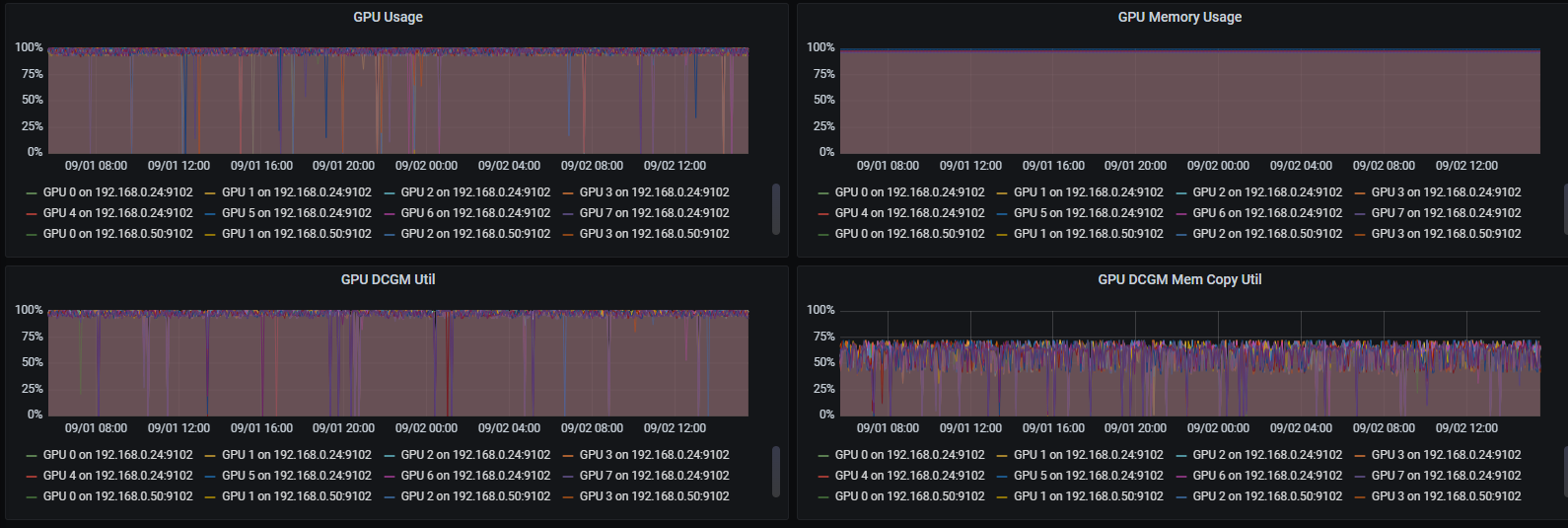
**Motivation and Context**
- Why is this change required? What problem does it solve?
- If it fixes an open issue, please link to the issue here.
Some models have QuickGelu(x)=x*sigmoid(1.702x), which has 3 Ops for
forward and 5 Ops for backward. The PR is to fuse this to a single Op
named QuickGelu and its gradient QuickGeluGrad.
For CUDA, tested in V100 using input tensor with shape [64,128,2048] and
float16 type:
Before, FW takes 335us, BW takes 614us

After, FW takes 115us, BW takes 139us, which is much faster.

For CPU kernel, using same shape and float type:
Before, FW takes 10us, BW takes 49us
Mul: 3480[µs]
Sigmoid: 1996[µs]
Mul: 4789[µs]
Mul: 4642[µs]
Mul: 4195[µs]
SigmoidGrad: 18328[µs]
Mul: 2988[µs]
Sum: 18576[µs]
After, FW takes 4us, BW takes 5us, which is also much faster.
QuickGelu: 3939[µs]
QuickGeluGrad: 5089[µs]
Co-authored-by: Vincent Wang <weicwang@microsoft.com>
### Description
<!-- Describe your changes. -->
Fix document generation CI. It's not currently updating the docs as
we're skipping the tests, which is the invocation of build.py that would
have generated the documentation.

Setup specific task to generate documentation for greater clarity.

### Motivation and Context
<!-- - Why is this change required? What problem does it solve?
- If it fixes an open issue, please link to the issue here. -->
Operator kernel documentation is not getting updated and is now out of
date.
### Description
Allow separated Q, K and V inputs to support cross attention:
* Q: [batch_size, sequence_length, hidden_size]
* K: [batch_size, kv_sequence_length, hidden_size]
* V: [batch_size, kv_sequence_length, v_hidden_size]
* Output: [batch_size, sequence_length, v_hidden_size]

To use separated Q/K/V inputs, the input tensor is for query, and two
optional inputs are added for key and value. Weights for input
projection is not included for now, so the MatMul of input projection
shall be done out of Attention operator, but Add bias is included for
performance consideration.
### Description
Bumping up version number to 1.14.0


### Motivation and Context
<!-- - Why is this change required? What problem does it solve?
- If it fixes an open issue, please link to the issue here. -->
### Description
<!-- Describe your changes. -->

Fix a bug in GreedySearch Op when batch > 1
Support custom attention mask in GreedySearch and BeamSearch with GPT2


### Motivation and Context
<!-- - Why is this change required? What problem does it solve?
- If it fixes an open issue, please link to the issue here. -->
### Description
<!-- Describe your changes. -->
fix some typo in docs


### Motivation and Context
singed vs signed
succeding vs succeeding
fileter vs filter
kernal vs kernel
libary vs library
* Change block dimension type to Int from Ints.
* In response to feedback that the block dimension corresponds to the
reduction dimension of the consuming matrix multiplication. There is
always only 1 reduction dimension.
### Description
binraries ==> binaries


### Motivation and Context
<!-- - Why is this change required? What problem does it solve?
- If it fixes an open issue, please link to the issue here. -->
* `QuantizeBFP` and `DequantizeBFP` schemas - similar to
`QuantizeLinear` and `DeQuantizeLinear`.
* BFP datatype is represented as a `uint8` tensor with shape and stride
metadata. This is preferrable to adding a new datatype for BFP, which is
more disruptive and [discouraged by
PyTorch](https://discuss.pytorch.org/t/training-with-custom-quantized-datatype/152132/2).

Context:

The Microsoft Floating Point (BFP) datatype shares an exponent for every
n numbers called a “bounding box.” Each number still has its own
mantissa and sign bits. BFP has been shown to incur 3-4 less cost
(energy and area) than BFloat16 and INT8 counterparts without reductions
in accuracy for the ImageNet benchmark as described in [Rouhani
2020](https://proceedings.neurips.cc/paper/2020/file/747e32ab0fea7fbd2ad9ec03daa3f840-Paper.pdf).

Requirements:

* There are many variants of BFP (number of mantissa bits, number of
shared exponent bits, size of bounding box, custom bit fields, etc.)
* The size and layout of an BFP variant varies across hardware
* bounding box can be over arbitrary dimensions; for example, for the
channel "C" dimension in a N x C x H x W tensor for convolution

Goals of this PR:

* Add initial versions of QuantizeBFP and DequantizeBFP operators to
enable QDQ-style quantization with BFP. Once the schemas stabilize, we
can consider upstreaming to ONNX.
* Add some basic type and shape inferencing tests; tests that run on an
EP will be a follow-up.
# Motivation
Currently, ORT minimal builds use kernel def hashes to map from nodes to
kernels to execute when loading the model. As the kernel def hashes must
be known ahead of time, this works for statically registered kernels.
This works well for the CPU EP.
For this approach to work, the kernel def hashes must also be known at
ORT format model conversion time, which means the EP with statically
registered kernels must also be enabled then. This is not an issue for
the always-available CPU EP. However, we do not want to require that any
EP which statically registers kernels is always available too.
Consequently, we explore another approach to match nodes to kernels that
does not rely on kernel def hashes. An added benefit of this is the
possibility of moving away from kernel def hashes completely, which
would eliminate the maintenance burden of keeping the hashes stable.

# Approach
In a full build, ORT uses some information from the ONNX op schema to
match a node to a kernel. We want to avoid including the ONNX op schema
in a minimal build to reduce binary size. Essentially, we take the
necessary information from the ONNX op schema and make it available in a
minimal build.
We decouple the ONNX op schema from the kernel matching logic. The
kernel matching logic instead relies on per-op information which can
either be obtained from the ONNX op schema or another source.
This per-op information must be available in a minimal build when there
are no ONNX op schemas. We put it in the ORT format model.
Existing uses of kernel def hashes to look up kernels are replaced
with the updated kernel matching logic. We no longer store
kernel def hashes in the ORT format model’s session state and runtime
optimization representations. We no longer keep the logic to
generate and ensure stability of kernel def hashes.
* Fix bug in pybind get_all_operator_schema due to premature reference dropping
* Add updated operator kernels markdown table
* Update build.py to include documentation generation for DML operators too
* Update GPU pipeline to include DML in the build to so operators can be generated.
* Use a separate pipeline stage, feedback from Changming and Scott
* Appease annoying Python linter
* Add onnxruntime_BUILD_UNIT_TESTS=OFF and remove stale --use_dml in cuda stage
* Make ORT as Pytorch JIT backend

LORT likely doesn't work with aten fallback so we only test LORT in its own CI.

* Revert changes to enable external CUDA allocator. Will add it later.

Revert "Revert changes to enable external CUDA allocator. Will add it later."

This reverts commit d5487f2e193014c805505afae8fb577c53667658.

Fix external allocator

* Relax tolerance and remove commented code

* Print more information in CI

* Fix pointer

* Address comments.
1. Reuse ORT-eager mode's environment.
2. Remove unused ctor.

* Use Pytorch master branch as all PRs are merged

Fix

* Refine based on cpplint feedbacks

* Revert changes to allow custom CUDA allocator in public APIs

* Use torch.testing.assert_close

* Use unittest framework

* Switch docker repo

* Rename *.cpp to *.cc

* Address comments

* Add comment

* Use same pipeline file for eager and lort pipelines

* Address comments

* Add yaml comment

* Fix cmake files

* Address comments

* Rename flags, remove printing code, remove dead comment
* Update to handle multiline declarations for the kernels which are typical these days.
* Update to new path for the cpu contrib_op kernel registrations.
* Update tools/python/find_optimizer_opset_version_updates_required.py

Co-authored-by: Justin Chu <justinchuby@users.noreply.github.com>
* add description of build ORT+TVM EP on Windows

* fix cmake error related to symlink creation on Windows

* add llvm config path to build flags for correct build on Windows

* update TVM_EP.md for llvm_config build arg

* fix warnings skipping during build on Windows

* fix using string or wstring for model path to correct build on Windows (MSVC error)

* fix error in custom logger for correct build on Windows

* implement glob algorithm for Windows

* additional build fixes

* update TVM with export of VM symbols for dll

* description of nasm issue and workaround

* update TVM with export of Executable from VM symbols for dll

* description of installation of ipp-crypto dependencies on Windows

* cmake key for ipp-crypto build

* fix wstring for TVMso EP

* fix ipp-crypto build

* cmake key onnxruntime_TVM_USE_HASH switch off not specific methods, but full hash functionality

* fix absolute path to compiled lib

* update TVM_EP.md, fix lint warnings

* update TVM_EP.md

* small fixes after review

* switch on handshake functionality for Linux workflow

Co-authored-by: Valery Chernov <valery.chernov@deelvin.com>
Co-authored-by: KJlaccHoeUM9l <wotpricol@mail.ru>
* infrastructure for handshake mechanism was implemented. sha256 was selected as first hash algorithm

* check hash during compile in TVMso EP

* add IPP-CRYPTO to external dependencies for TVM EP

* made checkHash method constant

* removed the public implementation of the SHA-256 algorithm so as not to cause a license conflict

* implemented SHA-256 calculation using ipp-crypto library

* fix dependency for ipp-crypto

* add provider options for hash check

* update documentation for added provider options

* add hash check condition

* fix docs

* fix lint

* fix ORT_THROW

Co-authored-by: Valery Chernov <valery.chernov@deelvin.com>
Co-authored-by: KJlaccHoeUM9l <wotpricol@mail.ru>
* Register signal ops for op set 17

Note code is mostly being moved, not added. These ops were previously
only registered as Microsoft contrib ops and only built if
`BUILD_MS_EXPERIMENTAL_OPS=1`. They've been added to the ai.onnx
standard op set in version 17.

Main components of this change:

* Move the kernels from the conrib_ops directory to the
  core directory.
* Add function bodies for ms experimental ops. This will allow
  old models that use the contrib ops to continue to function.
  All the function bodies consist of a single op (the
  new standard op), so performance overhead should be minimal.

Minor clean-up also in this change:

* De-duplicate get_scalar_value_from_tensor: put it in a new utils.h.
* Fix some bugs that caused compilation errors with the experimental
  ops. Tested with `build.sh --ms_experimental`
* Fix some spelling errors and lint violations.
* Replace a couple of switch statements with `MLTypeCallDispatcher`.
* Use `InlineVector` instead of `std::vector`.

Unblocks https://github.com/microsoft/onnxruntime/issues/11640
Prior to this every test shared the same tolerances. This meant
that if an ONNX test failed due to a small but acceptable difference in
output, the only alternative was to disable the test entirely.

In op set 17, the DFT operator is being added. Without this change, the
tests for that operator fail because the output is off by about 5e-5.
It's better to keep test coverage for this new op rather than disable
the test entirely.

Also prior to this change, the global tolerances were not shared between
C++, JavaScript, and Python tests. Now they are.

Also fix various minor issues raised by linters.

Unblocks https://github.com/microsoft/onnxruntime/issues/11640.
(1) Support T5 in BeamSearch operator, and add both CPU and CUDA implementation.
(2) Change BeamSearch op: rename encoder_decoder_init attribute to encoder, and add decoder_start_token_id attribute
(3) Update convert_to_onnx for T5 to use int32 instead of int64 inputs as default.
(4) Add more tests in best_beam_search.py
(5) fix ORT_ENFORCE of hypothesis_buffer_offset_
(6) Improve ONNX conversion:
   (a) Change encoder some dynamic axes to fixed dim value
   (b) add --separate_encoder_and_decoder_init
   (c) correct name t5-3B => t5-3b, t5-11B => t5-11b
   (d) Add --use_int32_inputs in convert t5 to onnx
   (e) Allow t5 beam search conversion in one step
* update description of TVM EP options in docs

* update sample notebook

* update TVM EP documentation

* add link to description of options

Co-authored-by: Valery Chernov <valery.chernov@deelvin.com>
* Initiate Ort SNPE EP
* fix snpe ep windows build which is caused by the utility method (ToUTF8String) name change on master
* correct the source path for libonnxruntime.so while building for andorid package
* add AdditionalDependencies for amr64
* On MS-Windows, the patchfile must be a text file, i.e. CR-LF must be used as line endings. A file with LF may give the error: "Assertion failed, hunk, file patch.c, line 343," unless the option '--binary' is given.
* fix build failure if snpe is not enabled
* update doc for contrib op
* separate out snpe ep settings to onnxruntime_snpe_provider.cmake
* renaming according review comments
* update according review comments
* Implement BitmaskDropout and associated unit tests.

* Implement BitmaskDropoutGrad and associated unit tests.

* Implement Dropout -> BitmaskDropout rewrite rule and associated unit tests.

* Implement (Dropout,DropoutGrad) -> (BitmaskDropout,BitmaskDropoutGrad) rewrite rule.

This commit does not yet include unit tests for this rewrite rule.

This commit also introduces improved documentation for all changes which will be grouped
into this PR.

* bitmask dropout

* fix win build

* bugfix for rocm

* bugfix

* fix code format

* fix ut

* fix build break

* fix ut in win

* resolve comments

* fix ut in trt

* resolve comments

* fix rocm build error

* fix typo

Co-authored-by: Aidan Beggs <aidanbeggs@microsoft.com>
Description: Format all python files under onnxruntime with black and isort.

After checking in, we can use .git-blame-ignore-revs to ignore the formatting PR in git blame.

#11315, #11316
* Implement TreeEnsemble for opset(ai.onnx.ml)==3
* use of InlineVector
* refactoring
* improve attributes retrieval
* avoid creating a temporary buffer
* modifies onnx.ml.cpu.json
* use unordered_map
* update docs/OperatorKernels.md
* address PR comments (TH -> ThresholdType, ORT_RETURN...)
* add a python unit test to load a TreeEnsembleRegressor following ai.onnx.ml==3 specifications
* improve NonZero

* fix megatron_fp16 optimzier, fix the doc

* multi_tensor_applier

* resolve comment

* fix building warning

* fix build error when enabling training and use tensorrt
* change BeamSearch op to support encoder decoder model

* check model_type and decoder attribute

* fix

* update comments

* warn shape inference issue with onnx v1.11 or T5

* skip parity test when tempature != 1.0

* fix build
Work on minimizing memory management calls by
  reducing number of allocations and copies.
  Replace std::unordered_set to InlinedHashSet
  and add usage of InlinedVector.
  Employ std::move() to minimize copying and memory allocations.
  Remove copying of the const shared data into each of the
  PropagateCast transformer instances.
  Move inlined_containers.h header to include/common
  Adjust AsSpan imlementation for C++ < 17
* add support for bool type

* add TVM EP support for tests

* include TVM EP in python test pool

* fix pylint

* moved technical imports to a separate file

* clean up post build actions & move _ld_preload.py extension to CMake level

* add files for include TVM EP into CI

* implement custom logger for TVM

* replace TVM logging with ONNX RT logging

* update link for TVM EP tutorial

* clean up TVM EP cmake

* add pybind auto enabling for TVM EP

* fix blank spaces

* code review fixes

* replace print with comment

* add list of EP without TVM EP

* enable onnx tests

* disable contrib ops and ml ops

* reuse Dockerfile.ubuntu

* Move install_tvm_test_dependencies.sh out of Docker context dir, update build definition.

Co-authored-by: Edward Chen <18449977+edgchen1@users.noreply.github.com>
* Fix incorrect type constraint registration for RoiAlign. This led to the input type not actually being checked when matching a kernel as the invalid constraint name is treated as a missing optional input.
  * fix missing dependency for the unit test exe. Whilst it doesn't link against the CUDA providers lib, without the dependency VS doesn't know it needs to rebuild the library if there are changes.
* Add check for invalid type constraints.
* Fix invalid registrations for other kernels.
* Add hash replacement logic to provide backwards compatibility in ORT format models when the registration is fixed.
* Add tests
Add abseil cgmanifest declaration. Update coding standards for InlinedContainers
  Adjust coding guidelines. Add default N calculation for InlinedVector<T, N> for general use.
  Rename T from InlinedShapeVectorT. Fix Eager build
  Add LLVM Copyright with modified derived code notice.
In a reduced ops build, some source files get updated. This change moves the updated files into the build directory. This way, it is easier to simultaneously manage different build directories (with possibly different reduced ops configurations) based on a single source directory.
* squashed commit for standalone tvm execution provider

* critical fix for correct python build with stvm ep

* get tuning log file from ep options. It has priority over AUTOTVM_TUNING_LOG

* updates and fixes

* update parsing of stvm provider options

* add support of external data for onnx model

* add conditional dump of subgraphs

* remove unused code

* get input tensor shapes through provider options. get output shapes for fixed input ones by TVM API

* support AUTO_TVM tuning log file inside ORT. Selector for Ansor and Auto_TVM is provider option (tuning_type)

* add fp16

* add functionality of conversion of model layout to NHWC if need. Necessary parameter was added to STVM provider options

* fix license text in header. fix log format

* small fixes

* fix issues from flake8

* remove model proto construction from GetCapability

* reserve memory for vector of DLTensors

* add simple tutorial for STVM EP

* STVM docs

* jroesch/tvm -> apache/tvm

* remove dead code, unneccessary logs and comments

* fix in readme

* improve tutorial notebook

* tvm update

* update STVM_EP.md

* fix default value

* update STVM_EP.md

* some TODOs for the future development

* shorten long lines

* add hyperlink to STVM_EP.md

* fix Linux CI error

* fix error in csharp test

Co-authored-by: Jared Roesch <jroesch@octoml.ai>
Co-authored-by: Valery Chernov <valery.chernov@deelvin.com>
Co-authored-by: KJlaccHoeUM9l <wotpricol@mail.ru>
* Changes to fuse embed layer for gpt2, kernal changes pending

* verified add output and regular add match

* Test added for additional output embedlayernorm, working on CUDA

* Test passing on CPU

* updated convert_to_onnx toll to check parity correctly

* removed some debugs

* couple of TODO left as in optimizer.py

* removed changes to optimizer.py

* fixing build

* fixing build

* updated order of initilization

* added a test case for float16

* updating the docs

* updating tests failing due to embed layer fusion

* update unit tests

* updating CUDA documentation in operatorkernels.md

* addressing comments

* OperatorKernels.md updated with CUDA

* adding TODO to qembed_layer

* minor edit

* updated docs

* addressing comments

* adding position ids to embed layer gpt2

* updating fused gpt2 model

* added extra test

* remove comments

* addressing comments

* contrib_defs.cc updated

* all tests passing

* fixing a typo

* minor edit

* trigger build

* qembedlayernorm checkinputs updated

* fixing build error

* fixing build error

* fixing build error
```
Component for aggressive decoding. Find the bifurcation index of predicted tokens, between source tokens,
starting from previous suffix match index, and predicted tokens.
Concat predicted tokens, starting from bifurcation index, to the back
of current tokens. This forms the output tokens.
Detect suffix match index in source tokens, between source tokens and output tokens.
Detection is based on finding the appearances of last n-gram in output tokens
in source tokens.
A match is considered found if source tokens contain a single matching n-gram.
Return the index of the start of the n-gram in source tokens.
No matching if found if src tokens contain multiple or zero matching n-grams. Return -1.
```
* bias dropout improvement

* add transform case for same shape case

* combine kernel

* merge with vectorized kernel

* use "has_same_shape_bias"

* minor: a "N % 4 != 0" case

* add op UT for has_same_shape_bias

* address comments; add param case for 1d bias;
add param case tests for 1d and same-shape bias

* rewrite logic condition

Co-authored-by: Peng Wang <pengwa@microsoft.com>
* Enable selecting custom ops in onnxruntime-extensions.

* Move cmake_helper.py.

* Remove over-indented spaces.

* Add doc.

* Remove onnxruntime-extensions from git submodules, and user should pass path of onnxruntime-extensions for build.

* Modify doc.

* Remove argument --enable_onnxruntime_extensions and use --onnxruntime_extensions_path.

* Fix build error.

* Fix build error.

* Use onnxruntime_extensions_path.

* support both submodule and external source folders

* refinement

* Update cgmanifest.json

* Support building onnxruntime-extensions from either git submodule or pre-pulled path.

* Update doc.

* more standard name

* update docs

* add the copyright header

Co-authored-by: Zuwei Zhao <zuzhao@microsoft.com>
Co-authored-by: Wenbing Li <wenbingl@outlook.com>
Co-authored-by: Wenbing Li <10278425+wenbingl@users.noreply.github.com>
* GridSample OP implementation for CPU and CUDA

**Description**: This change contains implementation for torch grid_sample OP.
Cuda implementation contains contribution from Muscle Wu.

* Use interpolation for out-of-bound points in zero padding mode

Out-of-bound points in zeros padding mode changed from constant 0 to
interpolation of surrounding pixels. This aligns with Pytorch implementation.

A bug in CUDA batch offset calculation is fixed.

Custom op exporter type is added.

* Fix nearest bug in CPU

* Update per CI build finding and review comments

* Force float to avoid potential integer T issue

* Style update

* PR update

* Remove c++17 feature from cuda code
* changes

* tile grad unsqueeze fix for opset 13

* clean up

* remove bool support for opset 2 to 12 for Pad as it is not supported.

* Copy OperatorKernels.md from artifacts of Windows CI build.
* updates for picking pnnx commit

* add tests filter to c# tests

* plus test fixes

* fix versioning for contrib ops

* fix tests

* test filter for optional ops

* more versioning related updates

* fix test

* fix layernorm spec

* more updates

* update docs

* add more test filters

* more filters

* update binary size threshold

* update docs

* plus more fixes

* updates per review

* update to release commit

* add filters for optional type tests

* plus updates
QGemm takes in quantized A, B, C, and quantization parameters of output Y, in which C and quantization parameters of Y are optional. Its output can be quantized or full precision, which depends on whether quantization parameters of Y exists or not. If quant params of Y are provided, the output will be requantized or is full precision.

Comparing with QLinearMatMul and MatMulInteger, QGemm supports transpose, apha and beta attribute.

The formula for quantized GEMM is:
Y = alpha * scale_a * scale_b * ((A_int8 - zp_a) * (B_int8 - zp_b) + C_int32), in which,
C_int32 is quantized with formula: C_int32 = (beta * C) / (alpha * scale_a * scale_b)
SparseTensor support
  Implement Builder pattern
  Fix support for 1-D and 2-D COO indices
  Implement and test CSR support.
  Handle shape inference for SparseTensors
  Implement conversion for COO, CSR and tests.
  Address the case where constant sparse initializer is the output.
  Implement test infra for SparseTensors
  Implement SparseDenseMatMul for Csr and COO and tested it.
  Add hash for SparseToDenseMatMul
  Finish shared provider refactor
  Refactor GetOrCreate to Create
  Working on py interface
  Expose OrtDevice and use it in allocate_numpy
	Adjust Sparse interfaces, add support for string SparseTensor. Add tests.
	Add and test to_cuda()
	Add accessors to format specific indices
	Test values and indices views, read-only flag, after GC access
	Add sparse related methods to OrtValue
	Re-work SparseTensor wrapper, add OrtValue methods
	Rework numpy_array_to_cuda/to_cpu
	Add run_with_ort_values
	Add models and test sparse_mat_mul with run_with_ort_values
	Refactor sparse tensor to use a single buffer
        Ifdef x86 Eigen CSR sparse matmul implementation
        Exclude broken test, check for string type when copying cross device
       Split pybind schema, regenerate docs, add exclusion
       Conditionally exclude schema module
       Update docs fix cuda build
       Add test to a filter and renerate JS docs
      Add conversion and test string support for sparse tensors
      Exclude conversion utils from minimal build
      Add CUDA Memcpy and adjust provider interfaces
* add Gridsampler contrib op

* fix gridsampler_paddingmode_border test

* disable the tests until the kernel added

* fix CI failure

* change GridSampler to GridSample
* changes working to convert akv nodes

* changes to replace nodes

* changes to accomodate qkv hidden sizes as attributes

* kernel to accept qkv_hidden_size attributes

* Working till compute for varied dimension, todo applyattention()

* changes to make all regression tests work

* inference running successfully without prepack

* success inference with pre-pack weights

* add test for diff sizes

* bias shape need not be a mul of 3

* get the output_hidden_size from input

* infer output shape from input

* merge with master

* cleaning up files that got merged wrong

* accurancy at accepted level

* added unit test case for different dimensions

* all unit tests passing

* packed weights working for attention

* prepacked weights working

* added test case for newly added extra qk input

* updated unit test to test only extra add qk

* fixing build error

* removing few debugs

* reverting test changes

* all python test passing

* cleaning up

* new unit test added, major clean up of code

* removed extra code

* minor

* minor fix to tests

* prepack weights code cleaned up

* compacted compute() in attention.cc

* reformat compute()

* making a parameter T

* adding 3 q,k,v buffers in all cases

* fixing build

* running tests only on cpu

* Updating docs

* trigger ci builds

* Addressing comments in PR

* addressing some more comments

* get add_qk_str from add_qk node directly

* updating docs, added extra check to verify attn inputs

* Optimized the extra add by parallelizing

* added attention_shape to symbolic_shape_infer.py

* minor refactoring to address comments
* Update submodule onnxruntime-extensions to latest.

* Add document for onnxruntime-extensions.

* Update cgmanifest.json for onnxruntime-extensions.

* Add example in JavaScript.

Co-authored-by: Zuwei Zhao <zuzhao@microsoft.com>
**Description**:
Enforce no repetition of n-grams. Scores are set to `-inf` for tokens that form a repeated n-gram if added to the back of the input_ids.

**Motivation and Context**
Needed by transformer models in sequence generation algorithms (greedy search and beam search). This module has heavy impact on performance, and can be highly parallelized.
* Update the operator documentation generation
  - Make layout a little nicer
  - Update to latest supported operators including training
  - Fix some links that are broken when the docs content is copied to github-pages
  - Fix incorrect usage of 'onnx.ai.ml' as the default domain
    - ML ops are now separated from the real default domain of 'onnx.ai'
  - Include CPU, CUDA and training kernels
    - exclude DNNL as it's not an EP we own

* There are separate paths for CUDA and CUDNN as they are not guaranteed to be in the same location on a Windows machine. Use the CUDNN path when looking for the CUDNN library.

* Enable validation of both contrib ops and operator kernels in build
Filter generation so it's deterministic
Add ability for CI to publish the md files as build artifacts if they differ so a developer can download and add to their PR to resolve any diffs.
Remove workarounds for github-pages as that will now link to the github docs which display correctly
* checkin

* add 4dmask support in attention cuda op

* trim

* add comments

* fix build/test error

* review comments and add tests

* sync doc

* review comments

* minor change
* Include ORT format model conversion scripts and infrastructure in ORT python package.
  - tweak existing script setup so it can be easily run directly and from the ORT python package
Add config file and readme for Android minimal build package
Update ORT Mobile doco
Disable warning if 'all' optimizations are enabled but NCHWc transformer is excluded (device specific optimizations don't apply in this scenario so the warning is moot).

* Address PR comments




